

Timer
Set time limits for individual blocks or the entire Riddle. Timers create urgency, increase engagement, and work especially well for quiz competitions and leaderboard setups where time-based scoring matters.
There are two timer types: a Riddle timer that counts down across the entire Riddle, and a Block timer that resets for each question. Use the Riddle timer for overall time pressure (e.g. "complete the quiz in 2 minutes"). Use the Block timer when each question should have its own time limit.
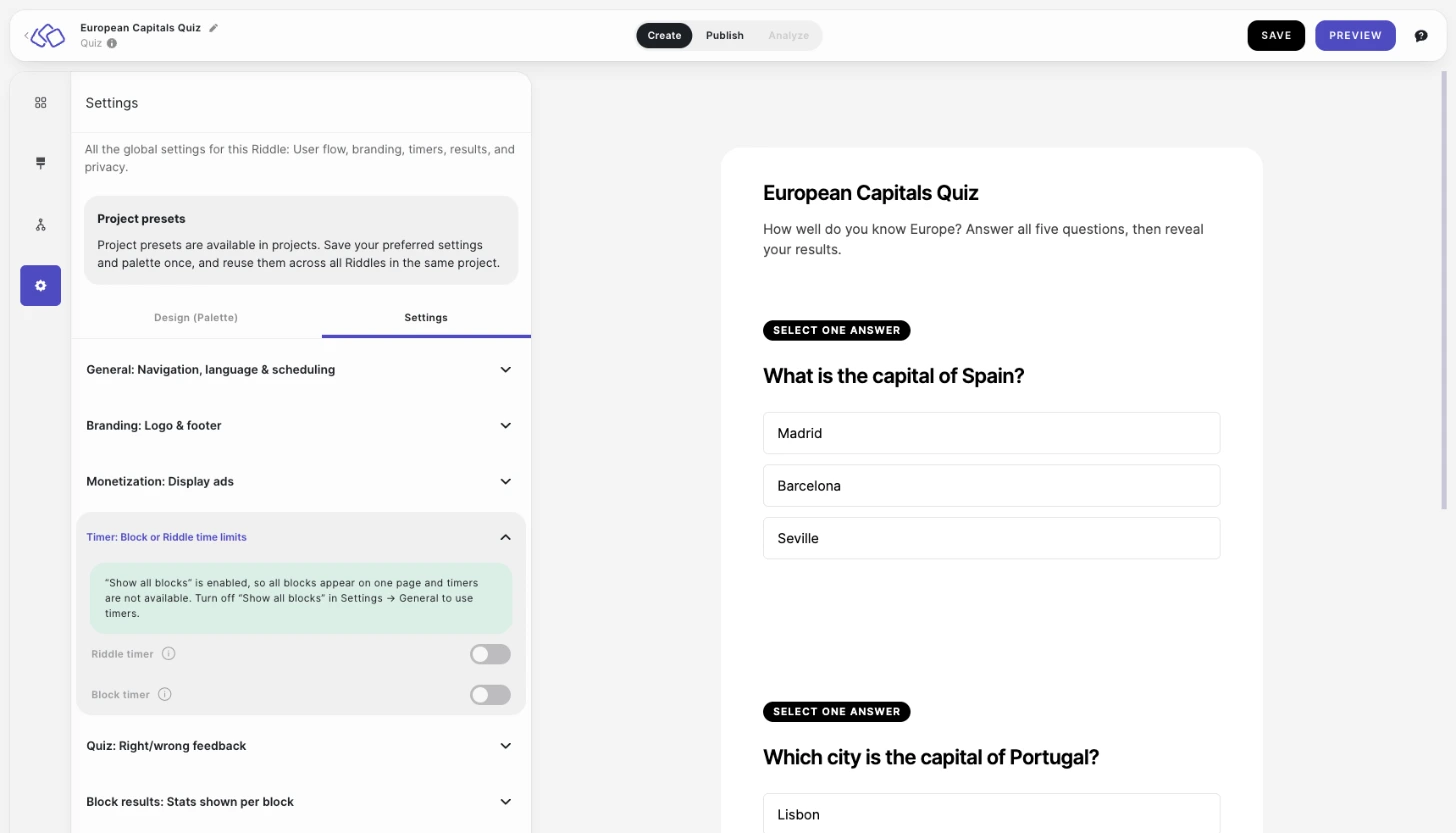
Timers are not available with "Show all questions at once". When that option is on in the general settings, all blocks appear on one page, so there is nothing to count down per page. The Riddle timer and Block timer switches are greyed out and the Timer section shows a notice instead. Turn off Show all questions at once under Settings > General: Navigation, language & scheduling to use timers again. Your timer settings are kept in the meantime.
Enable a timer for the Riddle
- Go to the Settings section and click on Timer: Block or Riddle time limits.
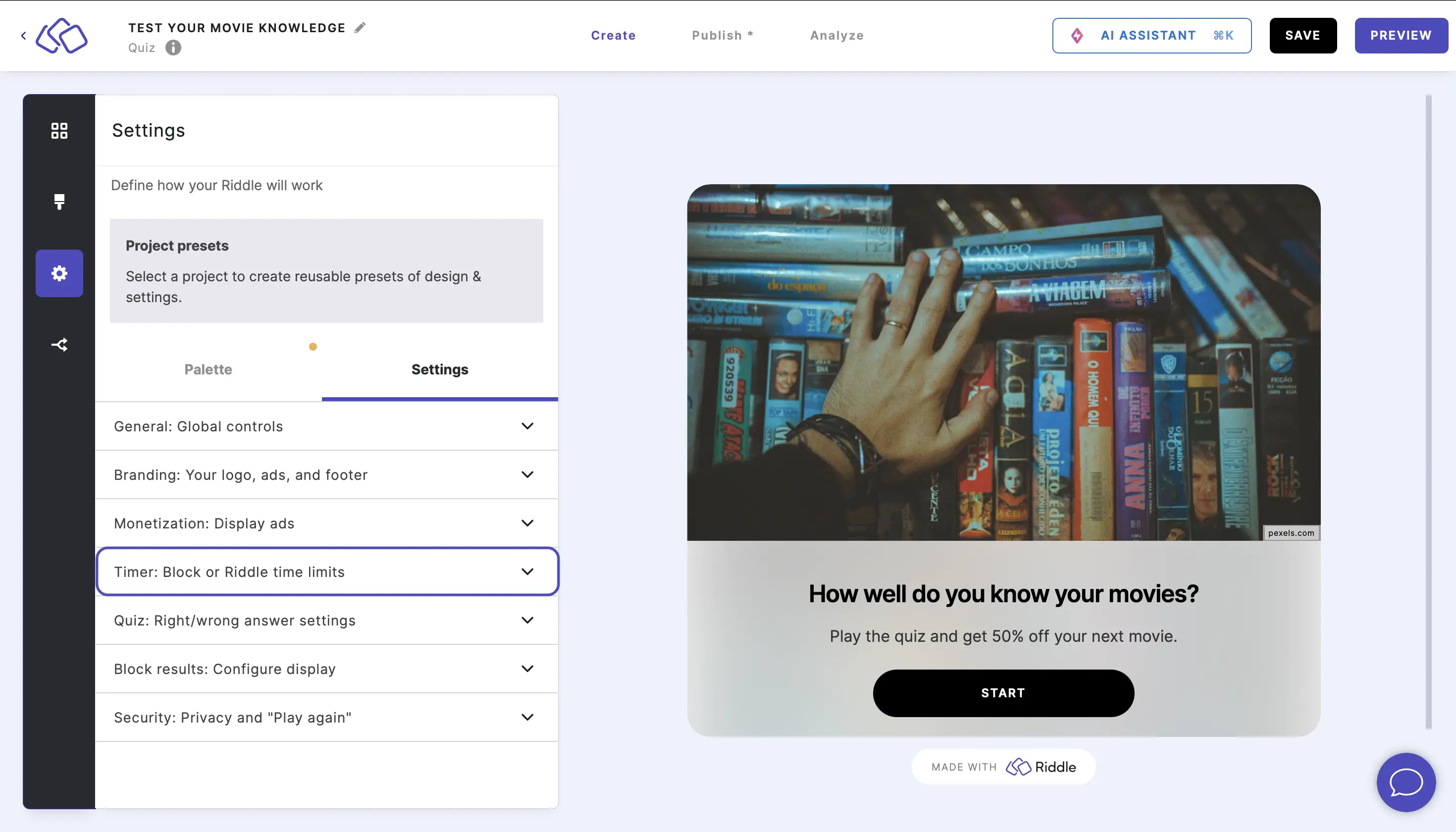
- Enable Riddle timer to have a countdown that runs from the moment your audience starts the Riddle and is for the entire Riddle.
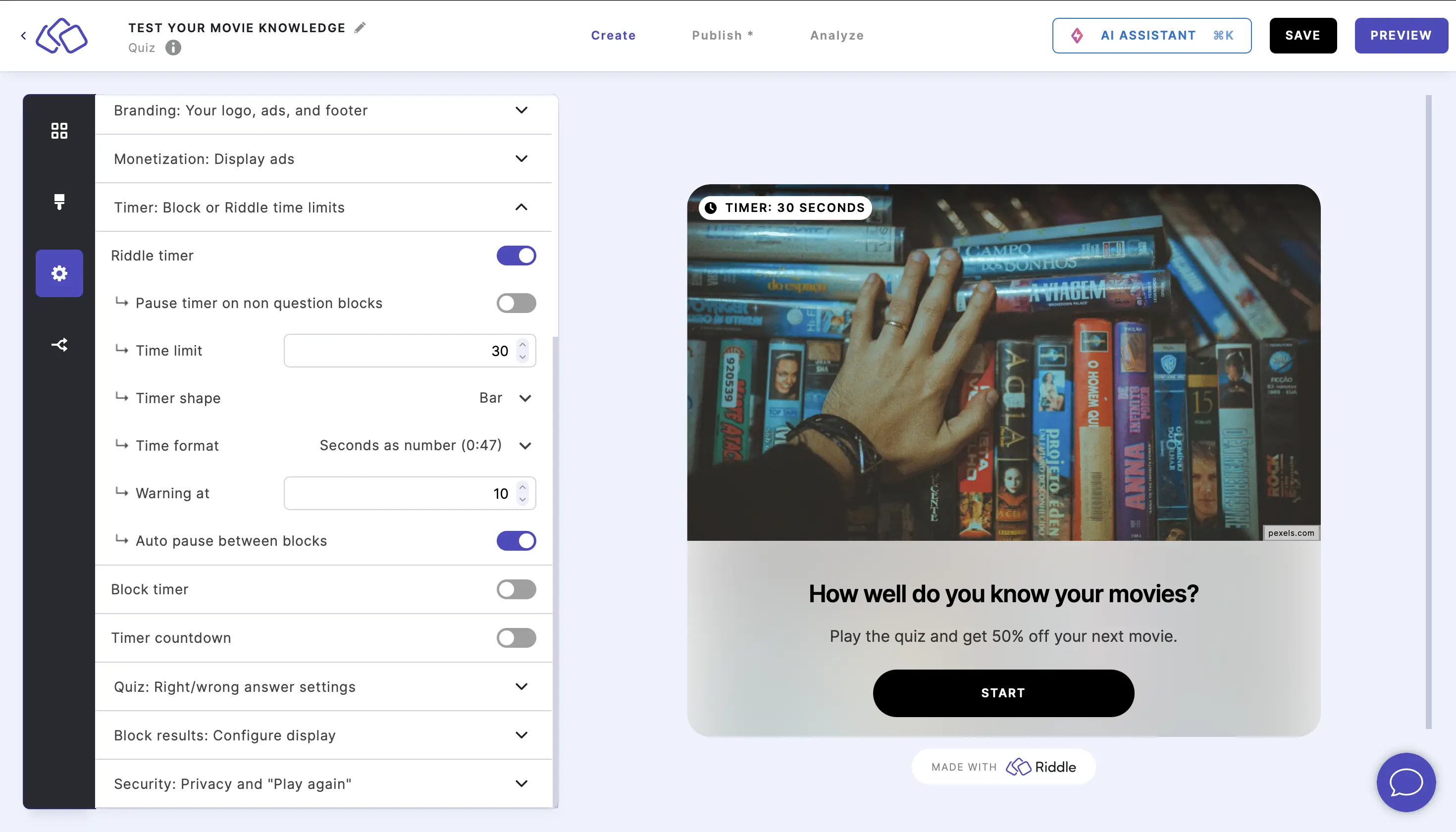
- Enable Pause timer on non-question blocks to stop the timer on blocks that don't count towards the score, such as content blocks and forms.
- Select a time limit (default: 30 seconds). For a full quiz, set this to the total time you want to allow – e.g. 120 seconds for a 10-question quiz gives about 12 seconds per question.
- Select a timer shape: Circle (compact, fits in a corner) or Bar (more visible, spans the width).
- Select a time format: Seconds as number (0:47), Minutes:seconds (3:47), or X minutes Y seconds.
- Enter the number of seconds at which you want a warning to appear in the Warning at field (default: 10 seconds). The timer changes color to signal urgency. Enter 0 to disable the warning.
- Enable Auto pause between blocks to automatically stop the timer in between blocks. This means that if your audience is experiencing slower or faster internet, the timer is not affected and will continue when the next block has fully loaded.
Enable a timer for each block
- Go to the Settings section and click on Timer: Block or Riddle time limits.
- Enable Block timer to have a countdown that runs from the moment your audience starts the specific block and is for that block only.
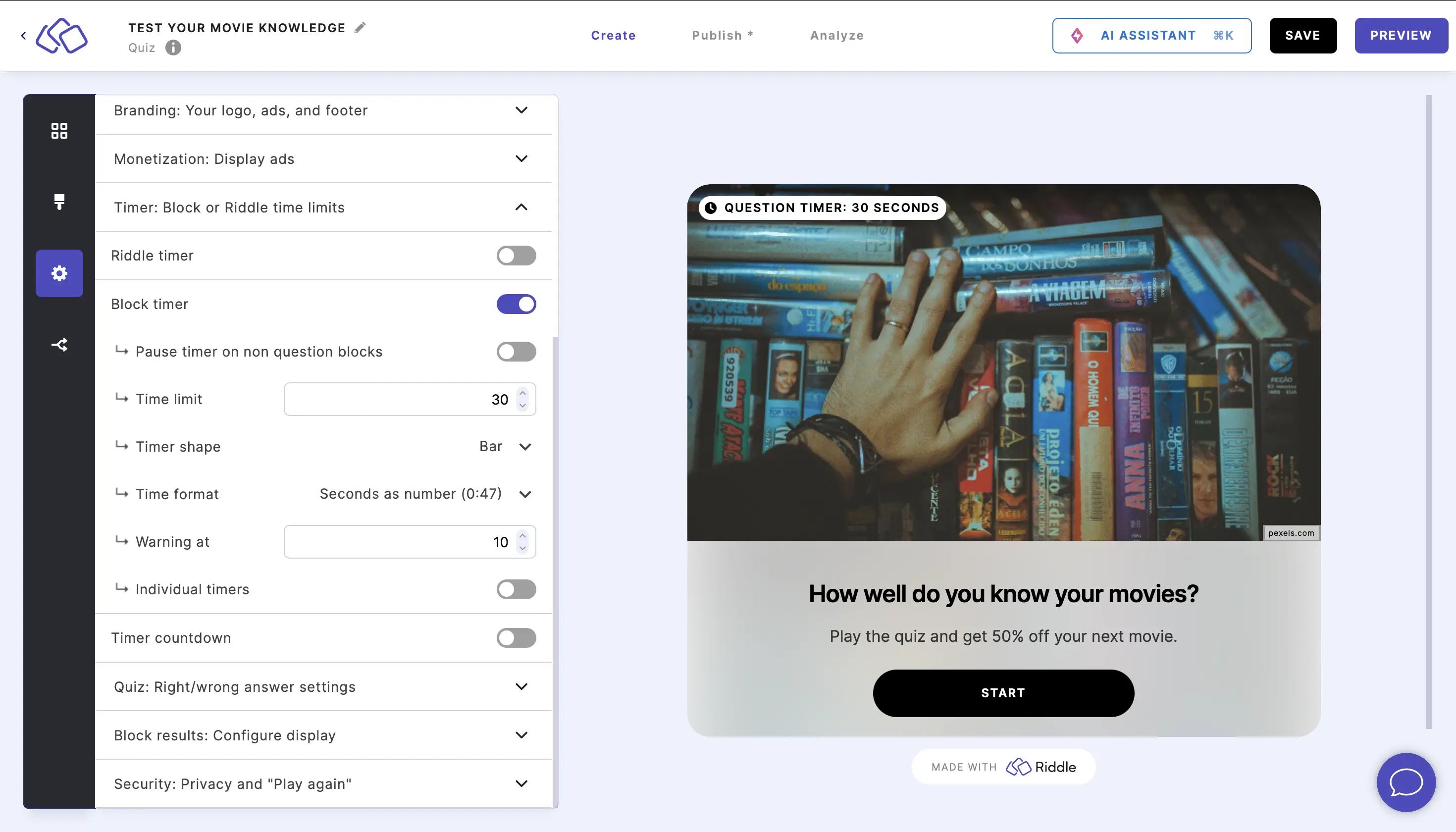
- Select a time limit (default: 30 seconds).
- Select a timer shape: Circle or Bar.
- Select a time format: Seconds as number (0:47), Minutes:seconds (3:47), or X minutes Y seconds.
- Enter the number of seconds at which you want a warning to appear in the Warning at field (default: 10 seconds). Enter 0 to disable the warning.
- Enable Individual timers to see the timers for each content block. The default is 30 seconds. Change the number of seconds for any of the blocks as needed using the up and down arrows or by entering the number of seconds. Use this to give harder questions more time and easier ones less.
Create a countdown
- Go to the Settings section and click on Timer: Block or Riddle time limits.
- Enable Timer countdown to add a countdown before the Riddle starts. This gives your audience a moment to get ready – useful for live events or competitions.
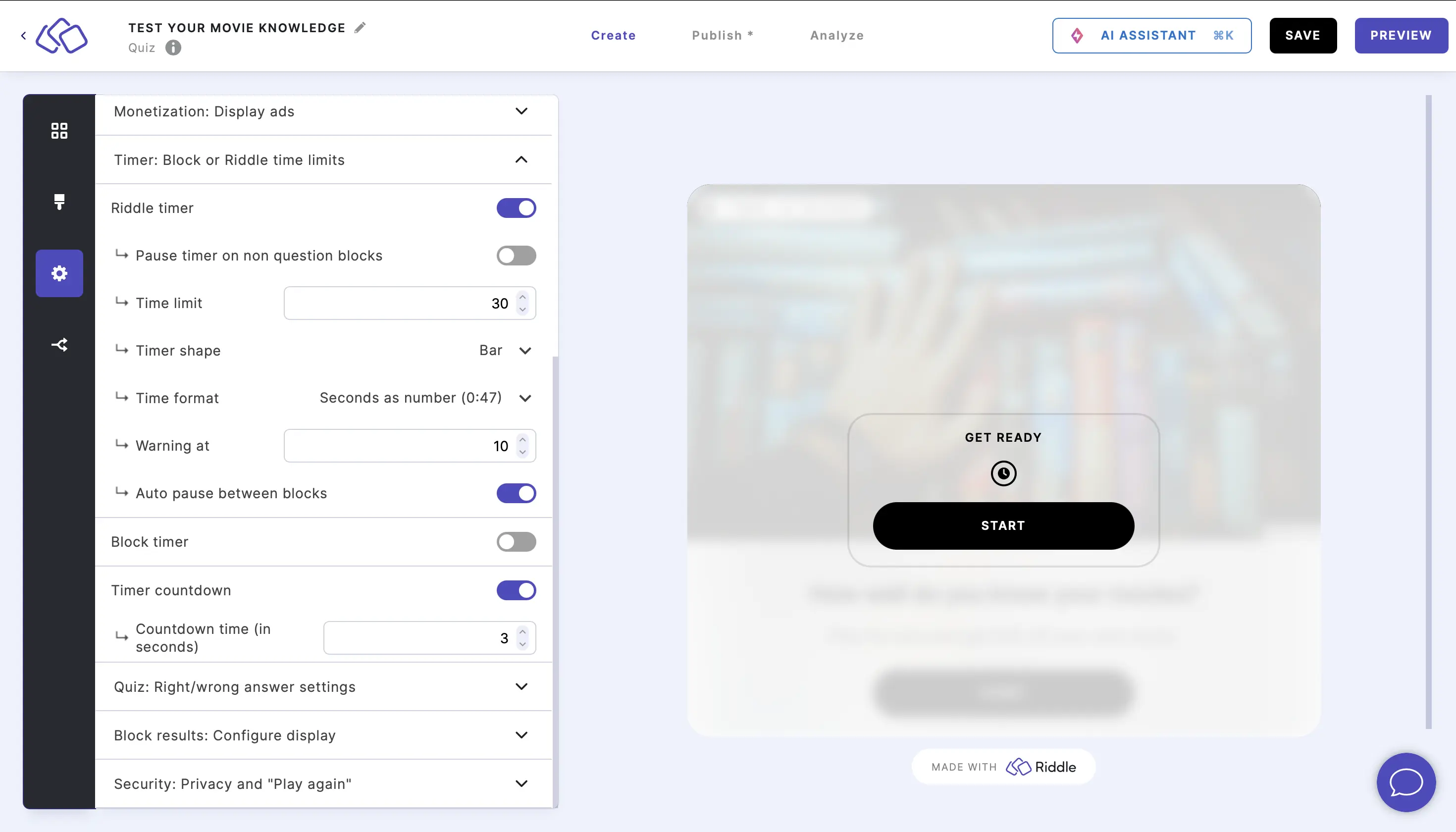
- Use the up/down arrows or enter the number of seconds.
What happens when timers run out?
When a block timer expires, the block is automatically submitted with 0 points, and the Riddle proceeds to the next block. In the rare case that the next block cannot be determined due to branching logic constraints, the Riddle will restart.
When the Riddle timer expires, your audience sees an error message prompting them to restart the quiz. Points earned up to that point are not saved.
Tips
- For leaderboard competitions, use the Block timer – it creates fair, per-question pressure and works well with time-based scoring multipliers.
- Set Warning at to 5-10 seconds to give your audience a visual cue without being distracting.
- Always enable Pause timer on non-question blocks so content blocks and forms do not eat into your audience's time.
- Keep Auto pause between blocks enabled to prevent network latency from unfairly affecting scores.
- Use Individual timers with Block timers to give harder questions (e.g. multi-select or order it) more time than simple single-choice questions.
Related articles: