

Stop Building Content for This Week. Build Content That Works for Years.
Most publishers, media companies, brands, and sports organisations are solving the wrong problem.
They keep asking: how do we produce more? The better question – the one that actually changes the economics – is how do we get more return from what we already build?
Topical interactive content runs for three weeks, then gets archived. Evergreen interactive content keeps earning – search rankings, return visits, first-party data – for years after launch.
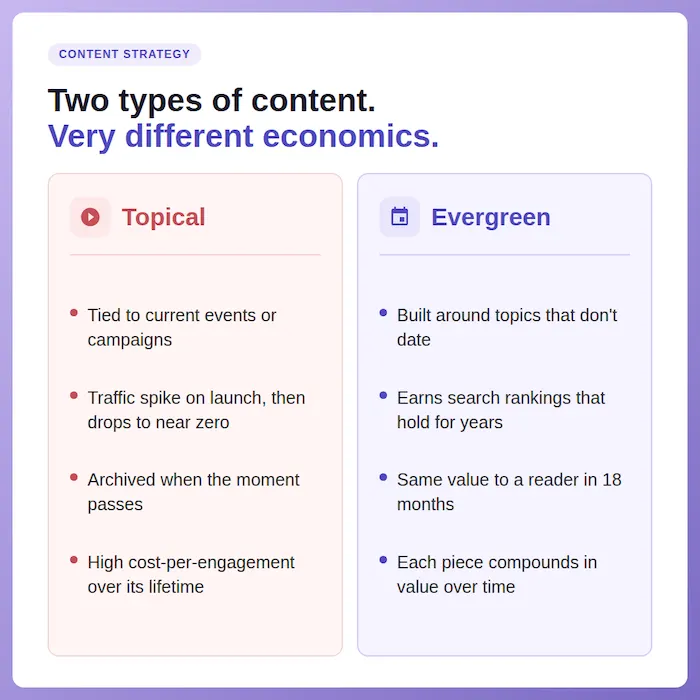
Building both – using AI to keep the topical stuff cheap, and human editors to make the evergreen stuff trustworthy – is what separates the teams getting real traction from the ones constantly refilling the calendar.
This post covers the key ideas. The full playbook – benchmarks, format guides, ROI data, and a planning template – is in the PDF below.
Download the Interactive Content Strategy Playbook
Download the full Playbook (PDF) – format-by-format guides, case study data, and a step-by-step planning template covering topical, evergreen, and automated quiz portal strategies.
The traffic problem no one wants to say out loud
Search traffic is under structural pressure (up to 25% for many publishers), and it’s not temporary. AI-generated answer boxes handle more queries without sending anyone to a publisher’s page. Zero-click results mean strong rankings no longer guarantee visits. Social reach is patchier than it was.
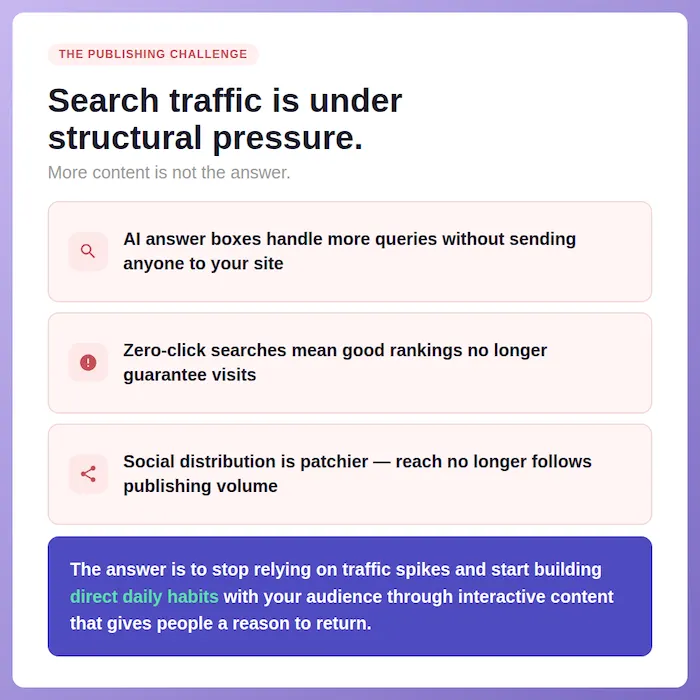
The publishers doing well right now aren’t the ones producing more content in response. They’ve stopped depending on traffic spikes and started building direct relationships with audiences who keep coming back on their own.
Interactive content – quizzes, personality tests, mini-games, polls – is central to that shift. But the economics depend heavily on what kind of interactive content you build and why.
Topical content: use AI and keep it cheap
A news quiz tied to a breaking story. A poll during a live match. A personality test for a product launch. Topical content has a clear job – drive engagement while the moment lasts – and there’s nothing wrong with building it. The problem has always been cost versus lifespan.
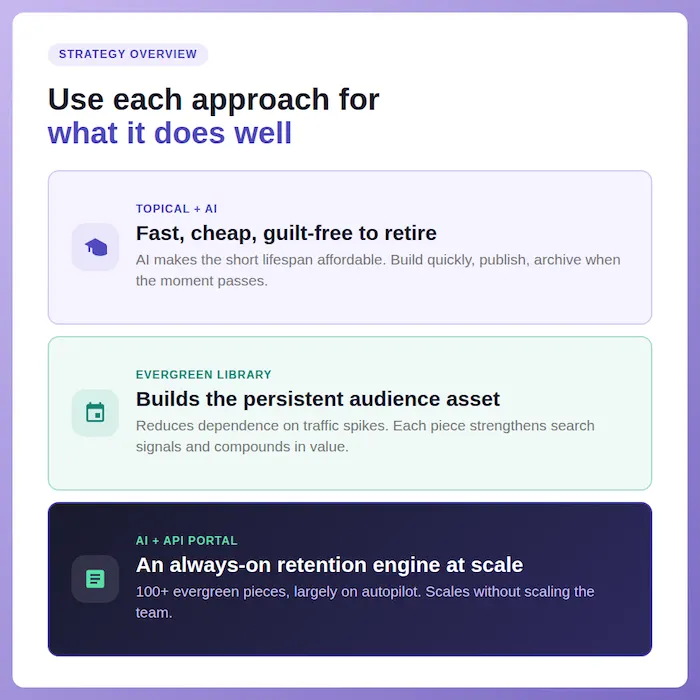
Building a quiz from scratch used to take 45-60 minutes of editor time. For teams on daily content cycles, that’s a hard ratio to justify for something irrelevant in a fortnight.
AI changes the calculation. Paste in a topic or article URL and get back a full draft – questions, answer options, and explanations – in under a minute. Two ways to do it:
- Via Riddle’s quiz maker – enter a topic or paste an article URL into Riddle’s AI quiz generation and get a complete draft in under a minute
- Via the Riddle MCP connector – for teams already using Claude, type a prompt and Claude builds the quiz directly, without opening Riddle at all
The editorial workflow stays intact. AI produces the first draft; an editor reads it, fixes anything off, and approves it. Five to ten minutes – enough to catch anything that doesn’t meet your bar without eroding the time saving.
The quiz rides the traffic from the original story, then gets archived when the topic cools. The editorial investment is small enough that retiring it doesn’t sting.
For sports leagues and sports media, this fits naturally onto existing content rhythms: AI generates a quiz, poll, or mini-game around a fixture preview or post-match story, it goes live quickly, and the team moves on.
AI drafts it – your team decides if it’s good enough
The question editorial teams always ask is: what about quality? It’s fair. Nobody wants to publish something that reads like a machine wrote it.
The workflow is simple:
- AI writes the first draft.
- Your editor reads it, fixes anything off, and approves it.
- Just five to ten minutes per quiz.
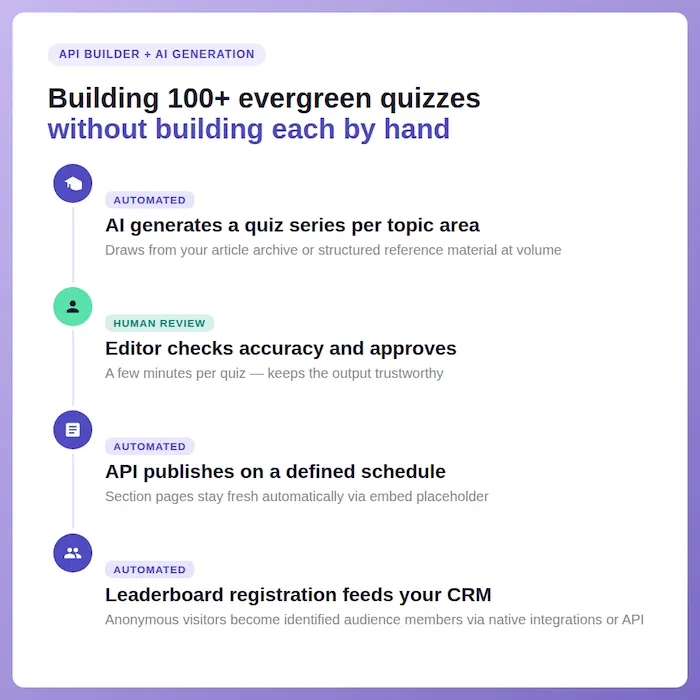
The AI handles the time-consuming part; your editorial staff bring the judgment, the voice, and the quality bar. For publishers where audience trust is the whole business, that’s the right division of labour.
Riddle’s content automation covers the full range: AI quiz generation from URLs, scheduled publishing via embed placeholders, and programmatic creation via the API for teams running at higher volume. For teams already using Claude, Riddle’s MCP connector creates quizzes, polls, and personality tests directly inside that workflow.
Evergreen interactive content: build it once, let it work
The quiz that will drive the most value over the next two years probably isn’t the one you’re planning to build next week. It’s the one built around something your audience cares about permanently – not the current story, but the subject matter underneath it.
Evergreen interactive content is built around topics that don’t age:
- Publishers and media companies – knowledge quizzes that hold search rankings for years rather than weeks
- Brands – product recommendation tools and personality tests that qualify leads around the clock
- B2B and trade publishers – industry knowledge tests where the fundamentals don’t shift week to week
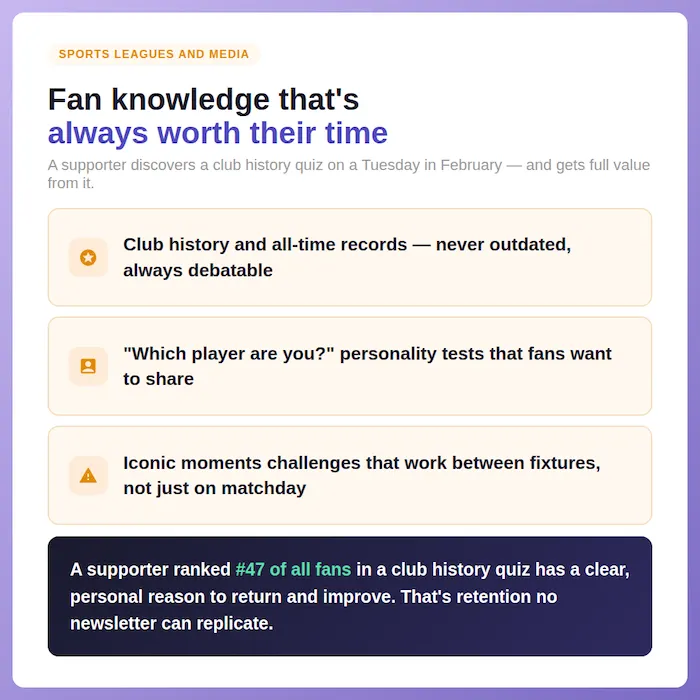
- Sports leagues and sports media – fan challenges built around club history, player records, and iconic moments that a supporter discovers on a quiet Tuesday and still finds worth their time a year later
What is evergreen interactive content, anyway?
It’s simple: would a reader who finds this 18 months after launch get the same value as someone who clicked it the week it went live?
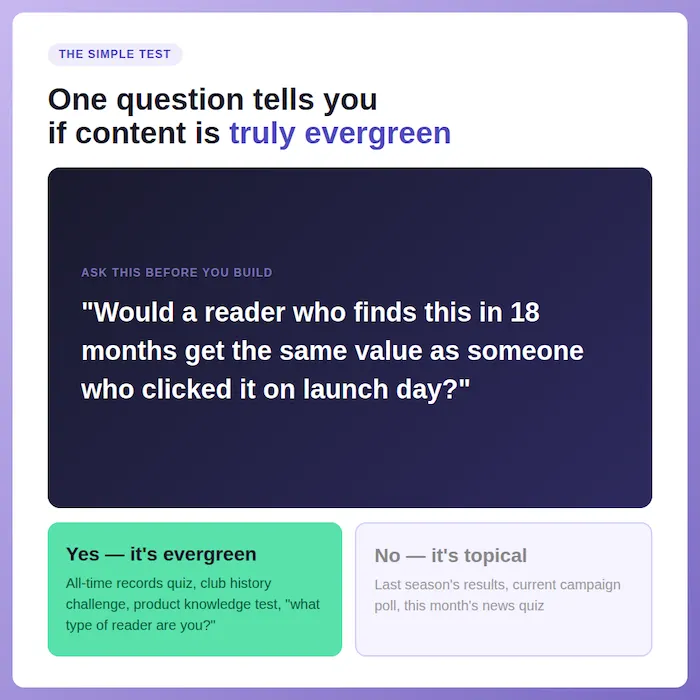
A sports media quiz on all-time records passes that test. One built around last season’s results doesn’t. A media brand’s personality test about what kind of reader you are passes easily. A quiz tied to last week’s cover story doesn’t.
The economics are completely different too. Well-built evergreen interactive content generating engagement for 18 to 24 months has a fraction of the per-engagement cost of a topical piece that runs for three weeks.
Maintenance is light – a fact check here, a stat updated there, 30 minutes once a year. The more evergreen content you have live, the less pressure to keep filling the calendar with new topical pieces.
What evergreen interactive content looks like across formats
Quizzes are the workhorse format. Knowledge tests built around durable subject matter earn search positions that hold for years – not just the brief spike of a news piece, but a steady flow of new readers. Publishers can engage with content around any topic – while for sports organisations, quizzes built around club history, iconic moments, or all-time statistics give fans something worth engaging with between fixtures.
Riddle’s quiz maker supports 37 content formats – including multiple choice, image-based, and free-text formats – each with full white-labelling and custom CSS to match your branding.
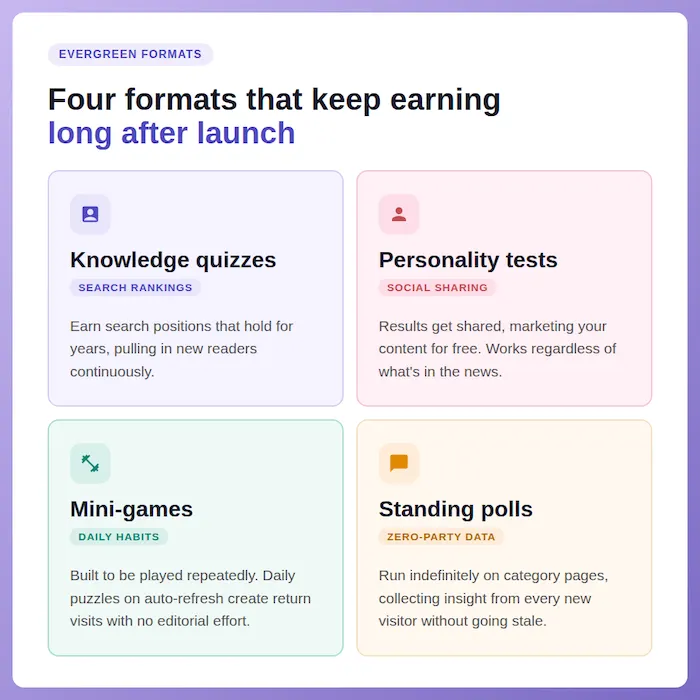
Personality tests are inherently evergreen – they tap into something that doesn’t date. People always want to understand themselves and compare with others, regardless of the news cycle. For publishers and media companies, they drive social sharing; for brands they function as product selectors that feel like entertainment. For sports organisations, “which player are you most like?” gives fans something to post that markets your content for free. Riddle supports weighted answer scoring, branching logic, and multiple distinct outcome tracks.
Mini-games – crosswords, Sudoku, word games – are built to be played repeatedly, not experienced once. A daily puzzle tied to a leaderboard creates return visits with no editorial effort after setup. Riddle’s auto-refresh publishes on a schedule – hourly, daily, or weekly – without anyone touching it. The New York Times built a meaningful chunk of its subscription business on exactly this logic.
Polls built around foundational audience questions can run indefinitely on category pages, collecting zero-party data from every new visitor without going stale. For brands, a standing poll on a product page turns passive browsers into participants and generates continuous insight into what that audience actually cares about – unlike survey data collected once during a campaign.
What this looks like in practice: History Extra
History Extra – Immediate Media’s digital home for BBC History Magazine – is a good example of what a consistent evergreen interactive content strategy produces at scale.
The team publishes quizzes weekly using Riddle (read the case study), building a library across core subject areas: historical periods, famous figures, iconic events. None of it is tied to a news cycle – it is all evergreen interactive content. A quiz about the First World War is just as useful to a reader who finds it two years from now as it was the week it launched.
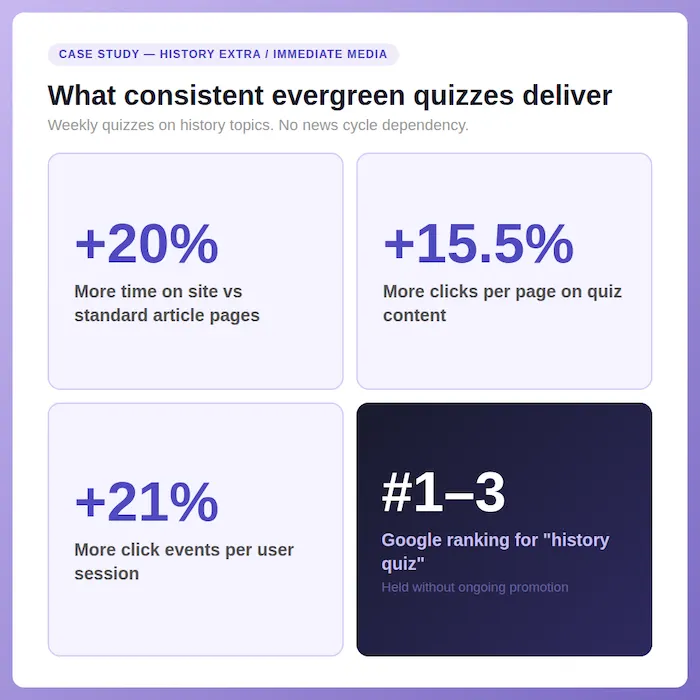
Compared to standard article pages, History Extra’s quiz content shows:
- +20% more time on site
- +15.5% more clicks per page
- +21% more click events per user session
Their quiz portal is among the most visited pages on the site. History Extra consistently ranks between first and third for the search term “history quiz” – not through ongoing promotion, but because a library of well-built, durable content is exactly what search rewards.
The quiz library also doubles as a subscriber acquisition tool. Deeper “ultimate” quizzes on major historical themes sit behind a paywall, giving casual readers a concrete reason to consider upgrading. Each new quiz strengthens the portal, improves search signals, and gives readers another reason to stay.
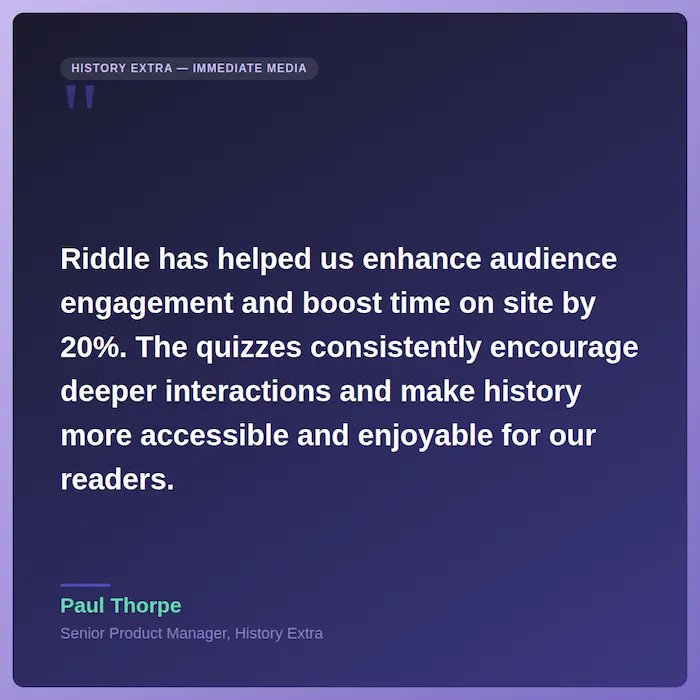
“Riddle has helped us enhance audience engagement and boost time on site by 20%. The quizzes consistently encourage deeper interactions and make history more accessible and enjoyable for our readers.”
Paul Thorpe, Senior Product Manager, History Extra
Now consider what that same model looks like running not on a weekly manual cadence, but on an AI-assisted pipeline that builds and maintains the library at a scale no editorial team could manage by hand.
Scaling it up: the AI-powered quiz portal
A manually curated evergreen library is already valuable. Combine AI generation with Riddle’s API Builder and you can go much further – creating quizzes programmatically without anyone logging into Riddle at all.
Identify your core topic areas. An AI-assisted pipeline generates a quiz series for each, drawing from your article archive or structured reference material. The API then publishes on a defined schedule, assigns each series to a leaderboard, slots content into an embed placeholder on the relevant section page, and connects completions to a lead generation flow.
The editorial team reviews and approves. They don’t build from scratch. The result is a quiz portal of 100 or more evergreen interactive content pieces, live and structured for long-term engagement, built in a fraction of the time manual production would take.
Humans still make the calls
This matters, so it’s worth being direct about. AI generates the content; your team decides what’s good enough to publish. That means a simple review queue: an editor checks accuracy, adjusts phrasing, and confirms questions are pitched at the right level.
For publishers and sports organisations, a content manager checks questions match what the audience actually know. A few minutes per quiz – not a bottleneck, the step that keeps the output trustworthy.
AI cuts the cost of production. Editorial judgment is what makes the output worth publishing.
Why leaderboards turn a content library into a retention engine
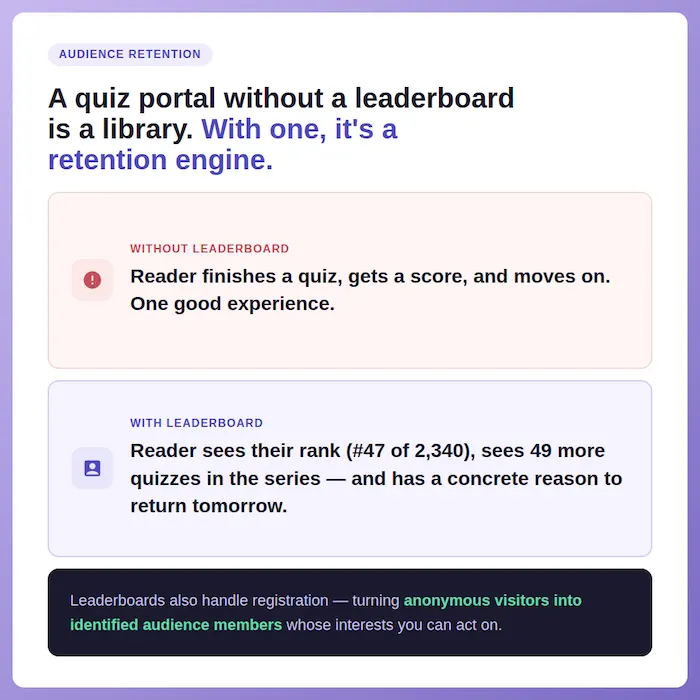
A quiz portal without a leaderboard is a content library. With one, it’s a retention engine.
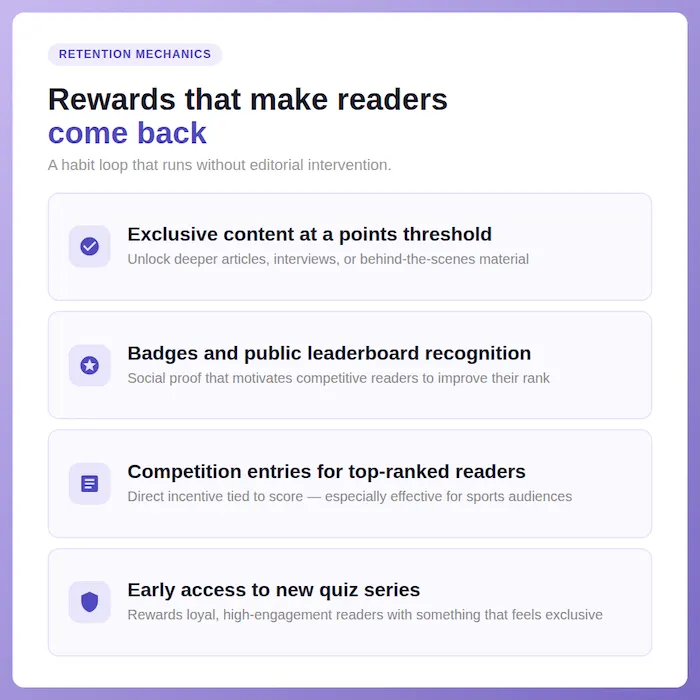
Score and move on – that’s one experience. Score, see your rank, discover there are 50 more quizzes in the series – that’s a reason to come back tomorrow. Add a streak mechanic or a reward at a points threshold and you’ve built a habit loop that runs without editorial intervention: exclusive content, competition entries, early access to a new series, badges on the leaderboard itself.
History Extra is a large media operation.
However, the same logic works just as well for niche publishers. JaneAusten.com has built a library of more than 350 quizzes covering Austen’s novels, characters, historical context, and film adaptations – 79% of readers finish, with members spending an average of 5 minutes 30 seconds per finish (read case study).
The quiz library sits at the centre of how the site converts casual visitors into paying members: to appear on a leaderboard, readers create an account, and that account puts them one step closer to a paid membership.
It’s an easy sell, because they’ve already seen what the quizzes are like and want more. It’s a membership funnel built around content people actively seek out, not a pop-up asking them to subscribe before they’ve seen anything worth subscribing for.
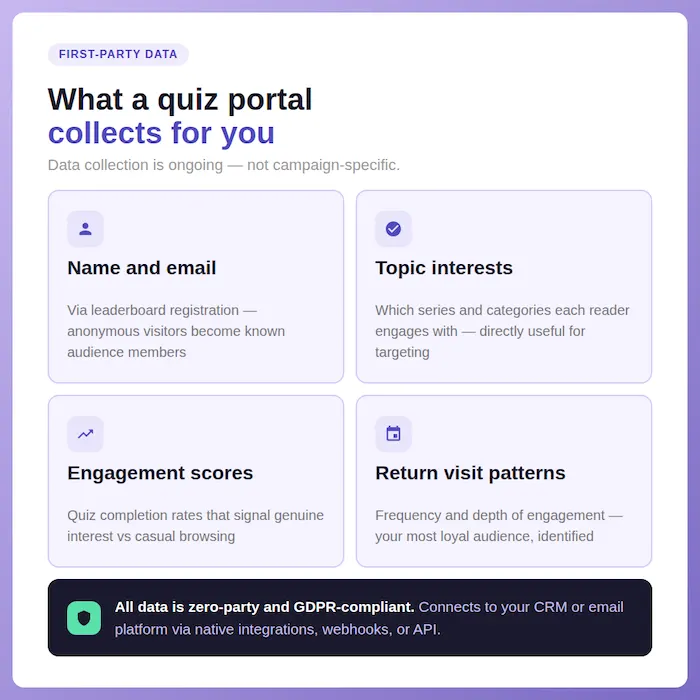
Paired with evergreen interactive content, leaderboards also solve a data problem. To appear on one, readers register – converting anonymous visitors into identified audience members you can act on. That data flows to your CRM or email platform via native integrations, webhooks, Zapier, or API. All zero-party, all 100% GDPR-compliant.
What a quiz portal looks like by sector
The mechanics are the same across organisations – the content and competitive dynamic just look different.
News publishers and media companies auto-generate a quiz whenever a new article publishes in a core category. Over six months that builds a library spanning politics, business, science, and culture, with a standing leaderboard giving loyal readers a reason to keep coming back and new readers finding the portal through search.
Sports leagues and sports media auto-generate quizzes for every club, competition, and season, drawing from match history, player stats, and club records. Each series feeds a fan leaderboard. For a league with 20 clubs, that’s 20 club-specific quiz series running simultaneously – a fan engagement programme that works on autopilot once the initial setup is done.
B2B and trade publishers build a knowledge test series across core topics – regulation, technology, market trends. Industry fundamentals don’t shift week to week, so the content stays accurate with minimal upkeep. Readers who engage regularly signal genuine professional interest, making them high-value leads for advertisers and sponsors.
Brands with content archives convert existing editorial into quiz form. A year of articles or a product knowledge base becomes a year’s worth of evergreen interactive content, published on a schedule and feeding a challenge series that rewards engaged customers without requiring net-new content work.
How to start with evergreen interactive content – don’t build the whole thing at once
Don’t worry. You won’t need to build the whole thing at once. Each phase pays for the next.
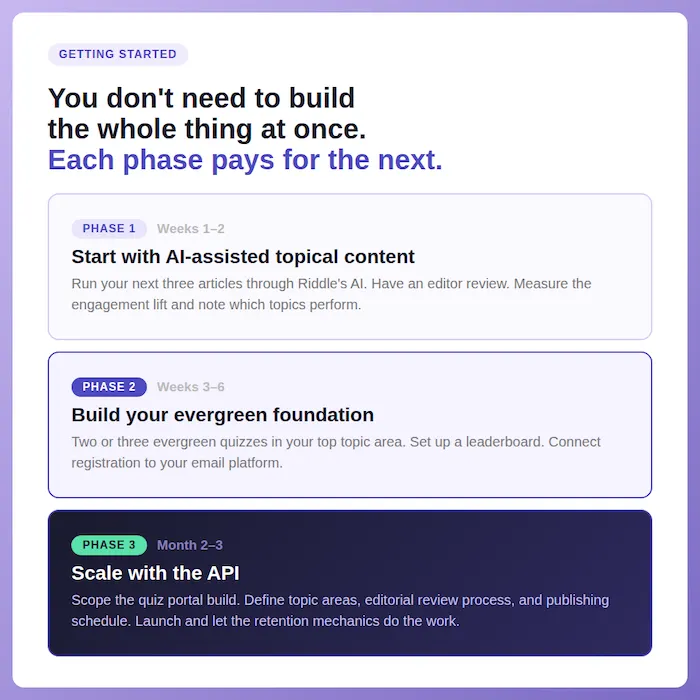
Phase 1 – Weeks 1-2: Start with AI-assisted topical content
- Use Riddle’s AI quiz generation on your next three major articles, campaign pages, or match previews
- Have an editor review each draft before publishing – this sets your quality baseline
- Measure engagement lift against non-quiz pages and note which topics get the most traction
Phase 2 – Weeks 3-6: Build your evergreen foundation
- Build two or three evergreen quizzes in your highest-interest topic area
- Set up a leaderboard and connect it to your most-visited relevant section
- Embed using a placeholder so the slot stays live and refreshed automatically
Phase 3 – Months 2-3: Scale with the API and MCP
- Scope a quiz portal build using Riddle’s API Builder and AI generation (plus Riddle’s MCP connector)
- Define topic areas, content pipeline, editorial review process, and publishing schedule
- Connect leaderboard registration to your CRM or email platform
- Launch and let the retention mechanics do the work
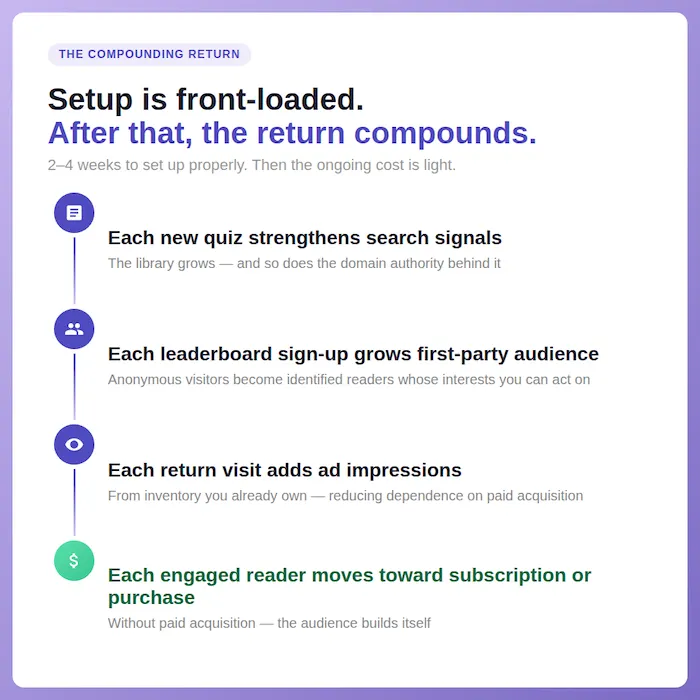
Setup is front-loaded – two to three weeks done properly. After that, content generates and queues automatically, editors review rather than build from scratch, and the leaderboard manages itself. New topic areas slot in without rebuilding the infrastructure.
Every new piece strengthens search signals. Every leaderboard registrant expands the first-party audience. Every returning reader adds ad impressions, reduces dependence on paid acquisition, and moves a step closer to a subscription, purchase, or deeper brand relationship.
The platform behind evergreen interactive content
Evergreen content only compounds if it’s easy to produce, keeps working without maintenance, and earns its keep over time. That takes an enterprise-grade quiz maker built for the long game:
- 35+ interactive formats – quizzes, personality tests, polls, predictors, mini-games, and more, so you can match the format to the topic
- White-label embeds that match your brand automatically, with no coding required
- Built to last – quizzes keep ranking, driving return visits, and collecting first-party data long after launch
- First-party data you own – every interaction feeds audience insight, captured on EU-based, GDPR-compliant infrastructure
- In-content ad serving on every format, so evergreen pieces keep monetizing themselves
That’s where Riddle fits. To see how it all comes together, read our guide to the enterprise quiz maker built for publishers and media companies.
Download the free Interactive Content Strategy Playbook
The full evergreen interactive content playbook has format-by-format guides, benchmarks from publishers already running this model, ROI data, and a planning template you can use straight away.
Try Riddle free at riddle.com – no credit card required, all features unlocked. Or book a 1:1 demo to talk through what this looks like for your setup.
Frequently asked questions
What is evergreen interactive content, and how is it different from topical content?
Topical interactive content is built around a current event and retired when the moment passes. Evergreen interactive content – knowledge quizzes, personality tests, sports history challenges, product recommendation tools, mini-games like crosswords – is built around subject matter that doesn’t date. The test: does a reader who finds it in 18 months get the same value as someone who clicked it on launch day? A smart strategy uses both: AI for fast, cheap topical production and a deliberate evergreen library for lasting audience value.
Does AI-generated content meet editorial quality standards?
Only if you treat it as a draft. Build a review step into the workflow: an editor checks each quiz for accuracy, voice, and question quality before it goes live. Five to ten minutes per quiz – a fraction of building from scratch, but enough to catch anything that doesn’t meet your bar.
Does evergreen interactive content work for brands as well as publishers and media companies?
Yes. Publishers are the most natural fit, but any brand with a content archive and a reason for their audience to return can run this model – a food brand with a recipe library, a financial services company with investor education content, a sports organisation with historical depth. The leaderboard and lead generation mechanics work the same way regardless of whether the content is editorial or brand-owned.
How do leaderboards improve audience retention?
Score and move on – that’s one experience. See your rank, know there are 50 more quizzes in the series, and you have a reason to return. For sports organisations, this maps directly onto fan competitiveness. Leaderboards also handle registration, converting anonymous visitors into identified audience members whose interests you can act on.
How does Riddle’s AI quiz generation work?
Paste in an article URL or topic description and Riddle’s AI quiz generation produces a full quiz, poll, or other interactive content – questions, answer options, and explanations – in under a minute. It’s a first draft for your team to review and approve, not a finished product. Topical quizzes can be live within the hour; evergreen portals can be built at scale without adding headcount. You can also use Riddle’s MCP connector with Claude to seamlessly create new content.
What kind of data does a quiz portal collect?
Every completion generates engagement data. Every leaderboard registration generates first-party data: name, email, interests, location. Because content runs continuously, data collection is ongoing rather than campaign-specific. Riddle connects to your CRM, email platform, or analytics stack via native integrations, webhooks, or API. All zero-party, all GDPR-compliant.