BuzzFeed vs Riddle: two very different ways to make a quiz
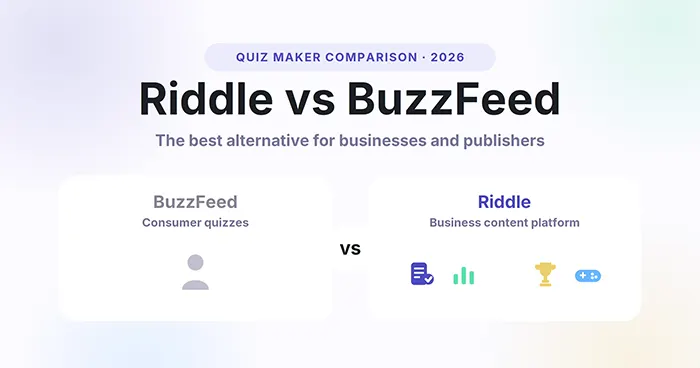
If you are searching for the best alternative to BuzzFeed in 2026, the first thing to know is that BuzzFeed and Riddle were built for different jobs. Pick the wrong quiz maker and you spend your time fighting the tool for features it was never meant to have.
Short answer: Riddle is the best BuzzFeed alternative for businesses and publishers. It offers 35+ interactive formats, white-label branding, GDPR-compliant lead generation, leaderboards, and built-in monetization, where BuzzFeed’s free quiz tools are built for casual consumer use.
BuzzFeed was one of the first quiz builders on the web. Launched back in 2006, it earned its place, then pivoted into a news and media company. That direction only sharpened this year:
- In May 2026, BuzzFeed sold a majority stake to Byron Allen’s Allen Family Digital.
- The company is now focused on AI and free streaming video, with its founder moving into a “president of BuzzFeed AI” role.
- The free quiz tools are still there, but they are further from the roadmap than ever, and it shows in the feature set.
Riddle took the opposite path. Since 2014 we have built a quiz maker specifically for publishers, brands, and media companies.
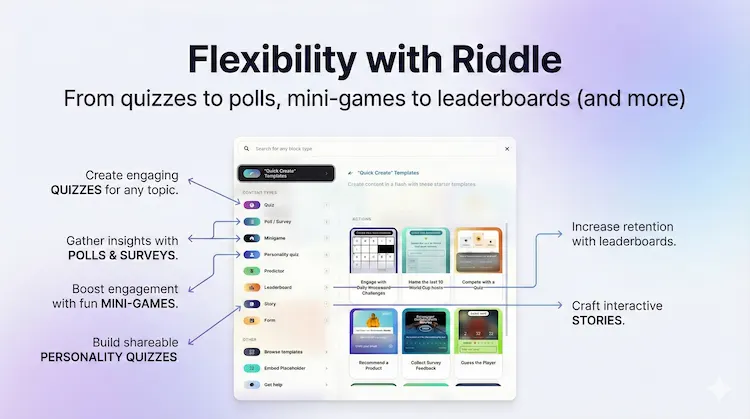
That focus shows up as:
- White-label branding on your own site
- GDPR-compliant lead capture
- Monetization built in – keep 100% of the revenue
- A platform that keeps shipping new formats
Publishers, brands, and media companies rely on Riddle every day. The BBC uses Riddle extensively for interactive content, Swiss public broadcaster SRF has seen 28,000+ years of dwell time in just 2.3 years, Immediate Media’s History Extra lifted time on site by 20%, and Tate now sees quizzes drive half of Tate Kids’ traffic.
This is a fair comparison, so we will be clear about where BuzzFeed does well and where Riddle pulls ahead. Below we look at both tools as they stand in 2026: format range, personality and poll options, media, automation, monetization, privacy, and pricing.
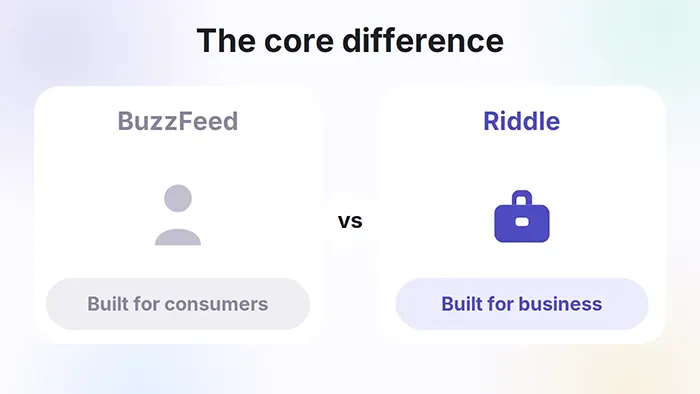
What a quiz maker is really for
Most teams reach for a quiz tool with one of two goals in mind, and often both:
- Audience engagement. Quizzes, polls, and surveys hold attention. People interact more, stay on the page longer, and share their results, which brings in new traffic.
- Lead generation and data collection. Add an opt-in form between the questions and the results, connect it to your email or CRM tool, and every quiz becomes a way to grow a segmented list you can follow up with.
Every BuzzFeed quiz has zero lead-generation built in. Riddle was designed around lead capture from the start, so you can place a form anywhere in the flow and send leads and answers to any marketing tool automatically. If you want the full picture, our guide to creating the perfect online quiz walks through both goals.
Quiz formats: how many do you get?
People say “quiz” to mean all sorts of interactive content: surveys, polls, personality tests, predictors, and more. The wider your toolkit, the more you can do without switching platforms.
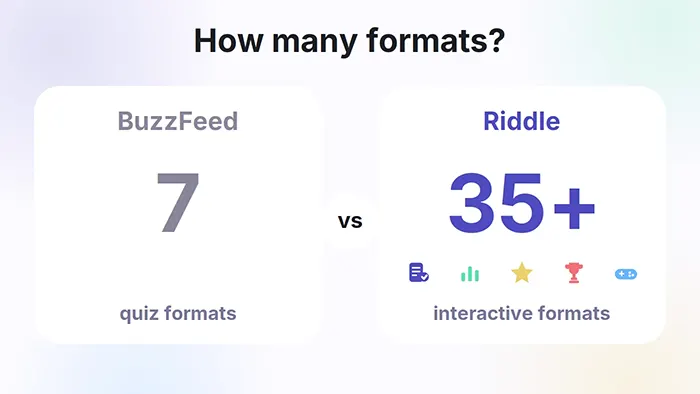
- BuzzFeed does fine here for a free quiz tool, with around seven formats including its personality test and checklist.
- Riddle offers 35+ interactive formats, including quizzes, personality tests, polls and surveys, score predictors, leaderboards, and mini-games like crosswords and sudoku.
The block-based builder is the real difference.
You can combine several formats in one experience and add drag-and-drop branching logic so people see different questions and results based on their answers. That makes it far easier to build multi-step pieces, sponsored content, contests, or themed content hubs. This flexibility is exactly why publishers, brands, and media companies use Riddle as their interactive content platform.
Personality tests: fixed results vs weighted scoring
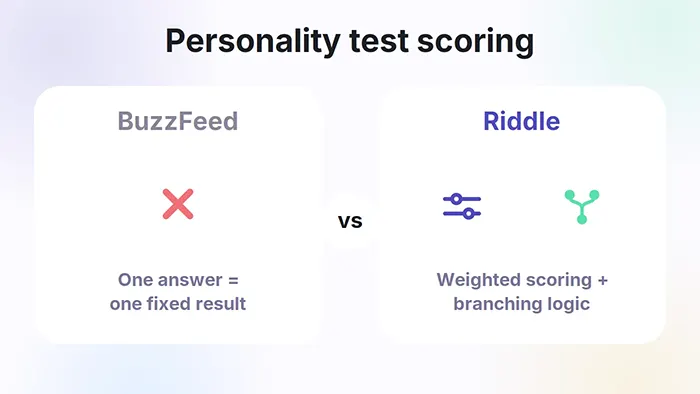
Personality tests are where BuzzFeed’s consumer roots show most. Each answer maps to a single result, with no flexibility. An answer counts toward Yoda or Darth Vader, but never both.
Riddle uses weighted scoring instead:
- Every answer can contribute to several results, on a scale from -100 to 100, for maximum flexibility.
- As you move the slider, each step adds more weight toward that result.
- At the end, Riddle totals the points and returns the strongest match.
That difference matters well beyond entertainment quizzes. Weighted scoring is what makes a personality quiz maker useful for nuanced assessments, product recommendations, and content matching, where the right result depends on the whole pattern of answers rather than a single click.
Pair it with branching logic and you can route each person to a tailored recommendation, offer, or next step. E-commerce brands do exactly this: The Hair Fuel runs a Riddle personality quiz that generates 65 to 70% of its leads and cut customer acquisition costs by 60%.
Poll formats
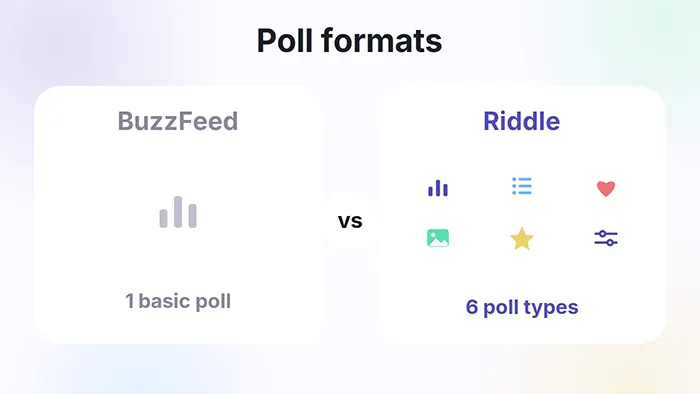
BuzzFeed keeps polls simple: quick, single-question units that show results after a vote. That works for a fast reaction, and not much beyond it.
Riddle offers twelve poll and survey types, from the classic single-question poll to the multi-poll, TikTok-inspired This or That, and the reaction poll. The multi-poll lets you ask unlimited questions, allow single or multiple votes, or have people rank their favorites. Publishers like the BBC use reaction polls to lift engagement inside long-form articles, with around a quarter of readers stopping to vote. The Fiesta Bowl sees 65.8% of its visitors engage with Riddle polls around its high school football series.
Media and embeds
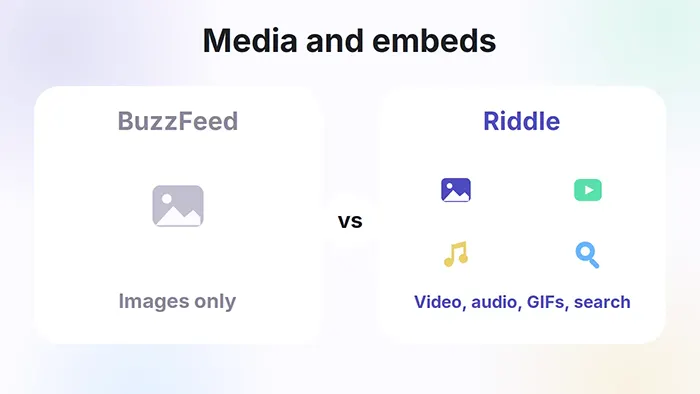
Attention lives and dies by what you can put on the screen. BuzzFeed lets you only add images, and just in some blocks, not everywhere.
Riddle supports a much wider range of media formats:
- Search and embed images, video, audio, and animated GIFs
- Upload your own MP3s and MP4s
- Pull media from Google, Giphy, YouTube, Instagram, and Pexels
- Crop and filter with built-in image editing
AI creation, automation, and the API
This is new ground since the last time most people compared these tools.
- AI creation. Riddle’s AI can build a draft quiz, poll, or personality test from a topic or straight from an article URL. Editors then adjust the draft, which is a real time-saver for teams publishing topical content on a deadline.
- Automation. Riddle can rotate content on a schedule, generate fresh quizzes or polls from a question bank, and use placeholder embeds that update on the page without any CMS work.
- API. For developers and larger teams, the Riddle API lets you create content, embed it, and pull stats programmatically, so interactive content fits into existing publishing and data workflows.
BuzzFeed’s consumer tools offer nothing comparable.
Leaderboards, contests, and retention
Getting someone to play once is engagement. Getting them to come back is retention, and this is where Riddle pulls furthest ahead.
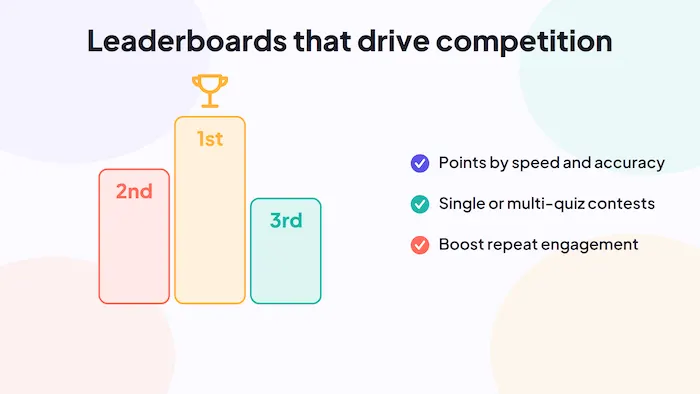
- Connect any quiz, poll, or score predictor to a leaderboard and you turn a single play into an ongoing competition.
- Run a “Quiz of the day” or a season-long predictor, and people return again and again to improve their rank. We dug into why this works in our post on the power of leaderboards for retention.
- Automated contests can open, run, close, pick winners, and email every entrant without anyone touching them again, which combines data capture, sponsorship, and monetization in one campaign.
BuzzFeed has none of this.
Turning content into revenue
For publishers and media brands, interactive content needs to earn its place, not just collect data. This is a distinct gap between the two tools.
With Riddle you can:
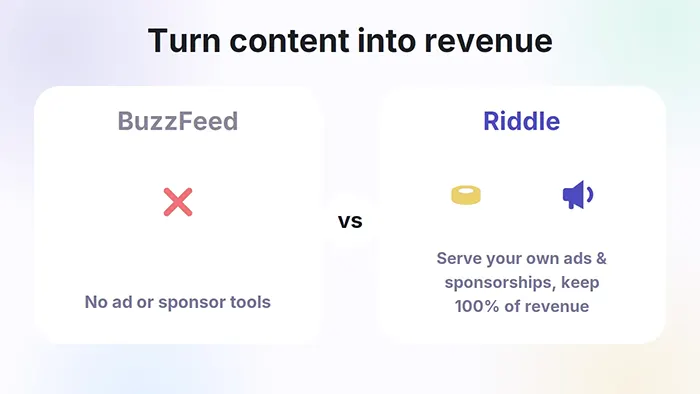
- Serve your own ads and sponsorship units inside quizzes, polls, and games, and keep all of that revenue
- Refresh the ads around the embedded interactive content as people play, for more impressions
- Sell fully branded sponsored formats, contests, and leaderboards without any development work
- Read our free detailed white paper: “The Publisher’s Guide to Content Monetization with Interactive Content”
Publishers already do this at scale. Swiss news brand 20 Minuten turns Riddle content into measurable ad revenue, and sports-media group Minute Media sells sponsored quizzes to its brand partners.
BuzzFeed offers no native ad or sponsorship tools at all.
Branding and white label
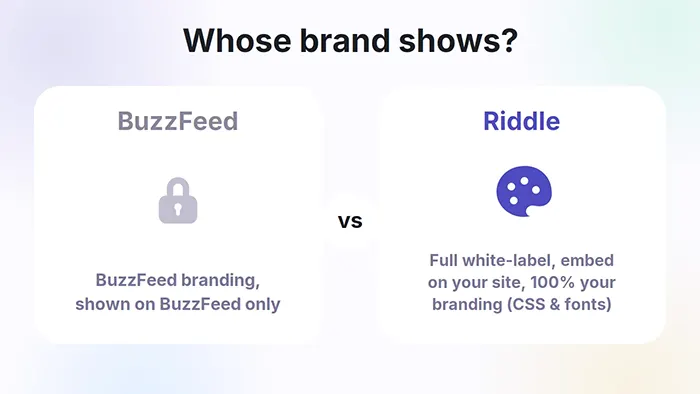
Another quick one. Riddle is fully white-label:
- Hide our branding and add your own logo
- Control the look with custom fonts and a CSS editor
- Embed the finished piece anywhere on your own site
A BuzzFeed quiz is a BuzzFeed-branded experience, and it lives on BuzzFeed. You cannot embed it on your own site or have it in your own branding, which is a dealbreaker for most businesses.
Data privacy and GDPR
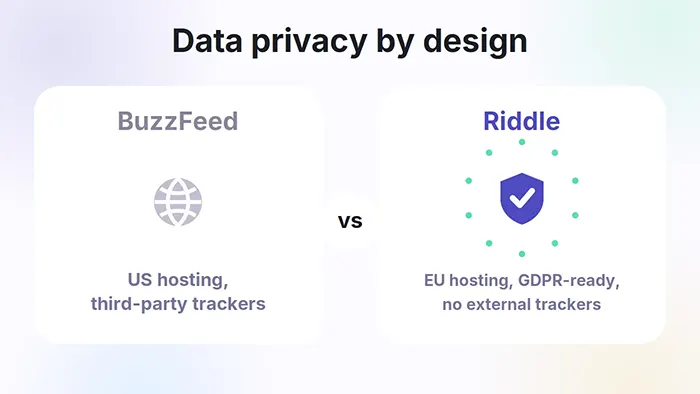
If you work under GDPR or similar rules, where your data lives matters.
- Riddle hosts all data in the EU.
- It avoids third-party trackers and external scripts, which keeps compliance straightforward as you scale.
- For more, see our guide to GDPR-safe interactive content.
Free consumer quiz tools rarely offer the same. Data handling tends to sit outside your control, which adds review steps for any team with real privacy requirements.
Riddle vs BuzzFeed pricing
BuzzFeed’s quiz tools are free, which suits casual consumer use. Riddle is a paid platform built for business, with flat-rate plans and no usage caps, so a viral quiz never triggers a surprise bill:
- Pro at $119 per month. All content formats, unlimited content, views, and responses, plus white-label branding, custom logo, and AI creation.
- Business at $349 per month. Everything in Pro, plus custom CSS and fonts, the Stats and Builder API, MP4 uploads, and advanced tracking (Google Tag Manager, Analytics, Matomo, and custom scripts).
- Enterprise at $749 per month. Everything in Business, plus programmatic ads, season-wide and multi-quiz leaderboards, custom roles, SSO, a Looker Studio connector, and custom media libraries.
Every plan includes unlimited content, views, and leads, with a 14-day full-featured free trial and no credit card required.
BuzzFeed vs Riddle: the features that matter
| Feature | BuzzFeed | Riddle |
|---|---|---|
| Content formats | ~7 | 35+ |
| Combine formats in one experience | No | Yes |
| AI content creation (from a topic or URL) | No | Yes |
| Content automation and scheduled rotation | No | Yes |
| API access (build content, pull stats) | No | Yes |
| Leaderboards and season-long competitions | No | Yes |
| Score predictors and prediction games | No | Yes |
| Mini-games (crosswords, sudoku) | No | Yes |
| Branching and conditional logic | No | Yes |
| Personality tests | Basic, fixed results | Weighted scoring |
| Lead generation forms, CRM, and webhooks | No | Yes |
| Embed on your own site | No | Yes |
| White-label branding (logo, fonts, CSS) | No | Yes |
| Ad serving and sponsorships | No | Yes |
| Video, audio, and GIFs | Images only | Yes |
| Custom result pages and CTAs | No | Yes |
| Analytics and stats dashboard | Limited | Detailed + Looker Studio integration |
| EU hosting, GDPR-compliant, no third-party trackers | No | Yes – EU-based, 100% GDPR-compliant |
| Multi-user team features | No | Yes |
| Customer support | No | Yes, on all plans |
Riddle is the best alternative Buzzfeed – a summary
Every quiz maker is different – with their strengths and specialties, just like your business. You’ll want to evaluate Buzzfeed and Riddle – and decide which suits your needs best.
But our takeaway? Buzzfeed has justifiably made a name for itself as a rapid, easy-to-create quiz creator – designed for consumers. It hasn’t really evolved over the past few years – as Buzzfeed is now a news and media business.
As such, it lacks many of the critical features marketers require of a quiz maker – including white labelling, lead generation, and extensive customization options.
If you’re looking for a flexible, powerful lead generation and engagement platform, you should check out Riddle. Free 14 day trial – all features unlocked (and no credit card required).
Related quiz maker comparisons
Frequently asked questions
Is Riddle a good alternative to BuzzFeed quizzes?
Yes. BuzzFeed’s quiz tools are built for consumers and have limited business features, while Riddle is a quiz maker built for publishers, brands, and media companies, with white-label branding, GDPR-compliant lead generation, and a platform that keeps adding formats.
How many quiz formats do BuzzFeed and Riddle offer?
BuzzFeed offers around seven formats, including personality tests and checklists. Riddle offers 35+ interactive formats, including quizzes, polls, surveys, predictors, leaderboards, and mini-games.
What is the best free alternative to BuzzFeed for quizzes?
Riddle is the best alternative to BuzzFeed for business use, and it offers a 14-day full-featured free trial with no credit card required. Unlike BuzzFeed’s free consumer tools, Riddle adds white-label branding, lead generation, leaderboards, and monetization.
Does BuzzFeed offer lead generation?
No. BuzzFeed quizzes have no lead-generation capabilities. Riddle was designed around it, so you can add an opt-in form and send all leads and quiz data to your marketing software.
Can I monetize quizzes with BuzzFeed or Riddle?
Riddle lets you serve your own ads and sponsorships inside quizzes and games and keep the revenue. BuzzFeed has no native ad or sponsorship tools.
What is the difference between BuzzFeed and Riddle?
BuzzFeed is a media company that offers free consumer quiz tools as a side feature, and in 2026 it moved further toward AI and streaming after its sale to Byron Allen. Riddle is a dedicated business quiz maker focused on engagement, lead generation, retention, monetization, and data collection.
Is Riddle GDPR-compliant, unlike free quiz tools?
Yes. Riddle hosts all data in the EU, avoids third-party trackers, and supports consent-based lead capture, which free consumer quiz tools like BuzzFeed’s typically do not.
Can I run leaderboards and contests to boost retention?
Yes. Riddle lets you connect quizzes and score predictors to leaderboards and run automated contests, which bring people back to improve their rank and support data capture, sponsorship, and monetization. BuzzFeed has no equivalent.