Everything your quiz contest needs – content creation, entry verification, winner selection, and follow-up emails – handled automatically.
Running a quiz contest used to mean late nights, spreadsheets, and a lot of crossed fingers that nothing went wrong. Someone had to build the entry form, write the rules, schedule the launch, monitor submissions, chase down fraudulent entries, pick a winner, send the emails, and make sure it all held up legally. That’s a full project in itself – and it’s a project that has to be done again from scratch every single time.
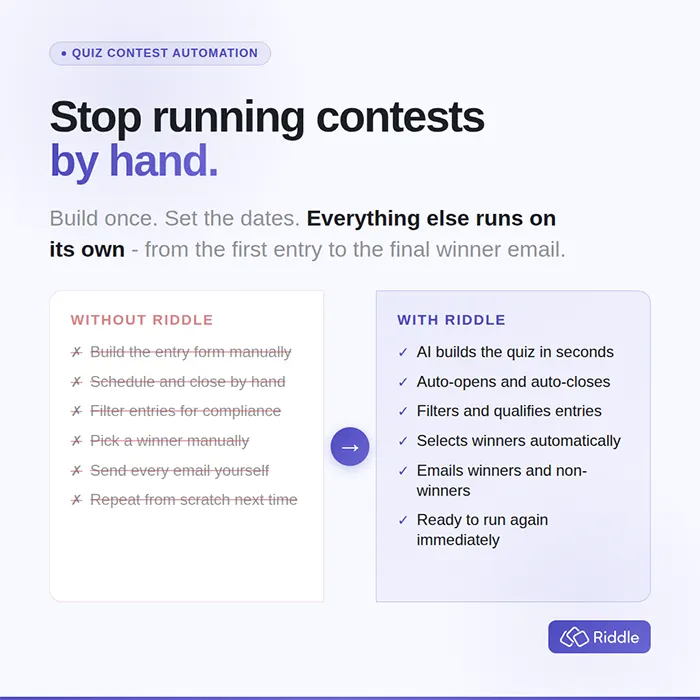
An automated quiz contest changes that. With Riddle’s quiz maker, you can build, launch, and close an online quiz contest with no manual effort – content creation, entry validation, security checks, winner selection, and personalised email delivery to every entrant all run on their own, from start to finish.
For publishers running quiz contests on behalf of sponsors, brands running giveaways to generate leads, or sports teams looking to reward and grow their fan bases, that matters. The idea is easy. Getting it done without burning hours is the hard part.
Here’s how automated quiz contests work in practice – and why publishers, brands, and sports clubs are making them a regular part of their engagement and sponsorship mix.
The hidden cost of running a quiz contest manually
Before getting into what Riddle does, it’s worth being specific about the problem. Most quiz contest workflows involve more manual effort than anyone would like to admit:
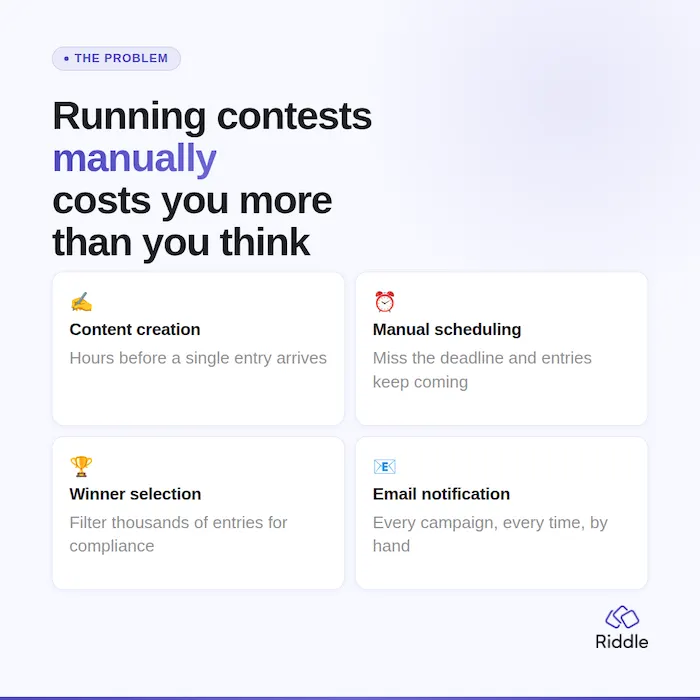
- Content creation – writing quiz questions, setting up an entry form, checking legal requirements – takes hours before a single entry comes in
- Scheduling means someone has to remember to take the contest offline when it closes. If they forget, entries keep coming in after the deadline, which creates fairness and compliance problems
- Winner selection from thousands of entries requires filtering for legitimate submissions, documenting the process, and being able to demonstrate it was fair
- Email notification – telling winners how to claim their prize, informing unsuccessful entrants, adding promotional offers for the sponsor – all done manually, one campaign at a time
None of these steps are complicated on their own, but together they add up. And the more successful your contest is, the worse it gets. Fifty thousand entries is a great result – and a genuine headache for whoever has to process them.
Who runs quiz contests – and why
The quiz contest use case spans three distinct groups, all with the same underlying problem: running contests takes too much time for what it delivers.
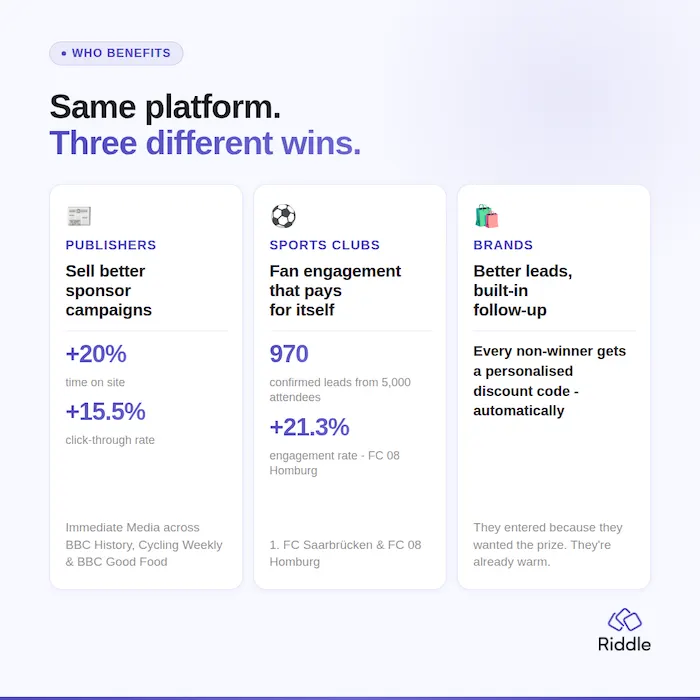
Publishers and sponsors
Publishers like Immediate Media – one of the UK’s largest magazine publishers, covering titles from BBC History Magazine to Radio Times Weekly – run contests extensively across their portfolio.
Quizzes and contests sit at the centre of their engagement strategy with Riddle, helping them grow time on site by 20% (view case study), collect first-party data, and give commercial partners something concrete to point to. Riddle’s interactive content platform gives their teams the tools to run these campaigns without the editorial overhead that manual contest management demands.
For any media publisher, the key selling point to a sponsor is simple: your brand sits inside an interactive experience that generates qualified leads, with a verified, compliant entry list and automated reporting. That’s a much stronger proposition than a standard display ad placement.
Sports clubs and leagues
Sports teams occupy a particularly interesting position. They have passionate, highly engaged fan bases, rich historical content to draw on for quiz questions, and strong relationships with kit suppliers, sponsors, and local businesses who want access to that audience.
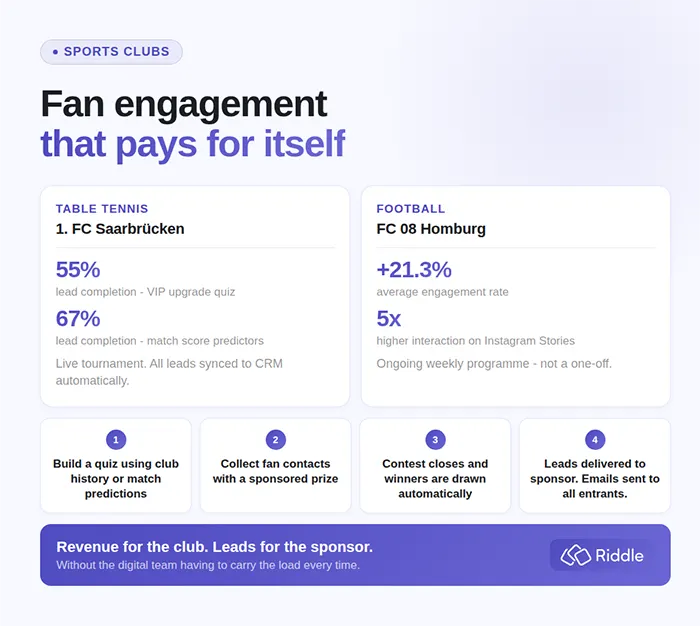
Two Riddle case studies show how this plays out across different formats and sports.
At the European Table Tennis Champions League Final Four, 1. FC Saarbrücken ran quiz contests and score predictors across a two-day live tournament. With prizes including VIP lounge upgrades, signed shirts, and home game tickets, the club collected double opt-in confirmed leads from attendees. Lead completion rates hit 55% on the VIP upgrade quiz and 67% on match score predictors – all syncing directly to the club’s CRM.
German football club FC 08 Homburg shows what the same approach looks like as an ongoing programme. Using Riddle quizzes, score predictors, and newsletter sign-up forms as a regular part of their fan engagement, the club saw a 21.3% increase in average engagement rate, a 19.73% newsletter sign-up rate from quiz takers, and a 5x higher interaction rate on Instagram Stories compared to standard content.
The mechanics work the same way for any sports club:
- Create a quiz contest using club history, player stats, or match predictions
- Attach a lead generation form to collect fan contact details and marketing consent
- Run it as a sponsored contest – local businesses or club partners provide the prize in exchange for brand exposure and access to collected leads
- Set it to close automatically after a defined period, select winners, and send personalised emails to all entrants
The result is a sponsored activation that generates revenue for the club, engages the fan base, and hands the sponsor a verified, consent-compliant lead list – without the club’s digital team having to carry the load every time.
Brands running their own giveaways
For brands running quiz contests directly, the same logic applies – but the stakes around lead quality and post-entry follow-up tend to be even higher. Every contest entry is a person who put their hand up because they want what you’re offering. The contest qualifies that intent and kicks off the follow-up automatically.
Build your quiz contest in minutes
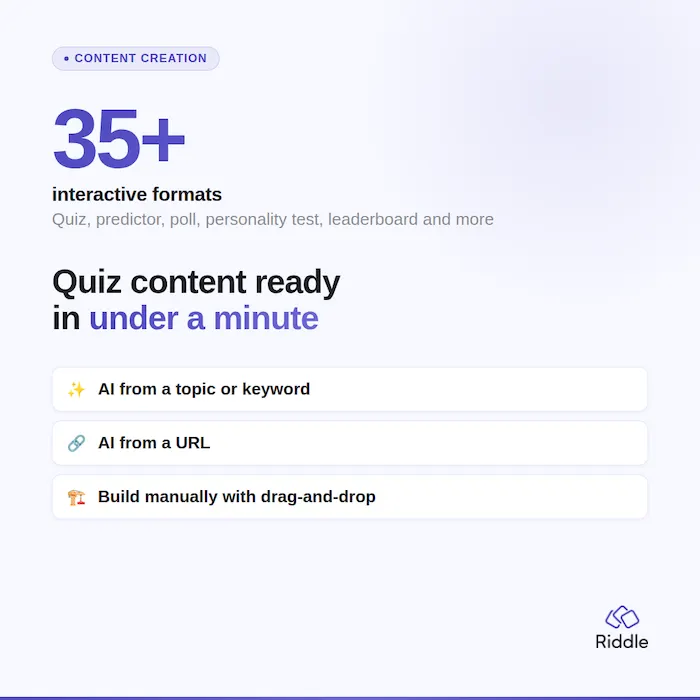
The starting point with Riddle is content creation. The platform offers more than 35 interactive content formats, which means your quiz contest can take almost any shape:
- A trivia quiz testing audience knowledge of your brand, sport, or editorial topic
- A score predictor inviting fans to call the result of an upcoming fixture
- A personality test matching entrants to a product, character, or outcome
- Mini-games like crosswords, sudoku, and more
- A poll, survey, or leaderboard challenge
If you need to move quickly – for a news publisher covering a live event, a sports club promoting a weekend fixture, or a brand with a short campaign window – Riddle’s AI content creator can generate a fully formed quiz, poll, or other content from a single topic or article URL. Type in a subject and you’ll have a complete quiz with questions, answer options, and result logic in under a minute. Your team can then review and edit before publishing, keeping editorial control without any of the build time.
If you already have content elsewhere – an article, a product page, a match preview – you can paste the URL directly into Riddle and the AI will scan the page and build related quiz content from it automatically.
For clubs or publishers working with consistent themes, Riddle’s question bank lets you save, organise, and reuse your best questions across multiple contests. For a football club, that might mean a bank of club trivia questions that gets refreshed season by season. For a publisher, it’s a library of topic-specific content – you can automatically show a new set of questions every hour, day, or week for constantly refreshed content (with no editorial involvement).
Entry forms, age checks, and compliance built-in
Every quiz or interactive format in Riddle can include a lead generation form, and the form builder gives you genuine flexibility around what you collect and how. For contest entries, that typically includes some combination of:
- Name and email address as a minimum
- Date of birth for age verification – relevant for alcohol brands, gambling promotions, and children’s content
- A checkbox confirming the entrant has read the terms and conditions
- Consent to receive marketing communications from the sponsor or organiser
- Location fields if the contest is restricted by country or region
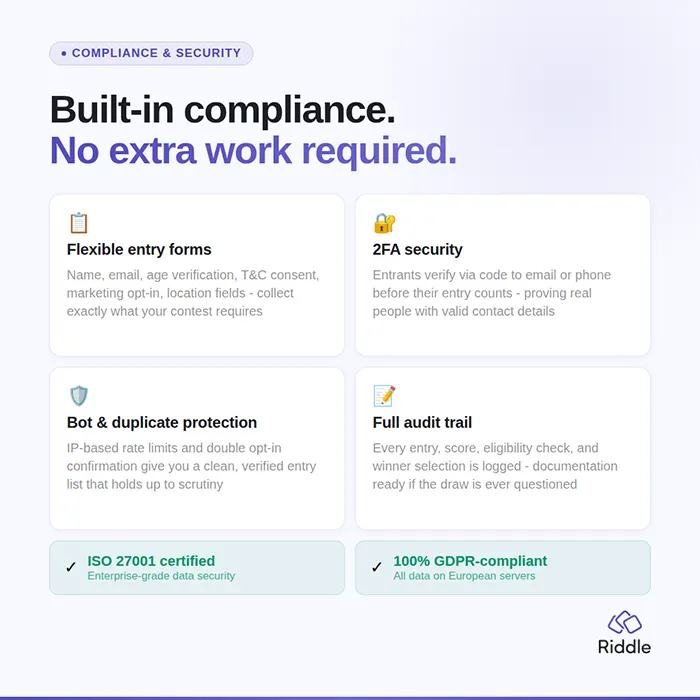
For higher-stakes contests where entry integrity matters, Riddle offers extensive security settings – including 2FA (two-factor authentication). Entrants verify their identity via a security code sent to their email or phone before their submission is counted. This matters for sponsors who need to show that entries came from real people with valid contact details, and for publishers who need to demonstrate compliance with competition rules.
On top of that, Riddle includes bot and duplicate entry protection. IP-based limits restrict the number of submissions from a single address over a given time period, cutting out automated spam entries. Combined with double opt-in email confirmation, these features give you a clean, verified entry list that holds up to scrutiny.
Riddle is ISO 27001 certified and 100% GDPR-compliant, with all data stored and processed on European servers. For publishers and brands running contests that collect personal data, that removes a significant compliance question before it gets asked.
Every entry – and every response – goes straight to your CRM
Every quiz contest entry collected through Riddle – including each entrant’s answers, score, form responses, and contact details – can be sent automatically to whatever system your team already uses for follow-up marketing and outreach.
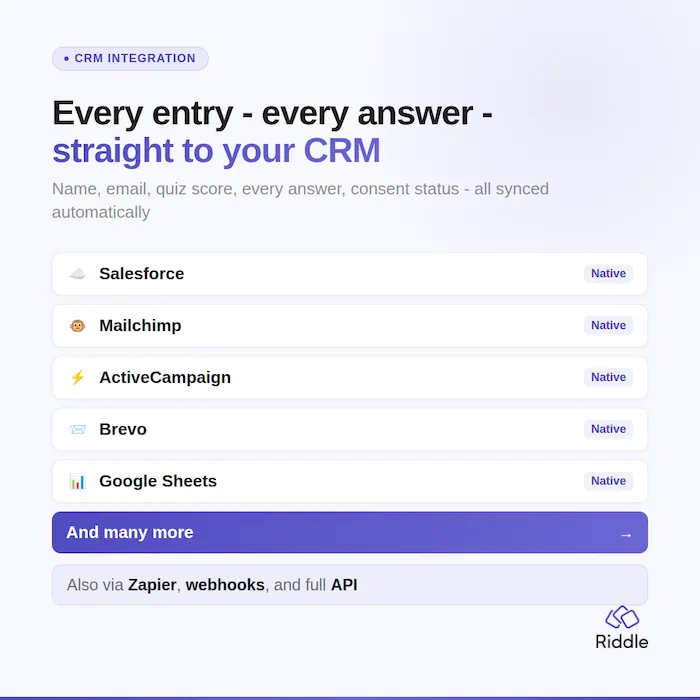
Riddle has native integrations with the most widely used platforms, including:
- Salesforce – entries flow directly into your CRM as leads or contacts, in real time
- Mailchimp – entrants are added to lists or audiences automatically, tagged by quiz result or score if needed
- Google Sheets – every entry lands in a live spreadsheet, updated as submissions come in
- And many more
If your stack isn’t on that list, Riddle also connects via Zapier, webhook, and a full API – which means it can push data to virtually any CRM, CDP, or marketing automation platform without custom development.
What makes this particularly useful for quiz contests is that you’re not just capturing an email address. You’re capturing how someone answered every question – their preferences, their knowledge level, what they selected when given a choice.
For a sports club, that might be a fan’s favourite player or their preferred seat category. For a brand, it might be which product they said they were considering. All of that response data travels with the entry into your CRM, ready to be used for segmented, personalised follow-up rather than a generic broadcast.
Schedule your quiz contest to start and close automatically
This is where the automation really earns its keep. Once your quiz contest is built and ready:
- Set a start date and time – the quiz contest goes live automatically, no one needs to be at a desk
- Set a close date and time – entries stop being accepted at the specified moment
- The quiz contest goes offline automatically when it closes – no open submissions sitting around after the deadline, no team member having to remember to switch it off on a Friday night
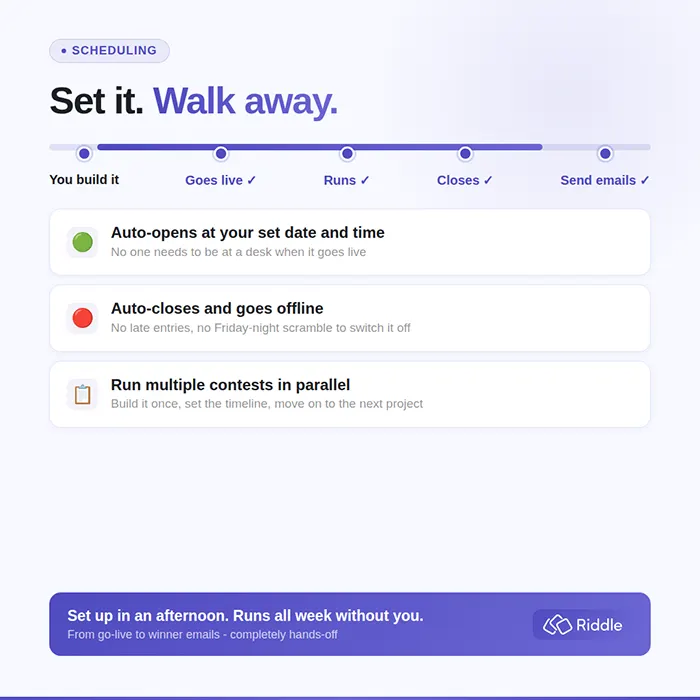
For publishers managing multiple campaigns at once – often several sponsor quiz contests running in parallel – this scheduling removes an entire layer of operational overhead. Build it once, set the timeline, and move on to the next project.
For sports clubs, it’s just as valuable.
A pre-match quiz contest that runs from Monday to Saturday and closes an hour before kick-off, with three winners drawn from qualifying entries and emails sent automatically – that entire workflow can be set up in an afternoon and runs without any further involvement from the club’s digital team.
Selecting quiz contest winners – your criteria, your rules
Not every entry should be treated equally. Riddle’s pick a winner feature lets you set specific eligibility criteria that determine which entries qualify for the quiz contest prize draw.
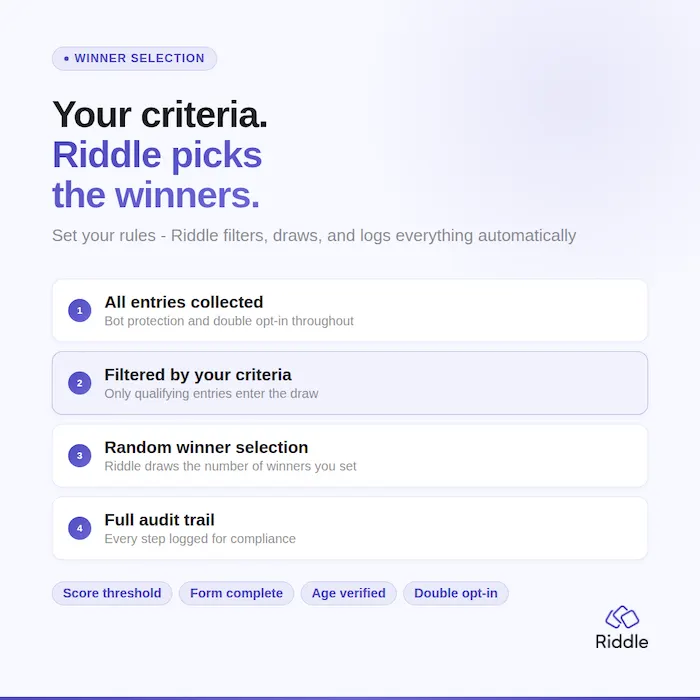
You can filter for:
- Entrants who scored above a certain threshold – for example, 80% or higher on a product knowledge quiz
- Entries where the form is fully completed, including all required fields
- Submissions verified via double opt-in email confirmation
- Any combination of the above – a quiz score floor, a completed form, and marketing consent ticked
Only entries that meet all the defined criteria enter the draw. From that qualifying pool, Riddle randomly selects the number of winners you specify. If 10,000 people enter and 400 of them meet the criteria, but you only want three winners, Riddle selects three at random from those 400.
Critically, Riddle creates a full audit trail throughout this process. Every step – who entered, when, what score they received, whether they met the criteria, and how the winner was selected – is logged and available. For promotions that need to demonstrate legal compliance, that documentation is already there without any additional work.
Quiz contest emails – including the ones that actually make money
Most people think of winner notification as the email component of a contest. That misses the bigger opportunity.
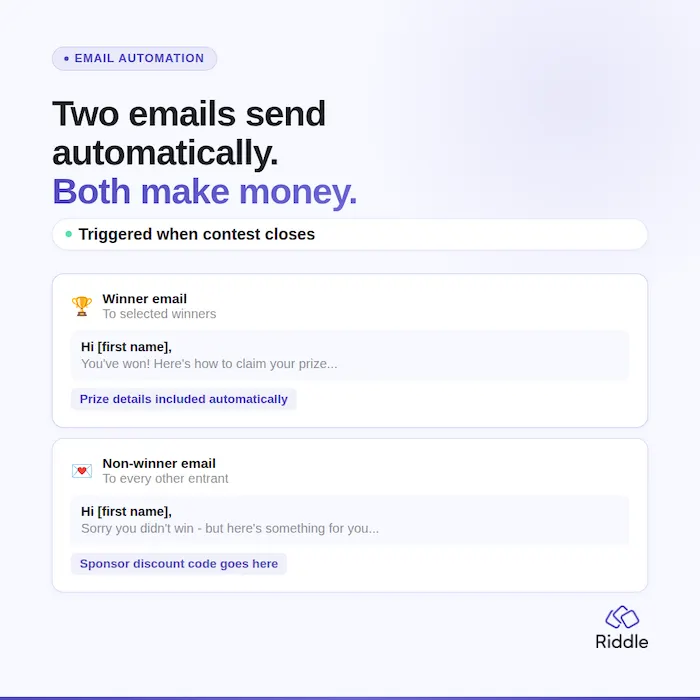
Riddle’s automated email system triggers at the close of the contest based on the outcome for each entrant:
- Winners receive a personalised email with their prize details – how to claim, what they’ve won, any steps they need to take – automatically, using the name and contact details captured in the entry form
- Unsuccessful entrants receive a separate personalised email, triggered at the same moment (e.g. ‘Sorry, you didn’t win – but here is a discount code’)
That second email is, commercially speaking, just as important as the first.
Think about who’s in that group. Everyone who entered gave you their name and contact details and worked through an interactive experience because they wanted the prize. They’ve already shown they’re interested in the brand, the product, or the topic. Not winning doesn’t change that.
A well-crafted losing email turns that a potentially disappointed audience into a commercial opportunity. The sponsor can include a personalised discount code – something along the lines of: “Hi [first name], you didn’t win this time, but here’s 15% off your first order.” That message goes to everyone who entered and didn’t win, automatically, with the first name pulled directly from the entry form.
For sports clubs, the same logic applies. Entrants who didn’t win can receive an email with a discounted tickets to the next home game, or an exclusive offer on club merchandise. That post-contest email sequence is a genuine commercial deliverable for the club’s sponsors – not just a courtesy message.
A quiz contest from start to finish – how it looks in practice
It helps to see a quiz contest as a complete workflow rather than a list of features.
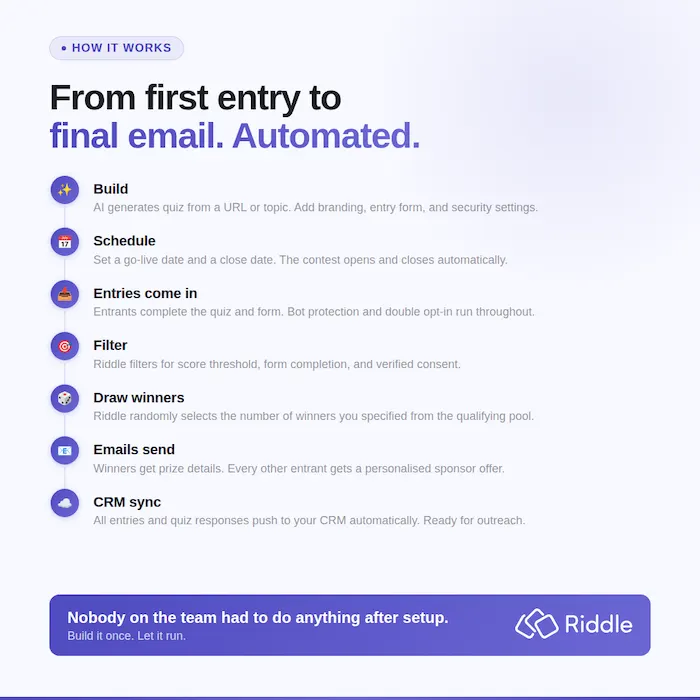
Let’s walk through an example. Imagine a publisher is running a sponsored quiz contest for an automotive brand tied to a major motorsport event. The prize is a pair of tickets to a race.
- The publisher’s team uses Riddle’s AI to generate a motorsport trivia quiz from the event’s website. They edit the questions, add the sponsor’s branding, and attach an entry form requesting name, email, date of birth, and marketing consent.
- Double opt-in is enabled to verify email addresses. Bot protection and IP-rate limiting are set.
- The contest is scheduled to automatically go live three weeks before the event and close 48 hours before ticket allocation is required.
- Over the contest period, 19,758 people enter. After filtering, 5,843 qualify based on minimum score, form completion, and confirmed consent.
- Riddle randomly selects two winners from those 5,843 qualified entrants at the scheduled close time. The contest goes offline automatically.
- All entries – including every quiz answer and form response – are pushed to the sponsor’s CRM via Riddle’s Salesforce native integration, ready for post-campaign outreach.
- Winners receive personalised prize claim emails. The remaining 19,756 ‘didn’t win’ entrants receive a personalised email from the sponsor with a discount code on branded merchandise.
The critical takeaway? No one on the publisher’s team had to do anything after the contest was scheduled. From first entry to final email, it was completely automated.
How long should a quiz contest run – and what results to expect
One question comes up more than any other: how long should a quiz contest stay open? Here’s how to think about duration, timing, and the results to plan for.
How long to run it
- One to two weeks is the sweet spot for most publishers and brands.
- Under five days cuts off entries before word of mouth kicks in.
- Over three weeks and urgency fades, so daily entries flatten out.
- Tied to an event – a match day, product launch, or seasonal campaign – match the close date to that moment rather than stretching it out. You can set open and close times under your timer and general settings.
When entries actually happen
- Entries cluster in the first 48 hours and again in the final 48 before closing.
- A reminder email near the deadline often recovers a meaningful share of people who started but did not finish.
- Recurring formats behave differently – our score predictor whitepaper shows steady daily returns rather than a single day-one spike. The same is true for mini-games and leaderboards.
Benchmarks to plan against
Based on how Riddle contests typically perform, realistic targets are:
- Lead form completion: 30 to 50 percent of quiz takers complete the native entry form – well above the 1 to 3 percent typical of standalone landing pages. Some campaigns go higher, with opt-in rates up to 41 percent.
- Newsletter opt-in: sports and media clients regularly see rates near 20 percent, as FC 08 Homburg did at 19.73 percent.
- Time on site: Immediate Media grew it by 20 percent using Riddle quizzes.
- Gated completion: 1. FC Saarbrücken Tischtennis reached 55 to 67 percent completion on lead-gated quizzes and predictors at a live event (case study).
Your own numbers will vary by audience, prize, and placement, but these give you a baseline to measure against rather than guessing.
Tips to protect those results
- Keep the quiz short – five to eight questions is enough to qualify an entrant without losing them.
- Ask only for the data you will actually use, since every extra form field lowers completion.
- Decide winner criteria and eligibility rules before you launch. Our guides on running an online raffle and legal templates for contests walk through a clean, compliant draw.
Set the duration, schedule the reminders, and let the automation handle the rest.
Run your first automated quiz contest with Riddle
Contests don’t fail because of budget, or strategy, or a shortage of good prizes. They fail because someone has to do the work – and the moment a team looks at what’s involved, the idea gets pushed to next quarter.
The actual effort of running a contest properly isn’t enormous. But the anticipated effort is. That’s what kills it.
Riddle changes that calculation. When the overhead disappears, running a contest stops feeling like a project and starts feeling like a Tuesday morning task. From the first entry to the final winner email, with Riddle’s enterprise-grade quiz maker, the whole process runs on its own.
Try Riddle free and build your first automated quiz contest today.
Quiz contest FAQ
What is an automated quiz contest?
An automated quiz contest is an online quiz contest that runs from launch to completion without requiring manual intervention. Using a platform like Riddle, you can schedule the quiz contest to start and close at specific times, automatically filter and qualify entries based on defined criteria, select winners at random from eligible entrants, and send personalised emails to both winners and unsuccessful participants – all without anyone needing to be actively involved at each stage.
How do I make sure a quiz contest is legally compliant?
Riddle’s entry forms support T&C acceptance, marketing consent, and age verification. Two-factor authentication confirms entries come from real individuals, IP-based limits and double opt-in block duplicates and fraud, and the audit trail logs every submission, score, and selection decision – documentation that holds up to scrutiny.
Can I embed a quiz contest on my website?
Yes. Riddle embeds into any website, CMS, or app with a single code snippet, inheriting your branding through Riddle’s customisation tools. White-label support keeps sponsored contests on-brand for both publisher and sponsor. The embed placeholder auto-replaces or takes the contest offline at close date without any page edits.
How do quiz contests help with lead generation?
30-50% of Riddle quiz takers complete the native lead form – well above pop-up benchmarks – because they’re already engaged and motivated by the prize. All entry data, including quiz responses and zero-party preferences, syncs directly to your CRM or marketing platform via native integrations, Zapier, API, or webhooks.
What’s the best way to follow up with quiz contest entrants?
Automate both sides. Winners get prize details immediately when the contest closes. Non-winners – the majority of your list, and already engaged – get a personalised email with a discount code or offer. Riddle uses first name and form data from each entry to personalise at scale, with no manual sending.
How do I prevent cheating or bot entries in a quiz contest?
Riddle combines IP-based rate limiting, double opt-in email confirmation, and optional two-factor authentication to block bulk and fraudulent entries. Eligibility criteria – such as a minimum quiz score – add a further filter, ensuring the qualifying pool reflects genuine participants.
Can I automate winner selection in a quiz contest?
Yes. Riddle filters all entries against your eligibility criteria at close – minimum score, form completion, verified email, or any combination – then randomly selects the number of winners you specified. The full selection process is logged with an audit trail you can produce if the draw is ever questioned.
How do I create an online quiz contest?
Choose a content format from Riddle’s 35+ options, then build questions manually or generate them with AI from a topic or URL. Add a lead form with any consent or age verification fields needed, configure your eligibility criteria and winner settings, set your dates, and publish. Everything from there runs automatically.