Riddle vs Opinion Stage (2026): Quiz Maker Platforms for Different Levels of Scale
In 2026, choosing a quiz platform is no longer just about creating quizzes. For many organizations, quiz makers have evolved into interactive content platforms that support engagement, first-party data collection, and long-term audience strategy.
Opinion Stage and Riddle are often evaluated together because both support polls and surveys. In practice, they are designed for very different operating environments.
- Opinion Stage emphasizes speed and simplicity for teams that need a lightweight quiz maker.
- Riddle’s quiz maker is built for larger organizations that treat quizzes and interactive content as a scalable, governed channel integrated into editorial, marketing, and data workflows.
Rather than comparing individual quiz features in isolation, this article examines how each quiz maker fits into real publishing, media, and brand environments, and where those differences begin to matter as usage grows.
How Each Quiz Maker Is Intended to Be Used
Opinion Stage and Lightweight Quiz Creation
Opinion Stage is optimized for teams that want to introduce quizzes and polls quickly without building long-term infrastructure. Its workflow prioritizes accessibility, templates, and minimal configuration, allowing users to publish interactive content with very little setup.
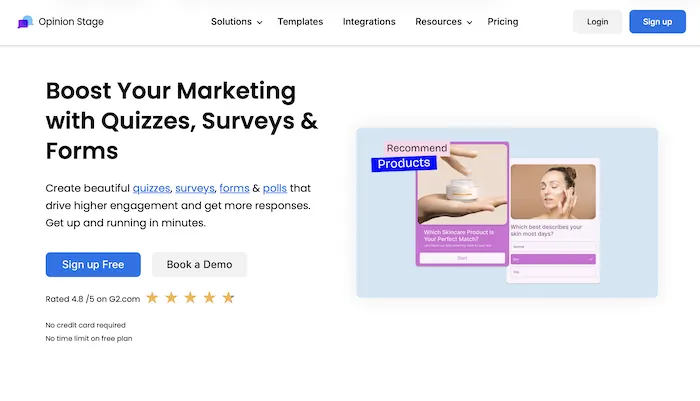
This makes Opinion Stage a practical quiz maker for:
- Small marketing teams
- Individual creators
- Organizations running occasional engagement or feedback campaigns
- Use cases where quizzes complement existing content rather than anchor it
The platform assumes that quizzes will be created intermittently and managed by a limited number of users.
Riddle and Quiz Makers at Scale
Riddle is designed around a different assumption. It treats the quiz maker as part of a broader interactive content system rather than a standalone tool. The platform is built for environments where quizzes, mini-games, and other interactive content formats are created frequently, by multiple teams, and across multiple sites or brands.
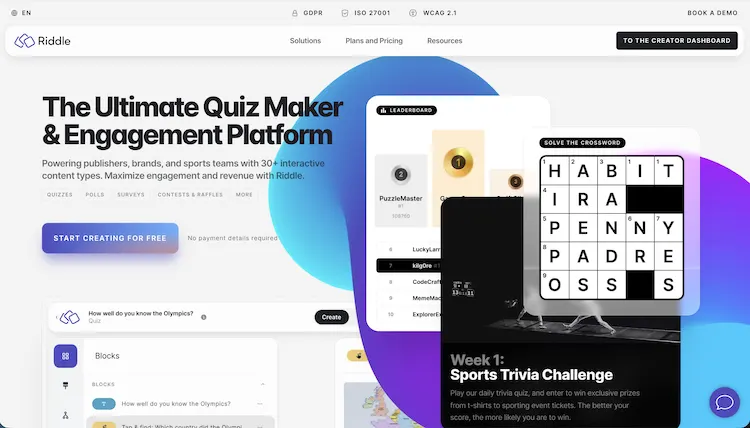
As a result, Riddle emphasizes:
- 35+ repeatable quiz formats rather than one-off projects
- Governance and consistency rather than manual configuration
- Integration with CRM, analytics, and publishing systems
- Scalability across traffic spikes and long-running campaigns
For publishers, media companies, and consumer brands, this approach aligns with how interactive content is used over time.
Read the full ‘Ultimate Quiz Maker Comparison (2026)’.
Riddle vs Opinion Stage at a Glance
Opinion Stage and Riddle both support quiz creation, but they are built with different use cases in mind. Opinion Stage is geared toward straightforward engagement and feedback, while Riddle is designed as a scalable interactive content platform for publishers, media companies, and brands.
The table below outlines how the two platforms compare across key areas.
| Category | Riddle | Opinion Stage |
|---|---|---|
| Primary focus | Scalable interactive content for large organizations | Lightweight interactive content and feedback |
| Typical users | Publishers, media companies, consumer brands, enterprises | Marketers, small teams, SMBs |
| Quiz maker role | Interactive content infrastructure | Standalone quiz maker |
| Supported formats | 35+ formats including quizzes, polls, leaderboards, mini-games | Quizzes, surveys, polls, forms |
| Usage limits | Unlimited content, views, and leads | Tiered plans with usage limits |
| Traffic handling | Designed for high and unpredictable traffic | Suited to predictable, lower-volume traffic |
| Collaboration | Multi-user workspaces with granular roles | Basic collaboration for small teams |
| Governance and brand control | Global presets, project templates, enforced branding | Template-based customization |
| Customization depth | Full CSS editor, custom fonts, project presets | Limited visual editor and layout controls, plus CSS editor |
| Automation | API builder, APIs, webhooks, automated publishing | Manual workflows, limited automation |
| AI capabilities | AI combined with automation and APIs | AI-assisted quiz and question creation |
| Data and analytics | Stats API, Looker Studio, advanced tracking integrations | Built-in dashboards and exports |
| CRM and marketing integration | Designed for CRM, CDP, and data warehouse workflows | Integrations for common marketing tools |
| Monetization | Built-in ad slots with full revenue control | Not supported |
| GDPR and data governance | EU-based infrastructure, no third-party trackers | GDPR-compliant configuration |
| Best fit when | Interactive content is a core, ongoing channel | Interactive content is used occasionally |
Quiz Maker Formats and Engagement Scope
Opinion Stage focuses on a core set of just four content formats, including quizzes, surveys, polls, and forms. These formats are fairly flexible and cover many common engagement scenarios such as feedback collection, lead capture, and audience insights.
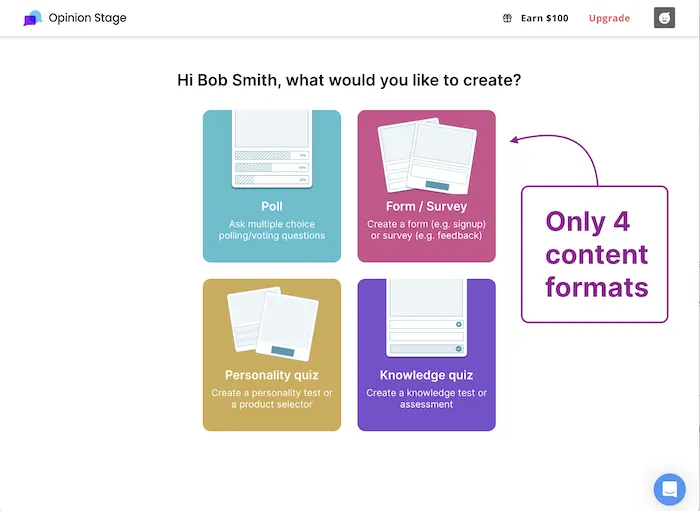
Riddle supports these same core quiz formats, but extends further into engagement models designed to encourage repeat visits and ongoing participation. These include:
- Leaderboards and score-based challenges
- Prediction games and competitions
- Automated contests
- Mini-games and recurring quiz formats
- Ranked and conditional quiz experiences
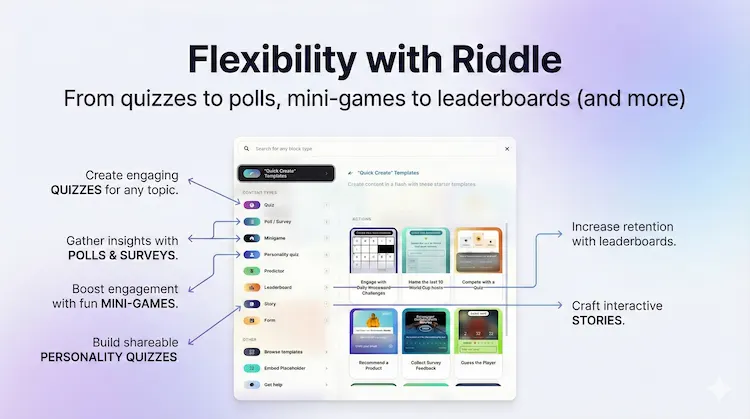
This broader scope allows organizations to move beyond single interactions and toward quiz-driven programs that support loyalty, retention, and audience growth.
While both platforms are commonly described as quiz makers, the role they play differs significantly. Opinion Stage functions primarily as a quiz maker for quick engagement and feedback. Riddle extends the quiz maker concept into a broader interactive content system designed for repeat use and scale.
Customization, Collaboation, and Brand Control
For smaller teams, quiz maker customization typically means adjusting colors, logos, and layouts. Opinion Stage provides visual templates and basic design controls that support this level of branding and work well for single-brand environments.
The overall set of design elements is limited – just six (background, buttons, fonts, etc.), although it does include a CSS editor with the more expensive plans.
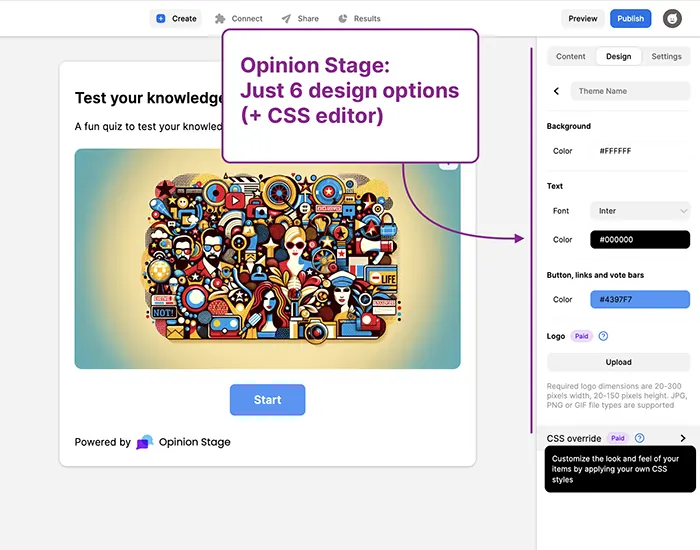
As organizations grow, customization requirements change. Maintaining consistency across dozens or hundreds of quizzes becomes less about individual design choices and more about system-level enforcement.
Riddle addresses this through:
- 60+ customization features – from fonts to hover states, buttons to backgrouhnd
- CSS editor – designers can customize any element to seamlessly match their site
- Custom font support – upload your own or use Adobe or Google Font libaries, as well 100+ built-in fonts
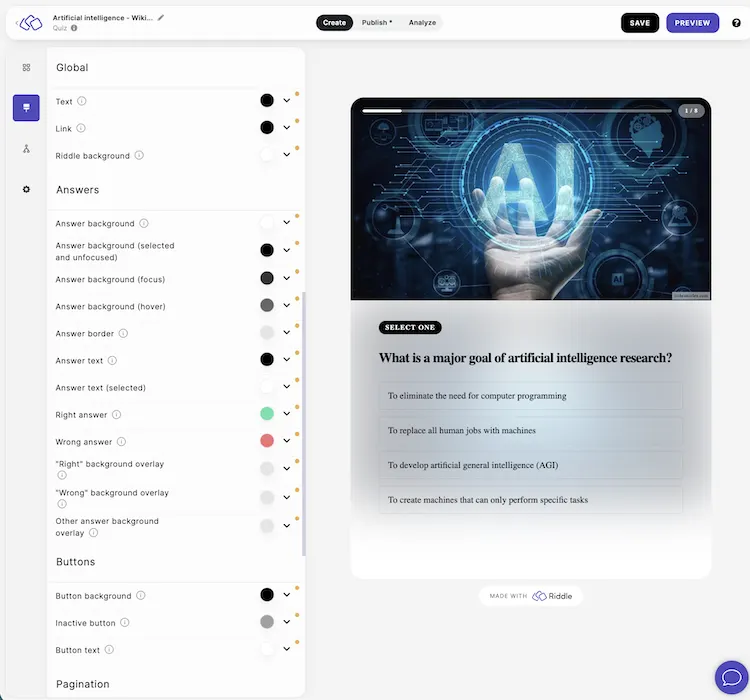
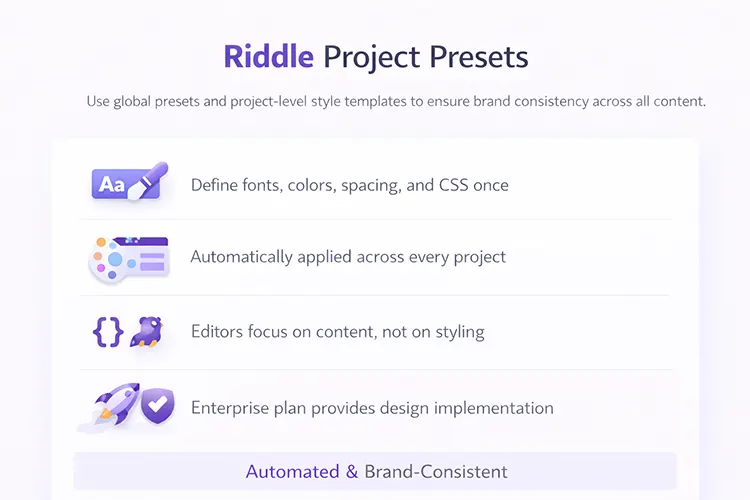
Riddle includes governance features designed to balance editorial freedom with brand consistency. In environments where dozens or even hundreds of users create interactive content, it becomes critical to ensure that individual creativity does not undermine broader brand standards.
Key governance capabilities include:
- Custom user roles – with highly granular permissions, covering everything from visual design controls to access to data collection and tracking settings
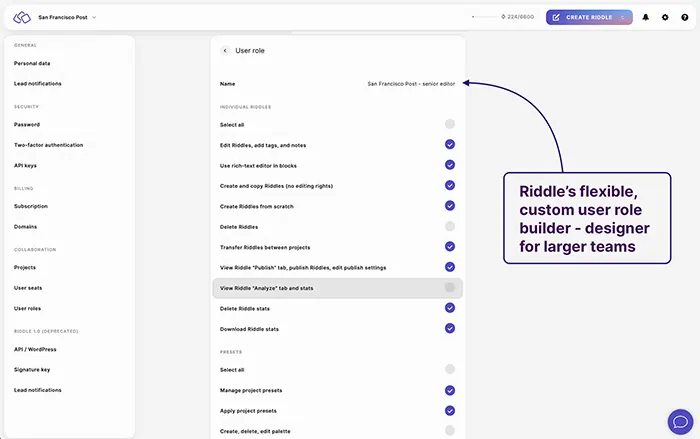
- Project presets – that automatically apply approved branding, layouts, and design elements
- Global publishing settings – that standardize lead generation, data collection, tracking, and embed behavior across all content
Together, these controls allow teams to create confidently while giving administrators the oversight needed to maintain consistency, compliance, and operational efficiency at scale.
Automation, AI, APIs, and Webhooks
Opinion Stage includes AI-assisted quiz creation tools that help users generate questions or quizzes from prompts and templates. These features are useful for ideation and speeding up one-off quiz creation, especially for smaller teams producing content occasionally.
The platform also has a basic API for displaying quizzes and collecting responses but it does not include any sophisticated ‘build’ capabilities to facilitate automatic content creation.
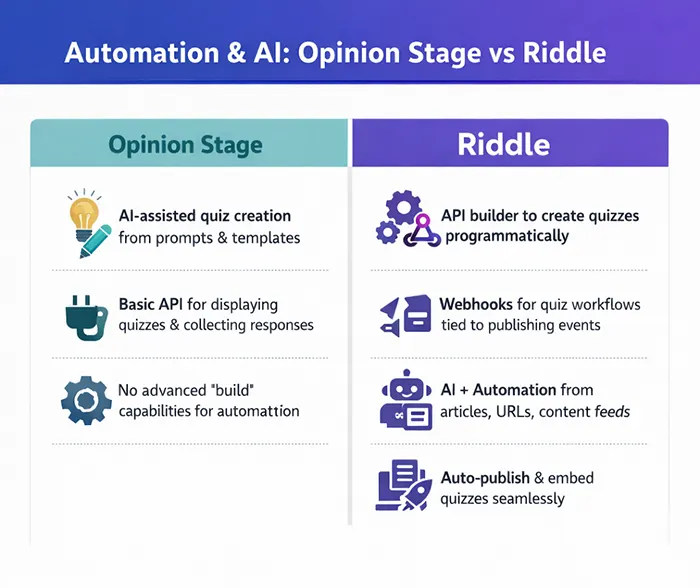
Riddle approaches content automation and AI from an operational perspective. Rather than treating AI as a standalone helper, Riddle integrates AI directly into its automation layer through a combination of APIs, webhooks, and an API-based content builder.
With Riddle, organizations can:
- Use the API builder to programmatically create quizzes and interactive content
- Trigger quiz creation workflows using webhooks tied to publishing or CMS events
- Combine AI with automation to generate quizzes from topics, articles, URLs, or structured content feeds
- Create content in Claude and other AI tools – with Riddle’s MCP connector
- Automatically publish and embed new quizzes without manual intervention (learn more)
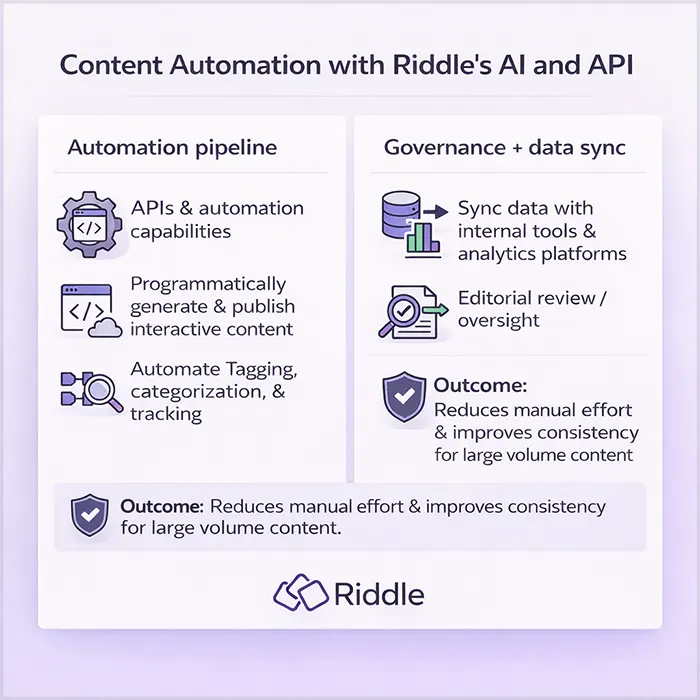
This allows publishers and media companies to synchronize quiz creation with editorial output. Interactive content can be generated, updated, and deployed as part of an automated pipeline rather than a manual task.
As interactive programs mature, the difference between AI-assisted creation and API-driven automation becomes more pronounced. The former speeds up individual tasks, while the latter enables organizations to scale reliably across teams and sites.
Monetization and Sponsored Content
For publishers and media companies, interactive content is not only an engagement tool but also a potential revenue channel. How a quiz maker supports monetization can influence whether interactive formats scale sustainably.
Opinion Stage is primarily designed for engagement, feedback, and lead capture. While it works well for collecting insights or qualifying leads, it does not include native features for monetizing quizzes through advertising or sponsorships. Any monetization typically happens outside the interactive experience itself.
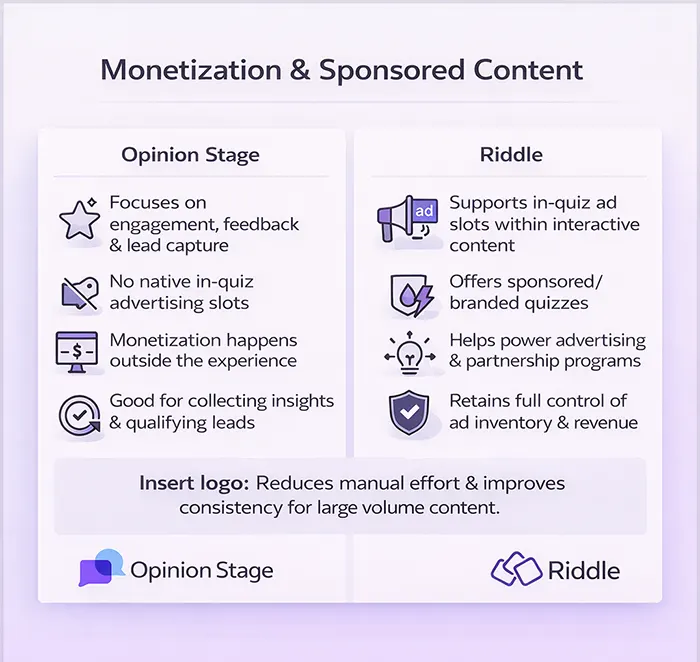
Riddle is built to support monetization directly within interactive content. Organizations can:
- Insert in-quiz advertising slots within quizzes and other formats
- Run sponsored quizzes or branded interactive experiences
- Use interactive content as part of broader advertising and partnership programs
- Retain full control over ad inventory and revenue, rather than sharing it with a platform
This approach allows publishers and brands to treat quizzes and interactive formats as monetizable editorial assets, similar to other content types. Over time, this makes it easier to justify investment in interactive content as part of a long-term engagement and revenue strategy, rather than as a one-off campaign tool.
See how publishers are monetizing interactive content with Riddle in this free white paper, “The Publisher’s Guide to Content Monetization with Interactive Content”.
Data, Analytics, and Integration
Opinion Stage provides built-in dashboards that track quiz responses, completion rates, and engagement trends. For many teams, these insights are sufficient to evaluate individual campaigns.
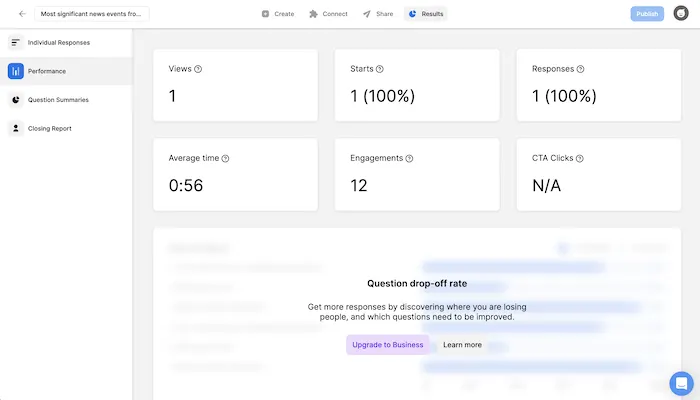
Riddle is designed to integrate quiz data into broader analytics and reporting environments. Capabilities include:
- A flexible statistics API for custom reporting and internal dashboards
- Google Looker Studio integration for advanced visualization
- Support for advanced tracking via Google Tag Manager, Matomo, Adobe Analytics, and many other enterprise-grade platforms
- Data layer support – to integrate data inside any Riddle content (tracking, personalization, and more)
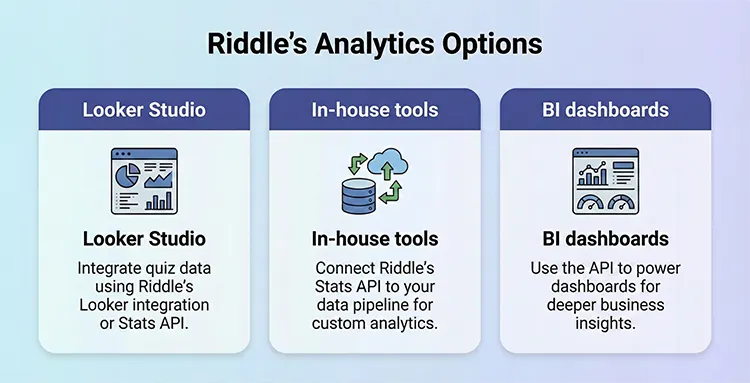
This allows quiz engagement data to be analyzed alongside subscriptions, conversions, ad performance, and audience growth metrics.
Pricing Models and Risk at Scale
Pricing models often reflect how a quiz maker is expected to be used.
Opinion Stage uses tiered pricing with limits on responses and features. This approach aligns with predictable usage and controlled engagement volumes.
Riddle removes usage caps entirely. Unlimited quizzes, views, leads, and domains reduce uncertainty for publishers and brands operating in high-traffic environments or running long-term quiz programs.
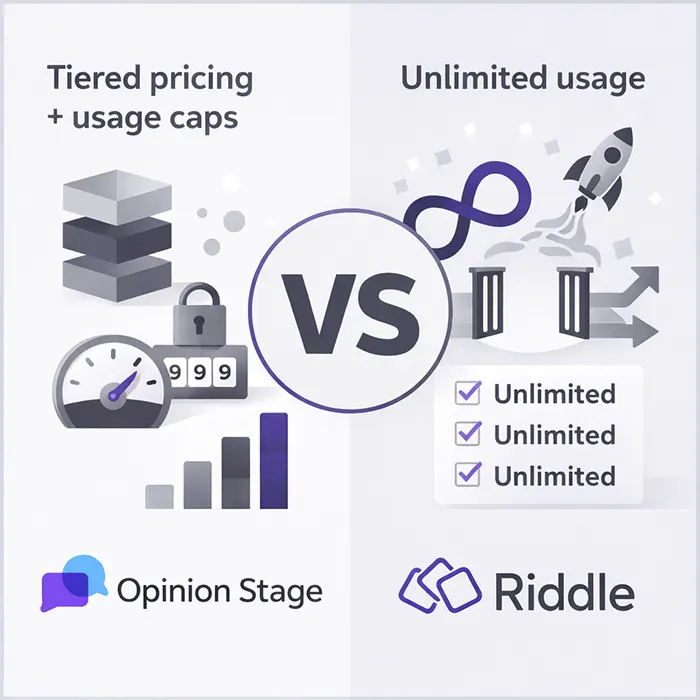
The distinction here is less about cost and more about managing operational risk as engagement grows.
Accessibility and GDPR Considerations
Both platforms support responsive, embeddable quiz content that can be configured to meet accessibility standards. For small projects, accessibility compliance often depends on careful setup at the individual quiz level.
Riddle is WCAG 2.1 compliant, a key requirement in 2026. Its structured formats and centralized presets make it easier to maintain consistent accessibility practices across large quiz libraries, particularly for publishers and public-facing organizations operating in the EU and UK.
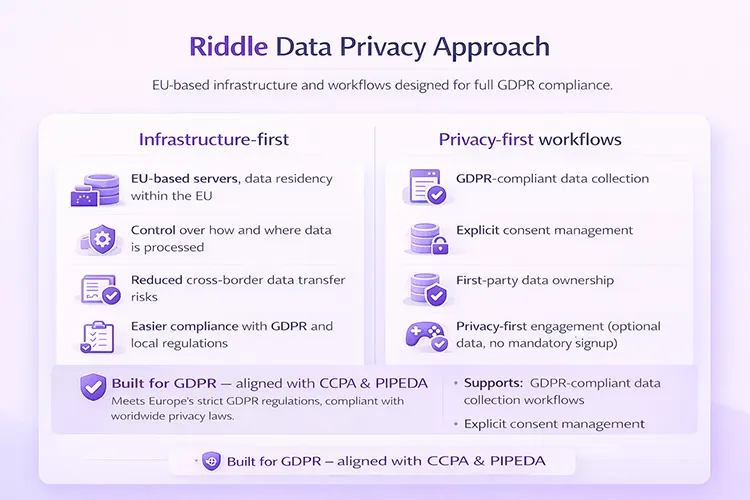
From a privacy perspective, Riddle is built with GDPR and data sovereignty as core principles. Its approach includes:
- EU-based infrastructure and data processing
- No cloud servers – all operation is on Riddle-owned servers
- No reliance on third-party trackers
- Clear ownership and control of first-party quiz data
Combined with centralized governance and tracking controls, this simplifies compliance for organizations collecting large volumes of interaction data across multiple sites and regions.
Opinion Stage supports GDPR compliance as well, but platform-level governance and enforcement options are more limited in complex environments.
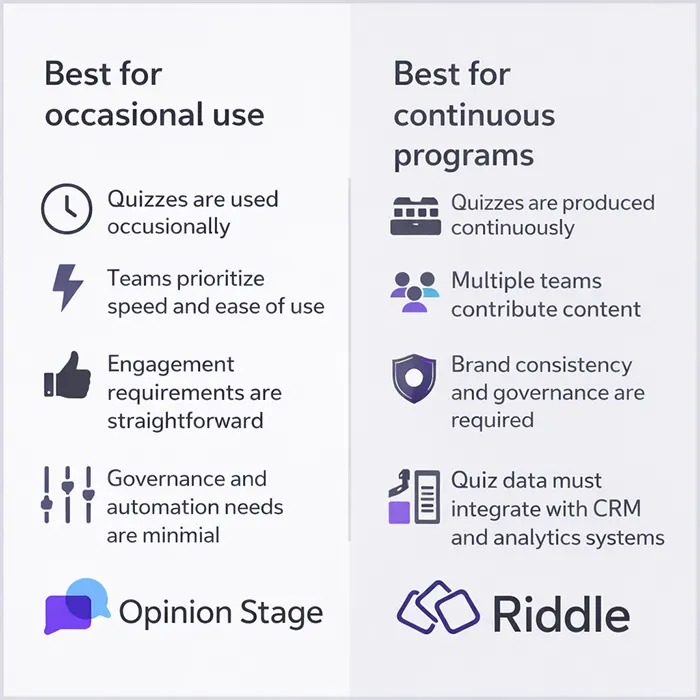
Choosing the Right Quiz Maker for Your Organization
Opinion Stage makes sense when:
- Quizzes are used occasionally
- Teams prioritize speed and ease of use
- Engagement requirements are straightforward
- Governance and automation needs are minimal
Riddle is more relevant when:
- Quizzes are produced continuously
- Multiple teams contribute content
- Brand consistency and governance are required
- Quiz data must integrate with CRM and analytics systems
Final Perspective
Opinion Stage and Riddle represent two different approaches to what an online quiz maker can be in 2026.
Opinion Stage works well as a lightweight quiz builder for teams that need fast interactive content. It is a good fit for marketers, small businesses, and creators who want to launch quizzes and polls without a steep learning curve.
Riddle is built for larger organizations that use quiz makers as part of an ongoing engagement and data strategy – especially those using AI-assisted content automation to scale interactivity without adding editorial resources. It also drives revenue – publishers can serve their own ads inside quizzes and mini-games, plus give commercial teams everything they need to create branded content for sponsors.
For publishers, media companies, and brands, the deciding factor is rarely how quickly a quiz can be created. It is whether the quiz maker can scale across teams, integrate with existing systems, and support consistent engagement over time.
In that context, Riddle functions less as a standalone quiz maker and more as interactive content infrastructure built to grow with organizational needs.
Related quiz maker comparisons
- Qzzr – focused on small companies and individual contributors
- ScoreApp – personal assessments and analysis to qualify and engage potential leads
- TryInteract – good entry-level quiz builder and other formats for infrequent interactive content creation needs.
What is Opinion Stage used for?
Opinion Stage is commonly used as a quiz maker for creating quizzes, polls, and surveys quickly, especially by small teams and marketers.
How does Riddle differ from Opinion Stage as a quiz maker?
Riddle is designed for scale, with stronger governance, automation, API access, and integration capabilities. Opinion Stage focuses on simplicity and fast quiz creation.
Which quiz maker is better for publishers?
Publishers with high traffic and ongoing quiz programs typically benefit more from Riddle’s unlimited usage, collaboration features, and analytics integration.
Does Opinion Stage and Riddle include AI for quiz creation?
Yes. Both Opinion Stage and Riddle include AI tools that assist with generating quiz questions and templates.
Can quiz data be integrated with CRM systems?
Opinion Stage and Riddle both offer native integrations for CRMs, while Riddle also supports marketing automation integration through APIs, webhooks, and connectors.
How do pricing models compare?
Opinion Stage uses tiered pricing with usage limits. Riddle removes usage caps, which is important for unpredictable traffic and long-running quiz campaigns.