
Riddle vs Genially: Which Interactive Content Platform Is Better for Enterprises, Media, and Brands? (2026)
Interactive formats are increasingly shaping how organizations capture attention and sustain audience engagement online. Quizzes, games, interactive visuals, and participatory experiences help increase time on site, encourage repeat visits, and generate valuable first-party data at a time when traditional tracking methods are becoming less reliable.
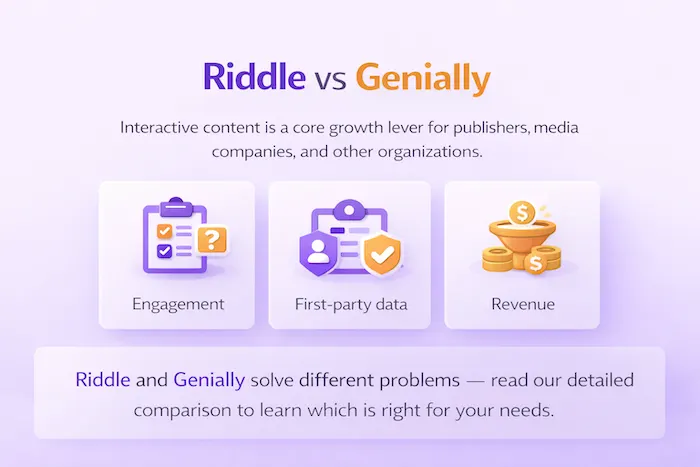
Two platforms often considered in this space are Riddle and Genially. While both support interactive experiences, they are built for very different operating models. Genially focuses on visually rich, design-led interactivity, while Riddle is designed as an enterprise-grade interactive content platform optimized for engagement, data, and scale.
This comparison examines how Riddle and Genially differ in 2026 across formats, accessibility, collaboration, monetization, automation, integrations, pricing, GDPR and privacy, and long-term suitability for large organizations such as publishers, media companies, brands, and sports teams.
Read the full ‘Ultimate Quiz Maker Comparison (2026)’.
Riddle vs Genially at a Glance in 2026
| Area | Riddle | Genially |
|---|---|---|
| Core focus | Scalable interactive content and data capture | Visual-first interactive design |
| Formats | 35+ formats including quizzes, leaderboards, and games | Interactive presentations and visual experiences |
| Enterprise readiness | Built for large teams and high traffic | Better suited for small, design-led teams |
| Accessibility | Lightweight, embeddable experiences | Strong visual accessibility focus |
| Monetization | Lead capture, sponsorships, ads, first-party data | Indirect, campaign-based |
| Automation & API | Full API and automation support | No public API |
| Integrations | Marketing, CRM, data platforms | Primarily LMS integrations |
| Collaboration | Granular roles, shared workspaces, global presets | Basic team collaboration |
| Pricing | Unlimited traffic and usage | Tiered by features and access |
| GDPR & privacy | EU-based, own servers, no third-party trackers | GDPR support via embeds and integrations |
The Role of Interactive Content in Modern Digital Strategy
Interactive experiences pull users in instead of letting them scroll past. Strong quizzes, games, and interactive elements keep people on site longer, help build habits, and provide insight into audience interests and behavior.
For publishers and media companies, interactive formats often support retention and loyalty. For brands and sports teams, they can drive fan engagement, lead generation, and personalization. Whether a platform can support these use cases at scale depends heavily on how it handles traffic, governance, automation, and data.
Platform Positioning and Core Philosophy
Riddle’s Platform-First Approach
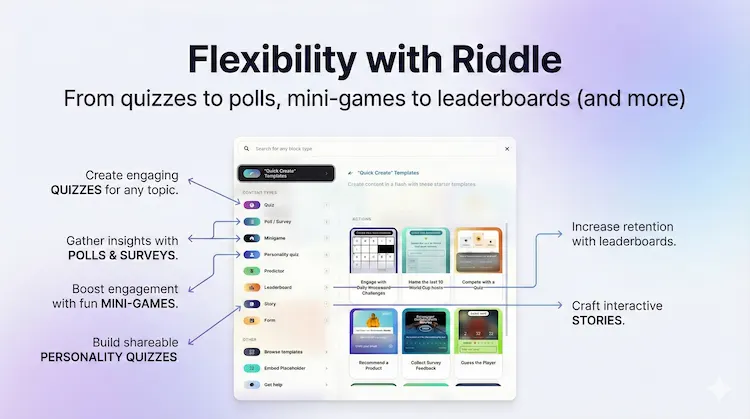
Riddle’s quiz maker is built as a full interactive content platform, not a single-purpose design tool. It supports 35+ interactive formats, including quizzes, personality tests, polls, surveys, prediction games, rankings, leaderboards, and mini-games.
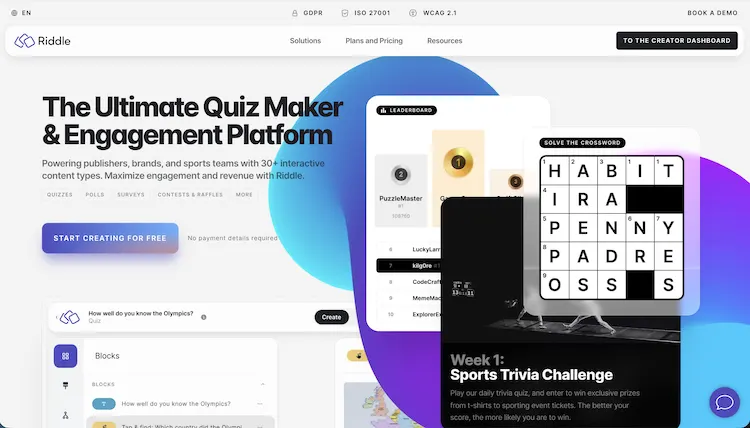
These formats are designed to embed directly into websites and apps, making Riddle especially suitable for organizations that publish interactive content frequently and want engagement tied to measurable outcomes such as subscriptions, advertising performance, or audience growth.
Genially’s Visual-First Approach
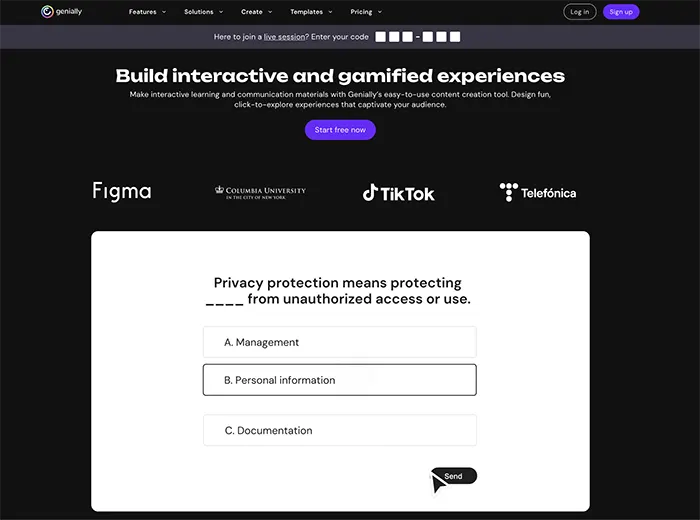
Genially positions itself as a tool for creating interactive visual content. Its strengths lie in animations, interactive presentations, infographics, and storytelling experiences with layered interactions and clickable elements.
This makes Genially appealing for education, internal communications, and design-heavy marketing projects where visual presentation is the primary objective.
Content Formats and Engagement Depth
Riddle’s Format Breadth
With more than 35 formats available, Riddle enables teams to experiment with quizzes, trivia, polls, leaderboards, and game-like experiences – no coding required. wMini-games and leaderboard-driven interactions are particularly effective for driving repeat visits and high time on site with relatively low production effort.
A clear example of this engagement style is Wordle at The New York Times, which shows how simple mechanics can drive daily habits and long-term audience loyalty.
Riddle also features interactive graphics (e.g. ‘Which New York neighborhood should you visit?’) – designed to make stand-alone graphics more engaging and compelling. Editors and journalists can add images with hot spots, letting the user click on anything that seems interesting to learn more.
Genially’s Interactive Design Model
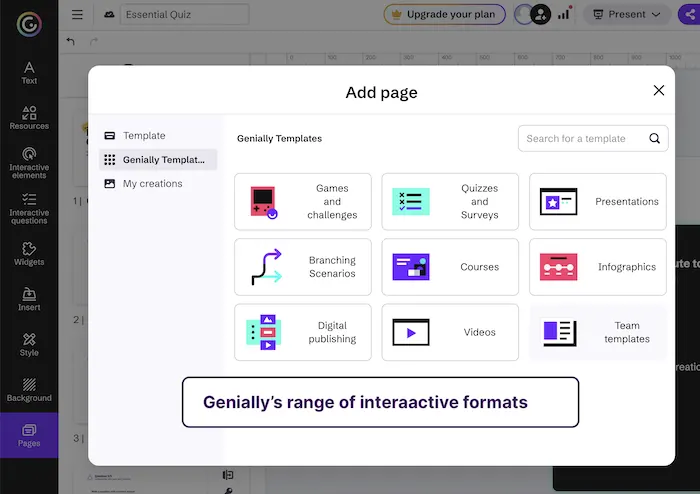
Genially does not offer a broad library of distinct engagement formats. Instead, teams typically build detailed, interactive presentations or visuals and layer in interactivity (such as games including hangman, escape rooms, and more).
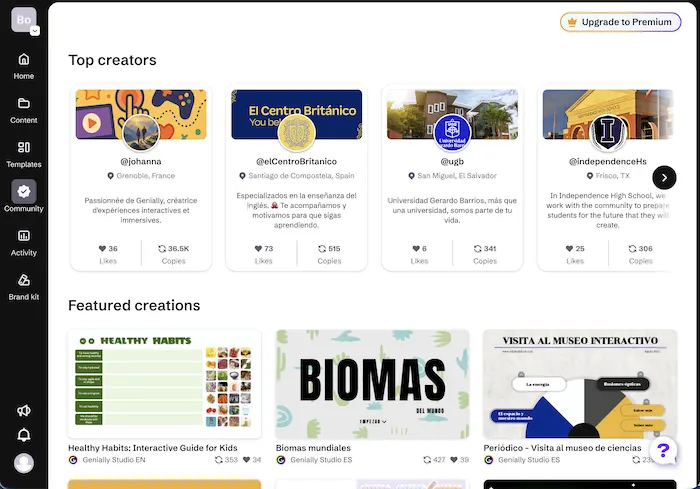
It is unique in offering a template marketplace – where creators can make and sell templates of interactive experiences. This could be a good time-saver for new users or busy agencies.
This approach works well for bespoke storytelling, but it is less optimized for repeatable, high-volume engagement formats such as daily quizzes or games.
Accessibility and Cross-Platform Delivery
Accessibility is a core requirement for organizations operating in the EU and UK, especially publishers, public-facing brands, and organizations expected to align with WCAG 2.1 and related accessibility standards. Interactive content must work reliably with assistive technologies, keyboard navigation, and screen readers, not just look good visually.
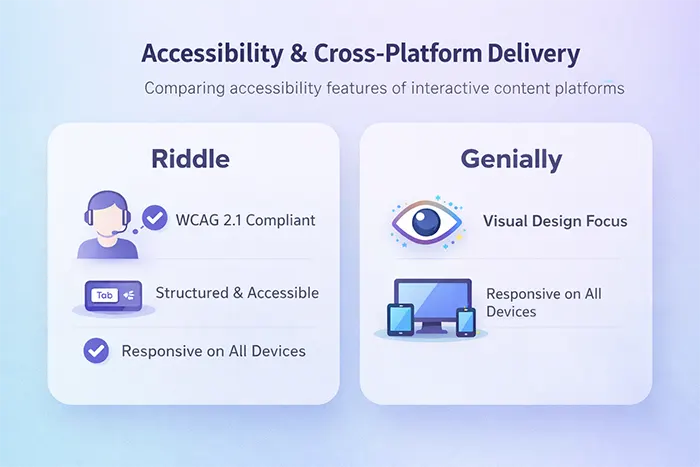
Genially focuses primarily on visual accessibility and responsive design:
- Interactive content adapts across desktop, tablet, and mobile devices
- Design tools support visually engaging layouts and animations
- Accessibility outcomes can vary depending on how individual projects are built
- Animation-heavy or highly customized designs may require additional effort to ensure consistent accessibility compliance
This makes Genially well suited for smaller sets of visually rich projects, where accessibility can be reviewed and managed on a case-by-case basis.
Riddle is an accessible interactive content platform (following the WCAG 2.1 standard, and is designed around structured, lightweight interactive components that are easier to standardize at scale:
- Embeddable content integrates directly into existing, accessibility-compliant pages
- Consistent semantic structure supports screen readers and assistive technologies
- Keyboard navigation can be applied uniformly across formats
- Centralized templates and presets help maintain accessibility standards across large content libraries
This approach is particularly valuable for publishers, media companies, and brands that need to meet accessibility requirements across hundreds or thousands of pages without introducing complex design dependencies.
Data Collection, Analytics, and Insights
Riddle’s analytics are built to show how audiences actually engage with interactive content, especially at scale. Rather than focusing only on surface-level views, Riddle helps teams understand participation, behavior, and performance across formats and sites.
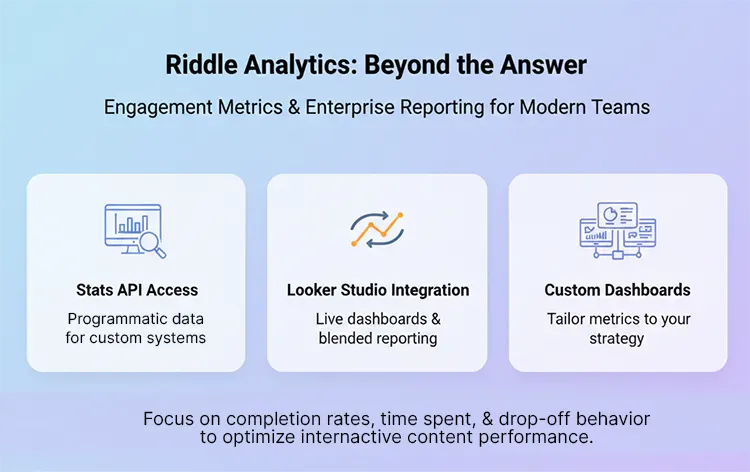
With Riddle, teams can track:
- Quiz and interaction starts and completions
- Drop-off points within content
- Engagement trends across formats and pages
- Lead capture performance tied to specific interactions
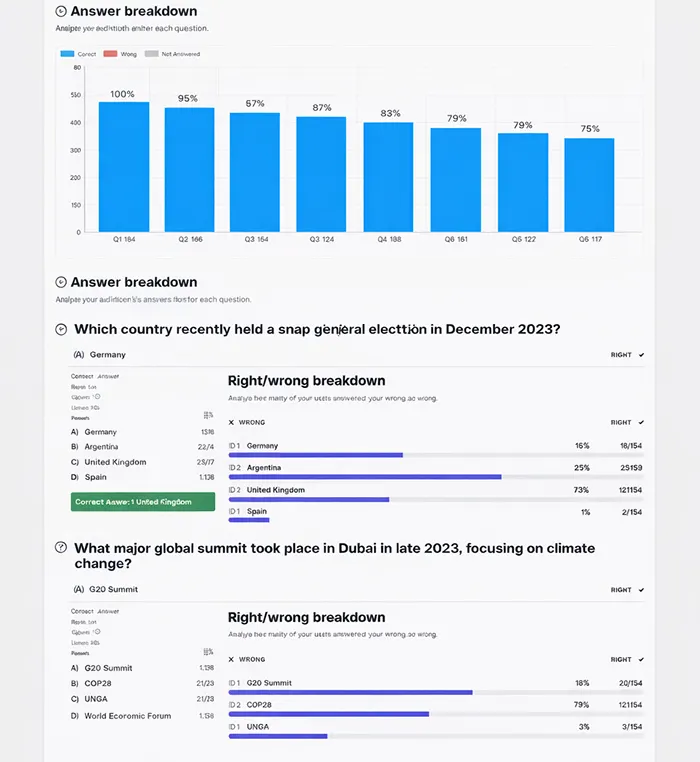
Because this data is collected as first-party data, it can be used directly to inform marketing, subscription, and advertising strategies. Publishers and brands can identify which formats perform best, where users disengage, and how interactive content contributes to broader business goals.
For organizations that need deeper reporting, Riddle also supports:
- Looker Studio integration, allowing teams to visualize engagement data alongside other business metrics
- A robust Stats API, which enables programmatic access to interaction data for custom dashboards, internal reporting, or data warehouse ingestion
These capabilities make Riddle well suited for enterprises, publishers, and media companies that want interactive content data to flow into existing analytics and BI environments.
Genially provides analytics focused on interaction within individual visual assets rather than cross-site or funnel-level performance. Its analytics typically include:
- Views and basic interaction counts
- Click activity within presentations or interactive graphics
- Time spent engaging with a visual experience
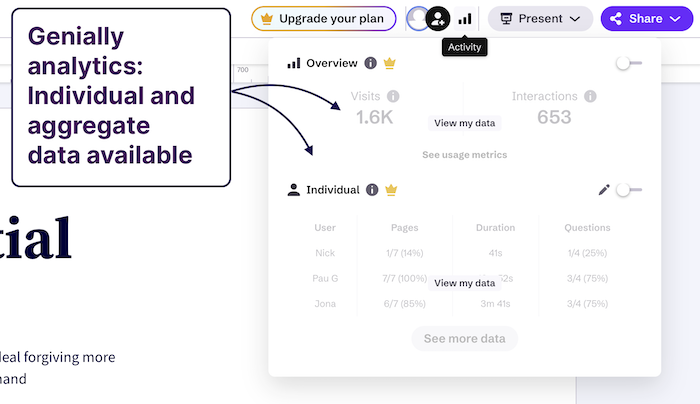
These metrics are useful for understanding how users engage with presentations, infographics, or learning materials. However, Genially’s analytics are less focused on lead qualification, segmentation, or downstream conversion, and offer limited options for exporting interaction data into external analytics, CRM, or marketing systems.
Monetization Opportunities
Monetization with Riddle
Riddle is purpose-built for publishers, media companies, brands, and sports organizations that need interactive content to drive revenue. Interactive content can support lead generation, newsletter growth, sponsorships, branded content, advertising-friendly placements, and first-party data strategies.
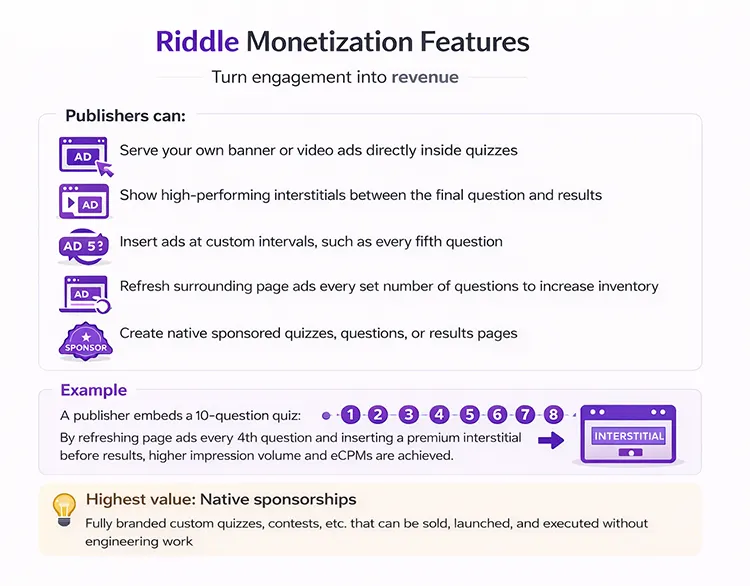
Because Riddle content embeds directly into editorial and brand environments, it integrates naturally with existing monetization models rather than sitting outside them.
Riddle recently created a free white paper ‘The Publisher’s Guide to Content Monetization with Interactive Content’ – giving an in-depth look at how media companies, publishers, and brands can leverage Riddle’s quiz builder to grow revenue.
Monetization with Genially
Genially’s monetization is more indirect.
Its interactive content is often used for campaigns, storytelling, or education rather than as a core revenue driver. While it can support one-off branded experiences, it is less optimized for high-volume monetization scenarios – such as serving in-content ads at scale.
Automation, AI, and APIs
Riddle incorporates AI-assisted content creation to speed up production:
- Generate interactive content based on a topic
- Create quizzes and other formats directly from an existing URL
- Quickly align interactive content with published articles or campaigns
- Reduce manual setup and production time for editors and content teams
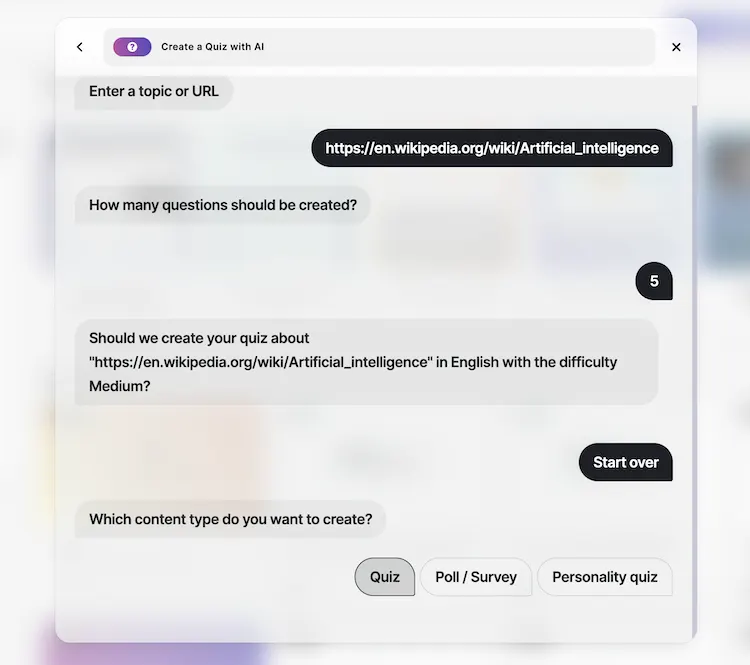
This approach is particularly useful for publishers and media companies that want to scale interactive content alongside editorial output without adding significant manual effort.
Riddle is also designed to support automation at enterprise scale. The platform provides API builder access and automation capabilities that allow organizations to integrate interactive content directly into broader systems and workflows.
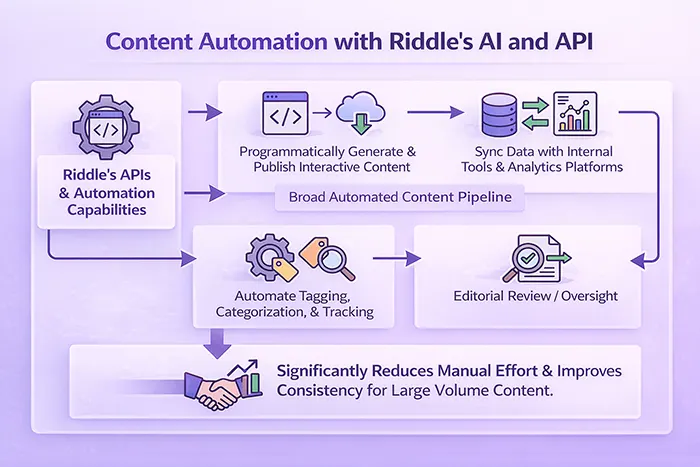
Using Riddle’s APIs and automation features, teams can programmatically create and publish content, automate tagging and tracking, sync interaction and lead data with internal systems, and trigger downstream actions based on user behavior. This makes Riddle well suited for organizations managing large content volumes or multiple brands.
By comparison, Genially also offers AI-assisted features, primarily focused on creative support:
- AI-generated images and visual elements
- Suggestions for basic content structure or question formats
- Tools aimed at speeding up design and ideation workflows
These features are helpful for visually driven projects and smaller teams, but they are less focused on automating content creation at scale or integrating AI-driven output into broader enterprise workflows.

However, Genially does not offer a public API.
Content creation and updates are handled through manual, design-led workflows. While this works well for standalone projects and smaller teams, it limits Genially’s role in enterprise automation where API access is a core requirement.
Team Roles, Global Presets, and Brand Consistency
As organizations grow, maintaining brand consistency and governance becomes increasingly complex.
Riddle supports organizations ranging from small teams to enterprises with thousands of users. It offers granular user roles and permissions, shared workspaces, default look/feel for content, and global presets for tracking, embeds, and integrations. Editors can create content confidently without worrying about compliance or configuration, while administrators maintain full control at the organizational level.
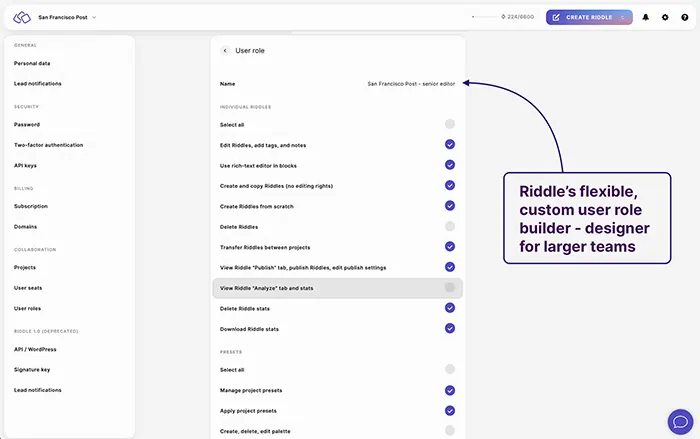
This governance model is particularly valuable for publishers, media companies, brands, and sports organizations operating across multiple sites, regions, or departments.
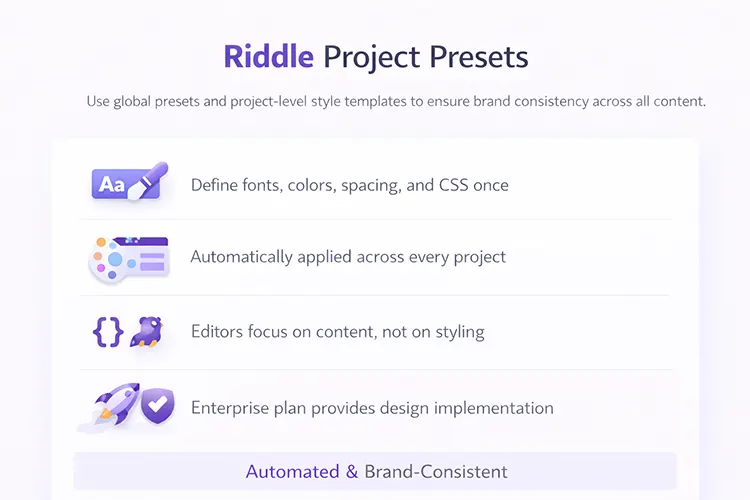
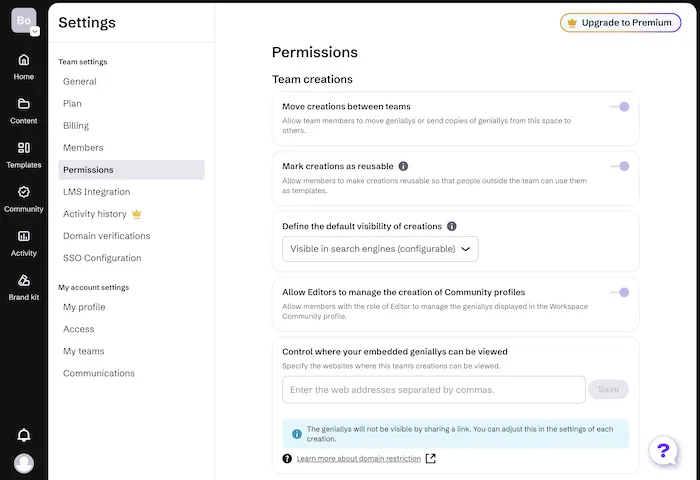
Genially provides basic team collaboration features suitable for small groups working closely on visual content. While effective for design collaboration, it offers less depth when it comes to granular permissions, global presets, or large-scale brand governance.
Integrations and Data Collection
Riddle is built with marketers, publishers, and data-driven organizations in mind. It integrates with a wide range of marketing and data platforms, including CRM systems like Salesforce, email marketing and automation tools including Zapier, analytics platforms, and data warehouses.
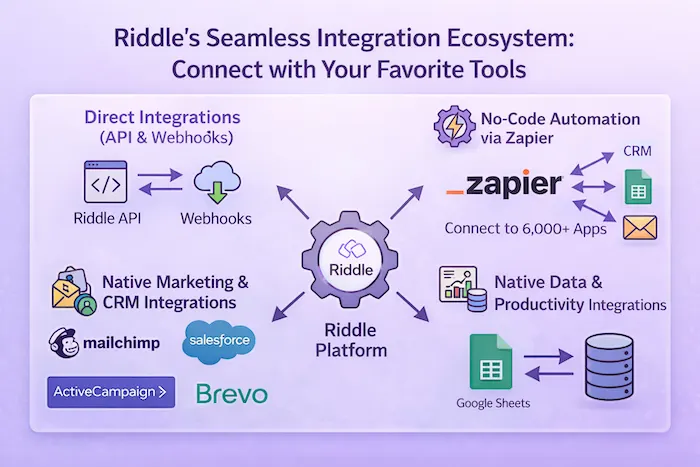
These integrations allow first-party data generated through interactive content to flow directly into existing systems, supporting segmentation, personalization, and downstream activation without relying on third-party trackers.
Genially’s integrations are primarily focused on learning and education environments, such as LMS platforms.
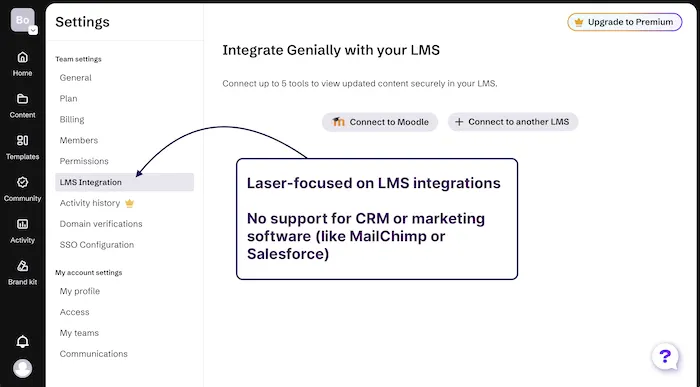
While effective for training and educational use cases, Genially is not designed as a marketing data collection platform, and integration options for CRM or marketing automation are limited.
GDPR, Privacy, and Data Sovereignty
Privacy is a critical consideration for organizations collecting first-party data in 2026.
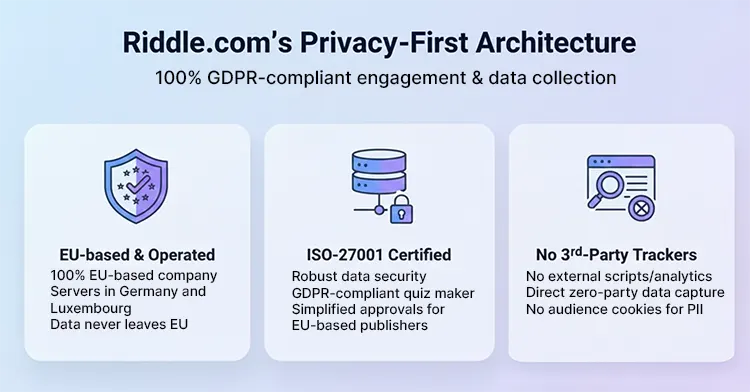
Riddle is 100% GDPR-compliant – entirely EU-based, Riddle operates on its own servers and does not use third-party trackers. This simplifies GDPR compliance and provides clear data sovereignty for publishers, media companies, and brands operating across regions.
Genially supports GDPR compliance, but because it is primarily a visual content platform, data collection often depends on embeds and integrations. Organizations should evaluate how these data flows align with strict privacy requirements.
Pricing, Traffic Limits, and Long-Term Value
Pricing plays a major role in whether an interactive content platform can scale sustainably.
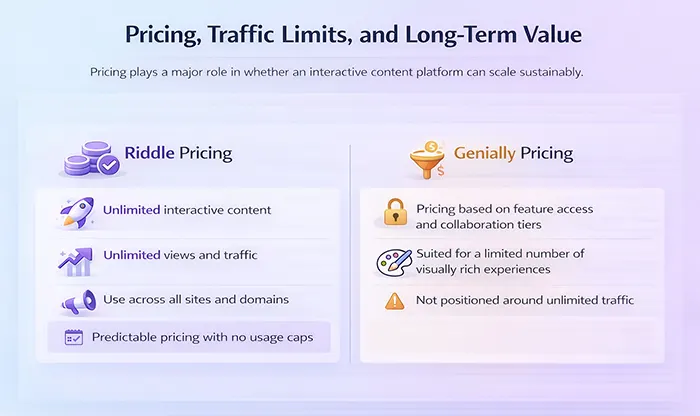
Riddle’s pricing is designed around unlimited usage across all paid plans, including unlimited interactive content, unlimited views, unlimited leads, and deployment across all sites and domains. Pricing is not tied to impressions or traffic volume, making costs predictable even during traffic spikes or viral moments.
Genially’s pricing is structured around feature access and collaboration tiers. While effective for teams creating a limited number of visual experiences, it is not positioned around unlimited traffic or high-volume publishing.
Pricing at a Glance: Built for Scale
Riddle
- Unlimited interactive content
- Unlimited views and traffic
- Unlimited leads
- Use across all sites and domains
- Predictable pricing with no usage caps
Genially
- Pricing based on feature access and collaboration tiers
- Suited for a limited number of visually rich experiences
- Not positioned around unlimited traffic
Which Platform Is the Better Fit?
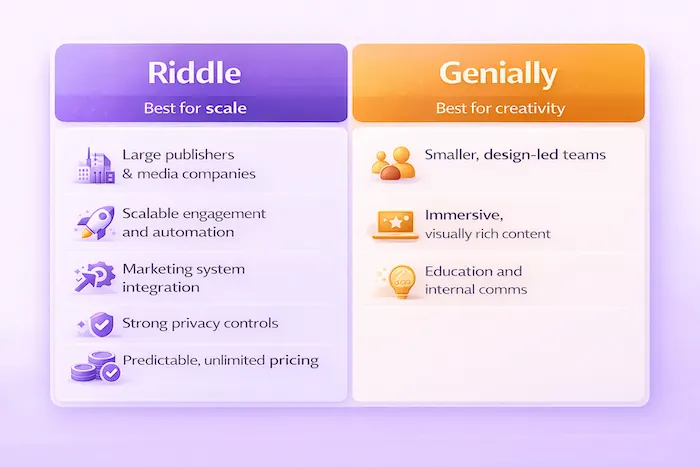
Riddle is a strong choice for large publishers, media companies, brands, and sports teams that require scalable engagement, automation, integration with marketing systems, strong privacy controls, and predictable pricing.
Genially is well suited for design-led smaller teams focused on visually immersive storytelling, education, or internal communications.
Choosing the Right Platform at Scale
While both Riddle and Genially support interactive experiences, they are designed to operate at very different levels of scale and complexity.
Genially excels in visual storytelling and design-led projects. Riddle is built for organizations that treat interactive content as an ongoing, scalable channel. With support for high traffic, automation, integrations, governance, monetization, and privacy-first infrastructure, Riddle offers a stronger foundation for enterprises and media organizations operating at scale.
The right choice depends less on which platform looks better in a demo and more on how interactive content fits into your long-term operating model in 2026 and beyond.
Related quiz maker comparisons
- Involve.me – ideal for small business, coaches and e-commerce.
- Typeform – easy to use and beautiful forms and surveys
- Outgrow – focused around calculators and other lead generation formats
What is the main difference between Riddle and Genially?
The main difference lies in how each platform is designed to operate. Riddle focuses on scalable interactive formats and first-party data collection, making it well suited for organizations that publish interactive content frequently and at high traffic volumes. Genially, by contrast, emphasizes visually rich, design-led interactivity, such as presentations and animated experiences. While both support interactive content, they are built for different operational needs and levels of scale.
Is Riddle better for publishers and media companies?
Riddle is typically better suited for publishers and media companies because it supports repeatable engagement formats, unlimited traffic, and enterprise-grade collaboration features. Its embeddable content, automation capabilities, and predictable pricing model make it easier to deploy interactive experiences across large content libraries without worrying about usage limits. These characteristics align well with the operational realities of high-traffic publishing environments.
Can Genially be used for marketing campaigns?
Yes, Genially can be used for marketing campaigns, particularly those that prioritize visual storytelling and presentation-style experiences. It works well for one-off campaigns, educational content, or design-driven initiatives. However, Genially is less optimized for lead capture, CRM integration, and data-driven marketing workflows, which may limit its effectiveness for teams that rely heavily on audience data and downstream activation.
Which platform supports more interactive formats?
Riddle supports over 35 distinct interactive formats, including quizzes, polls, surveys, leaderboards, prediction games, and mini-games. This variety allows teams to experiment with different engagement models and reuse formats across campaigns. Genially focuses more on interactive design within presentations and visual assets, rather than offering a wide range of standalone engagement formats.
How do the platforms compare on GDPR and accessibility requirements?
Riddle is EU-based, operates its own servers, and avoids third-party trackers, which simplifies GDPR compliance and data sovereignty considerations. Its structured, embeddable formats also make it easier to maintain consistent accessibility standards at scale. Genially supports GDPR compliance as well, but data handling and accessibility outcomes can depend more on how individual projects are built and embedded, especially for highly customized designs.
Is Genially suitable for large enterprise teams?
Genially can be used by enterprise teams for design-heavy or educational projects, particularly where visual impact is the primary goal. However, it offers more limited options for automation, granular user roles, global presets, and large-scale governance. For organizations with many users, sites, or departments, maintaining consistency and efficiency may require additional manual oversight.
Does Riddle support automation and APIs?
Yes. Riddle provides API access and automation features that allow organizations to integrate interactive content into broader systems and workflows. This includes programmatic content creation, automated tracking, and data synchronization with internal platforms. These capabilities are especially important for enterprises and publishers managing large volumes of content or operating across multiple brands and regions.
1. What is the main difference between Riddle and Genially?
Riddle focuses on scalable interactive formats and first-party data, while Genially emphasizes visually rich, design-led interactivity.
2. Is Riddle better for publishers and media companies?
Riddle is typically better suited due to its support for high traffic, monetization, automation, and enterprise governance.
3. Can Genially be used for marketing campaigns?
Yes, but it is less optimized for lead capture, CRM integration, and data-driven marketing workflows.
4. Which platform supports more interactive formats?
Riddle supports over 35 formats. Genially focuses on interactive design rather than distinct engagement formats.
5. How do the platforms compare on GDPR compliance?
Riddle is EU-based, operates its own servers, and avoids third-party trackers. Genially supports GDPR but often relies on embeds and integrations.
6. Does Riddle support automation and APIs?
Yes. Riddle provides APIs and automation features designed for enterprise-scale workflows.
7. Is Genially suitable for large enterprise teams?
Genially can work for design projects, but it lacks the automation, integrations, and governance features required at scale.
8. Which platform is better for long-term scalability?
Riddle is generally better suited due to unlimited usage, automation, deep integrations, collaboration features, and privacy-first infrastructure.