
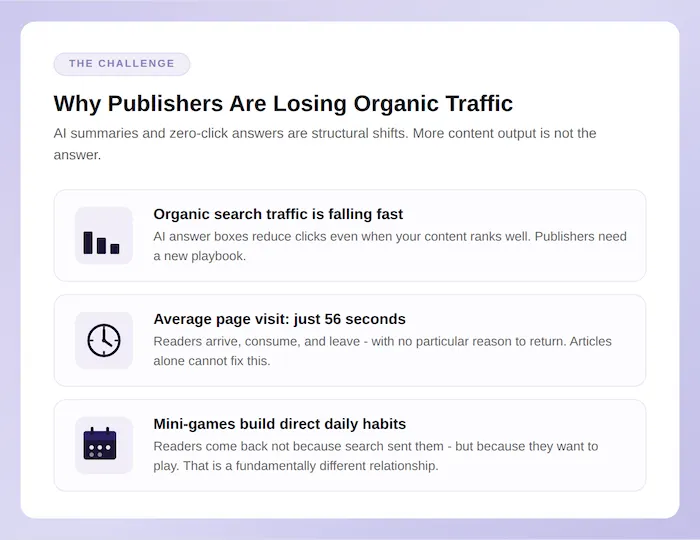
Organic search traffic is falling – and it is not a temporary blip. AI-generated answer boxes, zero-click searches, and shifting reader habits are structural changes. No amount of extra SEO output is going to reverse that.
The publishers who are doing well right now are the ones who have stopped trying to win back search traffic and started building something better: direct daily habits with their audiences.
Mini-games and leaderboards are at the center of that shift. As audience retention strategies go, they are among the most cost-effective available to publishers today. They:
- Drive return visits and build daily habits
- Generate zero-party data from engaged readers
- Create ad inventory from the audience you already have
- Run largely on autopilot once set up
This post pulls together the five key strategies from our full mini-games white paper.
If you want the complete picture – benchmarks, case studies, a step-by-step launch sequence, and detailed setup instructions – you can download it below.
Key takeaways
- Organic search is declining structurally for publishers; AI answer boxes and zero-click search mean more content won’t reverse the trend.
- Daily mini-games with leaderboards are among the most cost-effective retention tools available, because they build return-visit habits that articles alone don’t.
- The New York Times shows the model at scale: readers who use both news and games have the strongest long-term retention of any subscriber segment.
- Mini-games create three assets at once — repeat visits, zero-party data from signed-in players, and fresh ad inventory from your existing audience.
- Small publishers can run them without a large editorial team, since games can be auto-generated, embedded once, and refreshed on autopilot.
Key stats at a glance
- NYT Games generated 11.2 billion puzzle plays in 2025, up from 11.1 billion in 2024 and 8 billion in 2023 (source)
- NYT’s total subscriber base has grown from 8.8 million in 2021 to over 12.5 million today, with games and cooking driving a meaningful share of that growth (source)
- Swiss publisher 20min.ch saw an 80% quiz completion rate and 20% higher CPM on in-quiz ads versus standard placements
- JaneAusten.com built a 350+ quiz library that converts anonymous readers into registered, leaderboard-driven members
Download the Mini-Games Playbook (PDF)
Ready to go deeper? Download the PDF of the full Mini-Games Playbook – with benchmarks, case studies, technical setup guides, and the complete launch sequence.
Why the New York Times is the publisher engagement model worth studying
The NYT’s mini-games strategy is the most closely watched case study in digital publishing right now – and the numbers justify the attention.
After acquiring Wordle in January 2022, the results were immediate:
- Tens of millions of new users in the first quarter alone
- Their best-ever quarter for net subscriber additions to Games
- 11.1 billion total puzzle plays across the portfolio in 2024
- Wordle alone: 5.3 billion plays – roughly 14.5 million per day
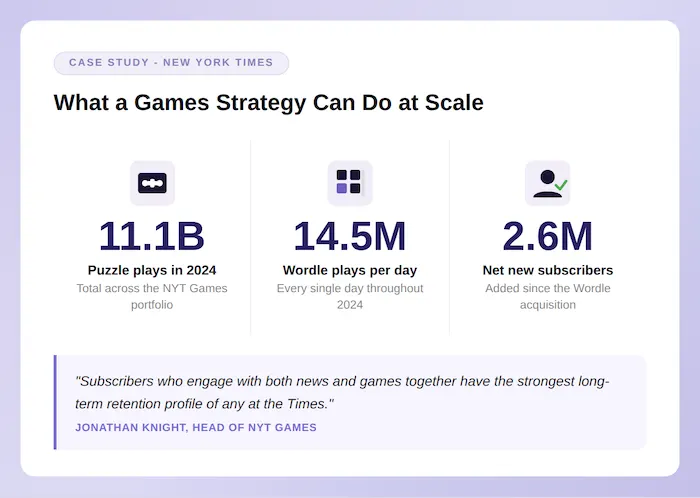
The retention data is equally striking. Jonathan Knight, head of NYT Games, told CNN that subscribers who engage with both news and games together have the strongest long-term retention profile of any segment at the Times.
The numbers bear this out – the Times grew from 8.8 million subscribers at the end of Q4 2021 to 11.43 million by end of 2024. By Q4 2024, nearly a third of all NYT digital subscribers were paying exclusively for non-news products like Games, Cooking, and The Athletic.
That is not a games company. That is a publisher that understood something important: games create habits that articles cannot.
The viral side is just as significant. By May 2022, 3.3 million people had tweeted about Wordle – 32.2 million tweets in total – driven by the emoji score-sharing mechanic that turned every player into a promoter. Organic, unpaid, motivated sharing by readers who wanted their network to join the competition.
You do not need to be the New York Times to apply this model. You just need to understand why it works, and then build the version that only makes sense on your site.
Three things daily games for news websites – and all publisher sites – do that articles cannot
Engagement: Mini-games pull readers in and keep them on page far longer than standard articles. Time on site goes up, bounce rate goes down, ad impressions increase. The reader is not passive – they are playing, which means they are focused and invested.
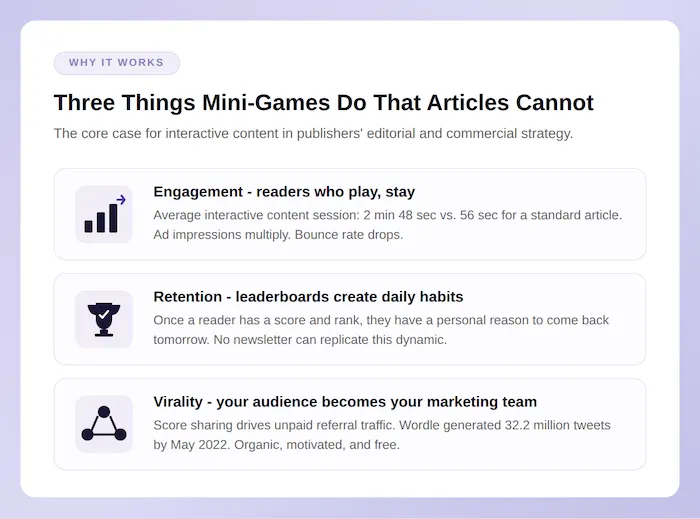
Retention: A leaderboard changes the relationship entirely. Once a reader has a score and a rank, they have a reason to come back tomorrow. Readers return to:
- Check their position on the leaderboard
- Try to beat their previous score
- Compete with colleagues and friends
- Maintain a daily or weekly streak
A daily streak mechanic or a weekly leaderboard creates a habit that no newsletter or push notification can replicate. You move from occasional visitor to daily active user – without spending anything on paid acquisition.
Virality: Score sharing turns your audience into your marketing team. When a reader shares their result and invites friends to compete, that is unpaid referral traffic from people who are already motivated to engage. Shareable results are a standard feature of the format – not a bonus.
Updated data (including 2025): the trend has held. NYT Games logged 11.2 billion total puzzle plays across the year, edging past 2024’s 11.1 billion, even as Wordle itself cooled slightly to 4.2 billion plays (about 11.5 million per day, down from 5.3 billion in 2024).
That’s the real lesson for publishers: a single breakout game doesn’t need to keep accelerating forever if it’s part of a growing portfolio.
- The Times’ total subscriber base has since climbed past 13 million.
- Its newest release, Crossplay, has already topped 3 million downloads and 30 million games played since launch.
Crossplay in particular is proof that the company keeps finding new game formats rather than resting on Wordle alone.
Key stats at a glance
- NYT Games generated 11.2 billion puzzle plays in 2025, up from 11.1 billion in 2024 and 8 billion in 2023
- NYT’s total subscriber base has grown from 8.8 million in 2021 to over 13 million today, with games and cooking driving a meaningful share of that growth
- Swiss publisher 20min.ch saw an 80% quiz completion rate and 20% higher CPM on in-quiz ads versus standard placements
- JaneAusten.com built a 350+ quiz library that converts anonymous readers into registered, leaderboard-driven members
What this looks like beyond the NYT: the JaneAusten.com case
JaneAusten.com is a useful example precisely because it is not a major media brand with a games team and a nine-figure budget. It is a niche publisher with a committed audience and rich subject matter to draw on.
Using Riddle’s quiz maker, they have built a library of more than 350 quizzes covering Austen’s novels, characters, historical context, and film adaptations – all connected to their leaderboard. The results:
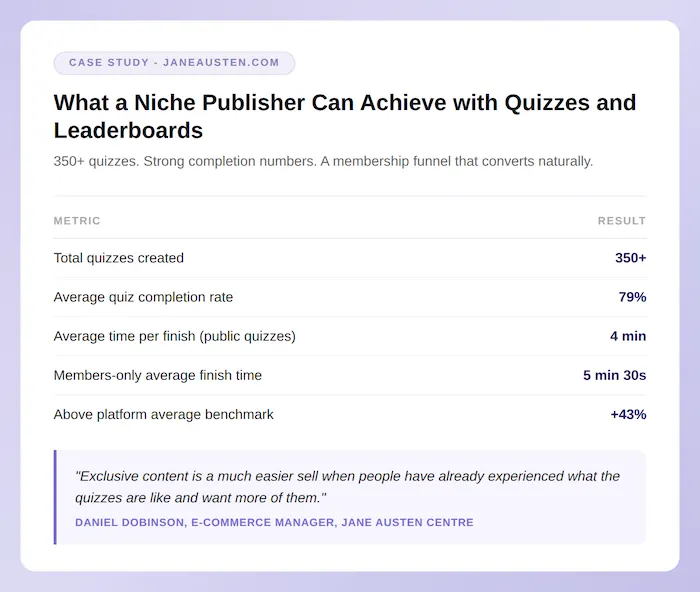
The leaderboard mechanic is central to how this works as a business. To appear on a leaderboard, readers need to create an account – and that single step delivers three things:
- Converts anonymous visitors into identified community members
- Moves them one step closer to a paid membership
- Builds a registered audience without disruptive pop-ups
Premium membership unlocks exclusive quizzes. That is an easier sell when readers have already experienced what the quizzes are like and want more of them.
“Our audience has a real depth of knowledge about Jane Austen – and they want to test it. Riddle gives them a way to do that, and the leaderboards have turned what could have been a one-time visit into something people come back to regularly.”
Daniel Dobinson, E-commerce Manager, Jane Austen Centre
The quiz library is not a side project. It sits at the centre of how the site builds community, grows its registered audience, and converts readers into members.
5 publisher engagement strategies for retention and revenue
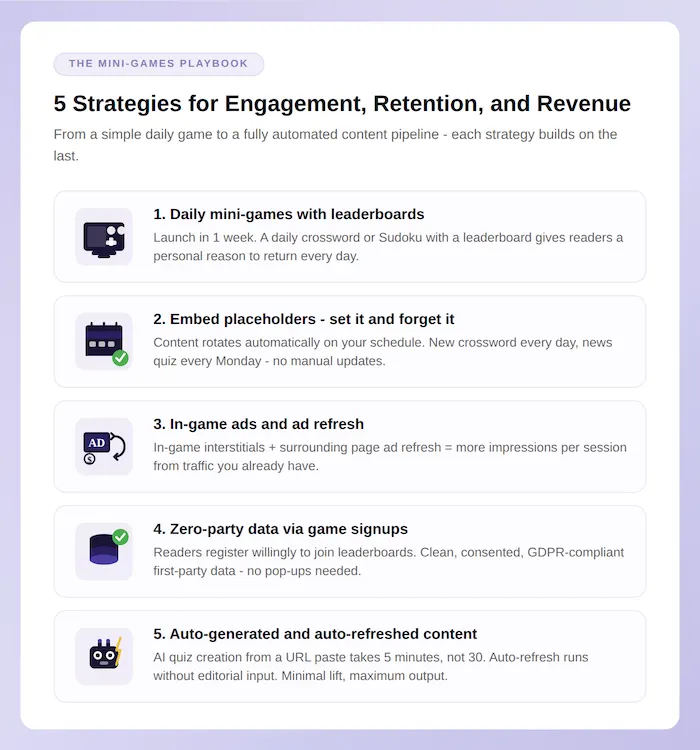
1. Daily mini-games with leaderboards – your best audience retention tool
A daily crossword or Sudoku is a proven driver of return visits. Pair a leaderboard with your mini-games – tracking scores, times, or streaks – and you give readers a personal stake in coming back. It is no longer just a game; it is their game.
The editorial lift is minimal. Once the puzzle is scheduled, it runs itself.
The most important principle here is one that often gets overlooked: a game tied to your brand, your beat, and your audience will always outperform a generic one.
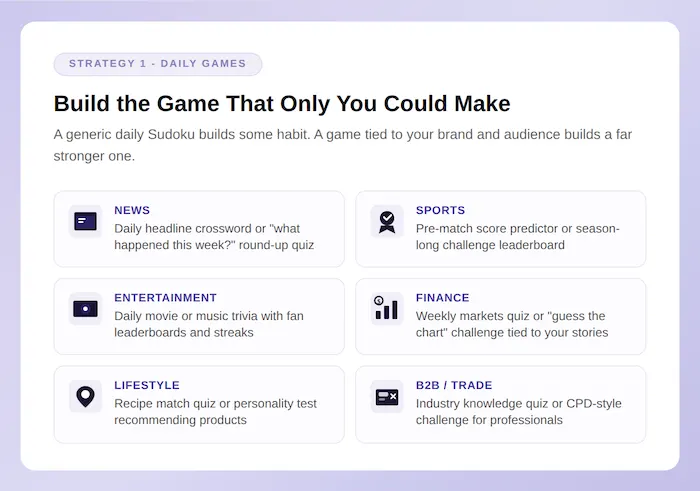
Here is what that looks like by sector:
- News publisher – a daily headline crossword, or a “what happened this week?” round-up game that tests readers on your own coverage
- Sports team or sports media – a pre-match score predictor, a player stats quiz, or a “name that season” challenge built around your history
- Entertainment brand – a daily movie or music trivia game themed to your coverage, with leaderboards that reward loyal fans
- Finance or business media – a weekly markets quiz, an economics knowledge test, or a “guess the chart” challenge tied to stories you have already published
- Lifestyle or food brand – a recipe match quiz, a “know your ingredients” challenge, or a personality test that recommends products
- B2B or trade publisher – an industry knowledge quiz, a regulatory update test, or a CPD-style challenge that gives professionals a reason to return regularly
Leaderboards do not have to be always-on either. Time-limited campaigns work especially well – a 10-week summer Sudoku challenge, a World Cup prediction leaderboard (like Convert by Riddle’s new sports predictor game), or a winter quiz series. These mini-games give readers a defined competition to follow, a clear end date, and a strong reason to keep playing until the final round.
2. Embed placeholders – set it and forget it
One of the most useful interactive content tools for editorial teams is Riddle’s embed placeholder. You add a single piece of code to your template once, and Riddle automatically swaps in new content on a schedule you define:
- Your crossword refreshes every day
- Your weekly news quiz goes live on Monday morning
- Your seasonal competition launches on the right date
All without anyone on your team manually updating the page. The game is always fresh. The experience is always live.
For teams managing multiple verticals – news, sport, entertainment, lifestyle – this removes a significant amount of repetitive work while keeping every section of the site active.
3. In-game ads and ad refresh – how mini-games increase return visits and revenue together
Mini-games generate more time on page. More time on page means more ad impressions. But the opportunity goes further than that – Riddle gives you two additional mechanisms to turn engagement directly into revenue.
In-game interstitials: Riddle’s ad block format lets you show an ad unit within the game flow – between quiz rounds, or when a player completes a Sudoku level. The reader is already engaged and in a positive mindset. Completion rates are consistently much higher than standard display ads, especially for high-eCPM video.
Ad refresh on the surrounding page: While a reader is playing, the page’s ad slots can refresh. A reader spending 8 minutes on a crossword might generate 4-6 ad impressions in the banner positions – rather than the single impression from a standard article page.
Both mechanisms work together: more engaged readers, more impressions per session, higher-quality placements. Swiss publisher 20min.ch reported an 80% quiz start rate and a 20% higher CPM of ads inside a quiz versus comparable ad placements outside quizzes after integrating Riddle interactive content into their editorial workflow.
4. Zero-party data collection via game signups
Third-party cookies are largely gone. The EU’s GDPR means audience data collected without clear consent is a liability. The publishers that are best positioned right now are the ones collecting zero-party data – information readers choose to give you, explicitly, in exchange for something they value.
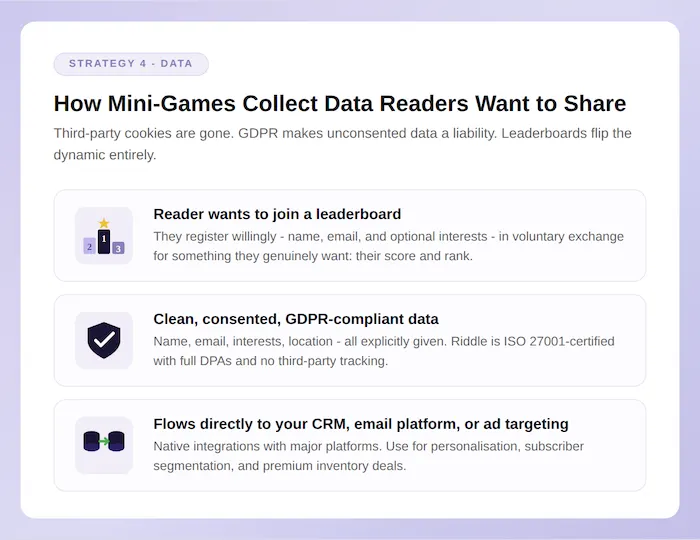
Mini-games and leaderboards are a natural mechanism for this. A reader who wants to save their score, appear on a leaderboard, or invite others to compete needs to register. That registration gives you:
- Name and email
- Interests and topic preferences (if you configure those fields)
- Location data
- Behavioural signals from their game activity
This data is clean, consented, and genuinely useful – for personalisation, targeted advertising, subscriber segmentation, and building direct relationships with your most engaged audience.
If your site already has a login system, you can pass user information directly into the embedded game via Riddle’s data layer. Readers who are already logged in are recognised automatically and skip the leaderboard signup form entirely – seamless for them, and no duplicate data for you.
For new or anonymous visitors, you can choose to show your own existing login or registration form, or a form built in Riddle – with all data collected synced directly to your own data systems either way via native integration (like Salesforce), webhook, or API.
5. Auto-generated and auto-refreshed content
The most common objection to running daily mini-games is the editorial workload. Who creates the crosswords? Who writes the quiz questions? Who makes sure everything stays updated?
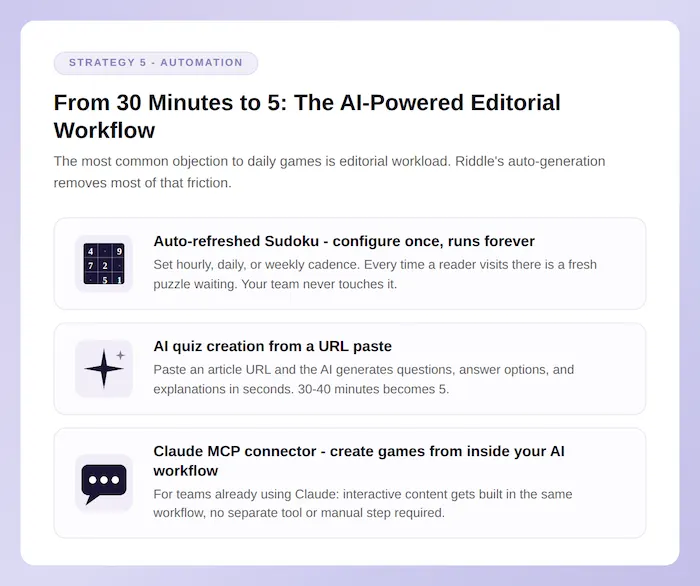
Riddle’s auto-generation and auto-refresh features remove most of that friction:
- Auto-refreshed Sudoku – configure once, and a fresh puzzle publishes automatically on whatever cadence you choose. Hourly, daily, weekly – always on, always refreshed. No need to touch it ever again.
- AI quiz generation – paste in an article URL and the AI generates a related quiz in seconds: questions, answer options, and explanations. A process that might have taken 30-40 minutes now takes 5.
- Programmatic creation via API Builder – a sports site can automatically generate mini-games or a match preview quiz whenever a new fixture page goes live; a news publisher can trigger a topic quiz from their CMS when an article is published.
- Claude MCP connector – Riddle’s MCP connector allows Claude to create quizzes, polls, personality tests, and mini-games directly from your AI workflow. For editorial teams already using Claude for drafting and research, interactive content gets built in the same workflow with no separate tool required.
Want a deeper look? Check out this detailed overview of Riddle’s content automation options for publishers.
A practical launch sequence
You do not need to launch everything at once. A phased approach lets you see results before investing more editorial or technical resource.
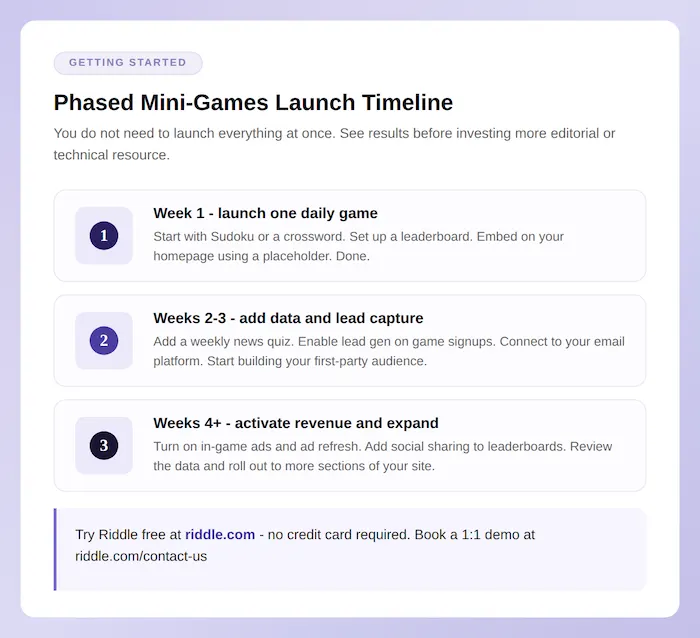
Phase 1 – Week 1
- Launch one daily game (Sudoku or crossword are good starting points)
- Connect a leaderboard with your mini-game
- Embed on your homepage using a placeholder
Phase 2 – Weeks 2-3
- Add a weekly news quiz (like the BBC’s ‘Quizzes of the Week’)
- Enable lead gen on game signups
- Connect to your email platform
Phase 3 – Weeks 4+
- Activate in-game ads and ad refresh
- Add social sharing to leaderboards
- Review the data and expand to more sections
Why publisher engagement tools matter more in 2026
The search traffic decline is not reversing. Waiting for organic traffic to recover is not a strategy.
The NYT understood this before most. Its investment in mini-games – from the crossword to Wordle to Connections – has driven subscriber growth, lifted retention, and generated billions of plays.
Crucially, those games are not generic. They are distinctively NYT: the crossword has been a daily ritual since 1942; Wordle became the puzzle everyone talked about; Connections has its own voice and editor. The games are inseparable from the brand.
That is the model worth following – not “add some games” but “build games that only we could make”:
- A football club’s score predictor
- A food brand’s recipe quiz
- A trade publisher’s weekly industry knowledge challenge
Mini-games that test what your audience knows and cares about, branded to your identity, embedded in your daily rhythm.
The combination of engagement, retention, zero-party data collection, and ad revenue makes this one of the better returns on editorial effort available right now. And the sooner you build that daily habit with your audience, the harder it is for anyone else to replicate it.
Turn mini-games into a retention engine with Riddle
Building a mini-games strategy that actually retains readers takes more than a one-off crossword. You need an enterprise-grade quiz maker built for the realities of a newsroom:
- 30+ interactive formats – crosswords, word games, quizzes, polls, personality tests, predictors, and leaderboards
- White-label embeds that match your brand automatically, with no coding required
- Daily or weekly publishing that runs as recurring features without adding to your editorial workload
- In-content ad serving on every format, so your ad ops team can monetize the engagement directly
- EU-based, GDPR-compliant infrastructure for first-party data you own
That’s where Riddle fits. To see how it all comes together, read our guide to the enterprise quiz maker built for publishers and media companies.
Download the Mini-Games Playbook (PDF)
Ready to go deeper? Download the PDF of the full Mini-Games Playbook Playbook – with benchmarks, case studies, technical setup guides, and the complete launch sequence.
Try Riddle free at www.riddle.com – no credit card required, with all features unlocked. Or schedule your 1:1 demo to see any of these strategies in action for your specific setup.
Frequently asked questions about mini-games
What are mini-games for publishers?
Mini-games for publishers are lightweight, interactive games – crosswords, Sudoku, quizzes, word games, score predictors – embedded directly into a media site or publisher platform. Unlike one-off articles, they are designed to be played repeatedly, often daily, and typically include features like leaderboards, score sharing, and streaks that drive return visits. For publishers, they serve as a direct-traffic and audience retention tool: readers come back to play rather than arriving through search.
How do mini-games help with audience retention?
Mini-games create habits in a way that editorial content alone rarely does. When a reader has a leaderboard score and a daily streak, they have a concrete, personal reason to return tomorrow. A weekly quiz or daily puzzle turns an occasional visitor into a regular. NYT’s own data illustrates the effect: subscribers who engage with both news and games together have the strongest long-term retention profile of any segment at the Times.
How do mini-games generate ad revenue?
There are two main mechanisms. The first is in-game ads – interstitial units shown within the game flow (between quiz rounds, or after completing a Sudoku level), where engagement rates are consistently higher than standard display. The second is ad refresh on the surrounding page: a reader spending 8 minutes on a crossword generates multiple ad impressions in the banner slots, rather than the single impression from a standard article. Together, these increase effective ad inventory from traffic you already have.
What types of mini-games work best for publishers?
The formats that work best are the ones tied to your subject matter and audience. A generic daily Sudoku builds some habit – but a daily Premier League prediction game on a football site, a movie trivia quiz on an entertainment brand, or a weekly markets quiz on a finance publisher will build a much stronger one, because it tests knowledge readers actually care about and cannot get elsewhere. Formats worth considering include crosswords, Sudoku, news quizzes, score predictors, word-guessing games, and personality tests – but the subject matter matters more than the format.
Can small publishers run mini-games without a large editorial team?
Yes – and this is one of the more significant shifts in the past couple of years. Tools like Riddle include auto-refresh for Sudoku and other puzzles (new content publishes automatically without anyone touching it), AI quiz generation from article URLs (questions generated in seconds from a URL paste), and embed placeholders that handle scheduling across your CMS. A small editorial team can run a daily game program with very little ongoing effort once the initial setup is done.
What is zero-party data, and how do mini-games collect it?
Zero-party data is information readers actively choose to share with you, in exchange for something they value. Mini-games collect it naturally: a reader who wants to save their score, appear on a leaderboard, or invite friends to compete needs to register. That registration gives you a name, email, and – depending on your setup – interests, location, or preferences. Unlike third-party cookie data, this is consented, accurate, and compliant with GDPR and similar regulations.
How long does it take to launch mini-games on a publisher site?
A basic setup – one daily game with a leaderboard embedded on your homepage – can be live within a week. A more complete program covering multiple game formats, lead generation, ad integration, and automated content refreshes typically takes 3-4 weeks to configure fully. A phased launch is usually the most practical approach: start with one game, see the data, then expand.