More engagement. More revenue. No developers. Here’s how.
Most publishers are sitting on a publisher revenue opportunity they haven’t fully tapped yet. Interactive content – quizzes, polls, personality tests, and mini-games – doesn’t just drive engagement. When set up correctly, it produces ad impressions, qualified leads, first-party audience data, and branded sponsorship packages. All from the same piece of content.
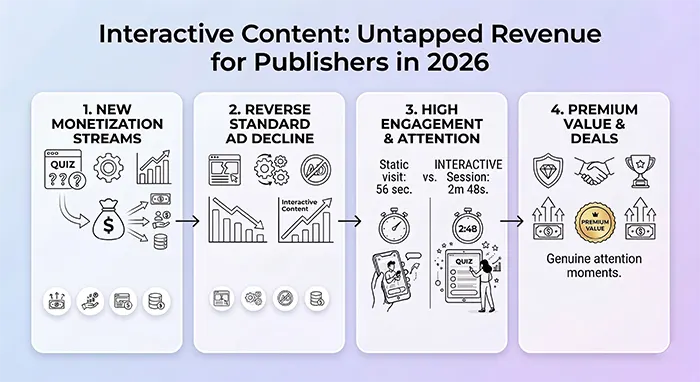
Standard display ads are harder to make work than they were five years ago:
- CPMs are squeezed
- Ad blockers are widespread (1 billion users so far – and rising)
- Audiences scroll past banners without registering them
- Publishers relying on impression volume alone are running a race with a shrinking prize
Interactive content reverses the trend:
- Average page visit: 56 seconds, then gone
- Average interactive content session: 2 minutes 48 seconds of active engagement (Source: Riddle’s annual quiz marketing report)
- Readers are emotionally invested in their result – exposed to ad inventory at a moment of genuine attention
Advertisers pay a premium for that kind of audience. And publishers who deliver it win the deals.
This post breaks down six practical publisher revenue strategies using interactive content (and a quiz maker like Riddle), how long each takes to set up, and what the returns actually look like.
Download the Riddle Content Monetization Whitepaper (PDF)
Ready to go deeper? Download the full PDF of the ‘Riddle Monetization Playbook’ – with benchmarks, case studies, technical setup guides, and the complete launch sequence.
Why interactive content works for publisher revenue
The core mechanic is simple: a quiz or personality test requires active participation. The user clicks, reads, and responds to every question. By the time they reach the end, they’ve spent several minutes in an engaged state – on your page, inside your content.
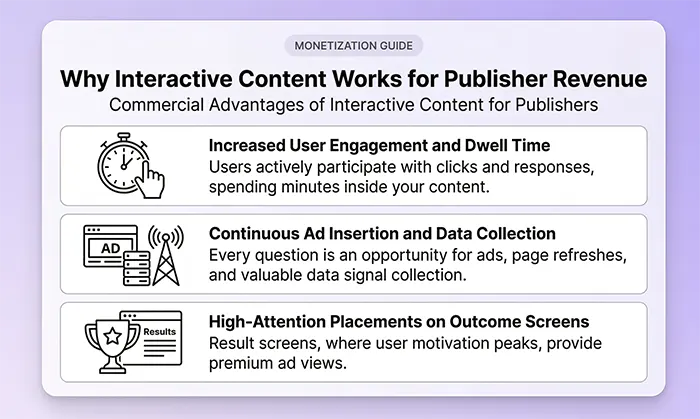
That dwell time is commercially useful for publisher revenue in ways that standard articles aren’t.
Every question answered is an opportunity to serve an ad or collect a data signal. The results screen – where users are at peak motivation because they want to see their outcome – is one of the highest-attention ad placements available in digital publishing.
20min.ch case study: Real numbers around publisher revenue
Swiss publisher 20min.ch reported an 80% quiz start rate, 72% completion rate, and a 20% uplift in CPMs for ads placed inside a Riddle vs. comparable placements.

These aren’t edge cases. Publishers that build interactive content into their regular editorial and commercial output consistently report better ad performance, higher lead capture rates, and new sponsorship revenue they couldn’t have sold before.
6 publisher revenue strategies for 2026 – from easy to advanced
1. Serve ads inside your interactives
Time to launch: same day. Revenue model: CPM.
This is the starting point for publisher revenue with interactive content, and the fastest to get running. Riddle’s built-in ad block lets you drop ad units anywhere inside a quiz or poll – between questions, or as a full-screen interstitial before the results screen.
All ads serve directly from your own GAM/DFP account. Riddle never runs its own ads inside your content – you have full control over ads, pluskeep 100% of the revenue. Standard IAB display formats (300×250, 728×90 etc.), video ads via MP4 or VAST, and full-screen interstitials are all supported.
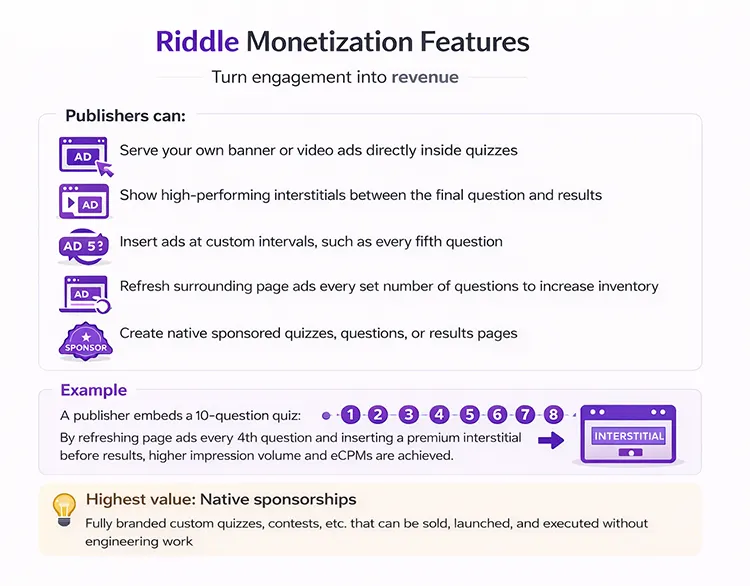
The interstitial placement deserves special attention. After a user has spent three minutes or more answering questions, they are highly motivated to see their result – and that motivation means they’ll tolerate a short video ad in a way they absolutely wouldn’t on a standard article page.
Riddle lets you configure a delayed skip button on video interstitials, so you can set a minimum viewing window to protect eCPM while still giving users an out. It’s a sensible dial to have – completion rates on this placement are strong even with a skip option available.
Time-saver
Set up a template in Riddle with your GAM ad tags, fonts, and branding pre-configured. Every quiz or poll your team creates afterwards automatically inherits those settings – no one needs to manually add ad slots each time.
2. Trigger ad refresh on the surrounding page (increase your ad inventory)
Time to launch: 1–2 days. Revenue model: additional CPM impressions.
Here’s a publisher revenue lever that’s easy to overlook: the longer a reader spends on your page, the more times your surrounding ad slots can refresh. Interactive content dramatically extends page dwell time – and Riddle can fire a JavaScript event each time a reader progresses through the quiz (on each answer, at the halfway point, or on the results screen).
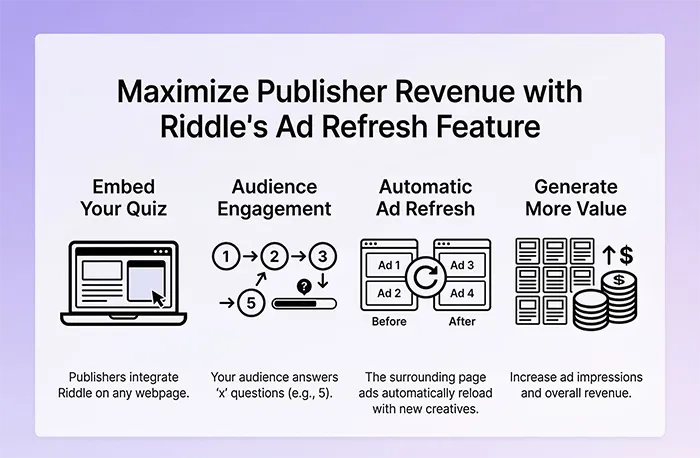
- Your ad tech team adds a listener for this event on your page.
- Choose the frequency (e.g. every 5 questions)
- The listener then triggers a refresh of your existing GAM/DFP inventory – header, sidebar, in-content – exactly as it does for standard page refreshes.
No changes to your ad products, line items, or creative are needed. Once the listener is set up for one Riddle embed (see sample code), it works automatically for every Riddle across your properties.
3. Build first-party audience data
Time to launch: 1–2 weeks. Revenue model: premium inventory, advertiser packages.
First-party audience data is one of the most valuable publisher revenue assets in 2026 – and interactive content generates it naturally, without feeling like a data collection exercise.
When a reader takes a sports quiz, you know which team they support. A travel personality test surfaces holiday preferences. A news poll reveals political attitudes. These are declared signals from genuinely engaged users – not inferred from browsing behaviour, but stated directly. That’s a different quality of data entirely.
The integration works in both directions — and that distinction matters.
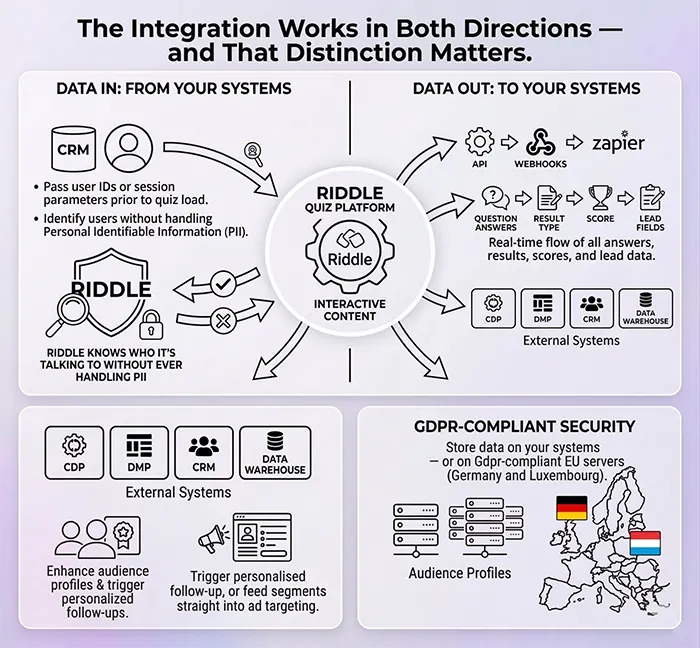
Data in – via the Data Layer:
- Your login or CRM passes in a user ID, session data, or tracking parameters before the quiz loads
- Riddle knows who it’s talking to without ever handling PII
Data out – via Riddle’s API, webhooks, Zapier, and native integrations:
- Every answer, result type, score, and lead field flows back to your systems in real time
- Connects directly to your CDP, DMP, CRM, or data warehouse
- Match declared quiz signals to existing audience profiles
- Trigger personalised follow-up, or feed segments straight into ad targeting
All data stored on your systems – or on GDPR-compliant EU servers (Germany and Luxembourg).
Publishers using this approach can build audience segments that support premium programmatic deals and direct advertiser packages – “sports fans who support Arsenal”, “readers who indicated they’re planning to buy a car in the next six months” – the kind of targeting that commands significantly higher CPMs.
4. Capture leads and grow subscriber lists
Time to launch: 1–2 weeks. Revenue model: CPL deals, subscriber acquisition.
Lead capture is one of the strongest publisher revenue tactics in the interactive toolkit – because it works with user psychology rather than against it. A reader who has spent four minutes answering questions wants their result. Placing an email opt-in between the last question and the results page converts at a dramatically higher rate than a pop-up or inline form ever would.
Riddle’s lead generation forms average a 32.83% opt-in rate across all formats. Standard website pop-ups average under 3%. That’s not a marginal improvement – it’s a different category of tool entirely.
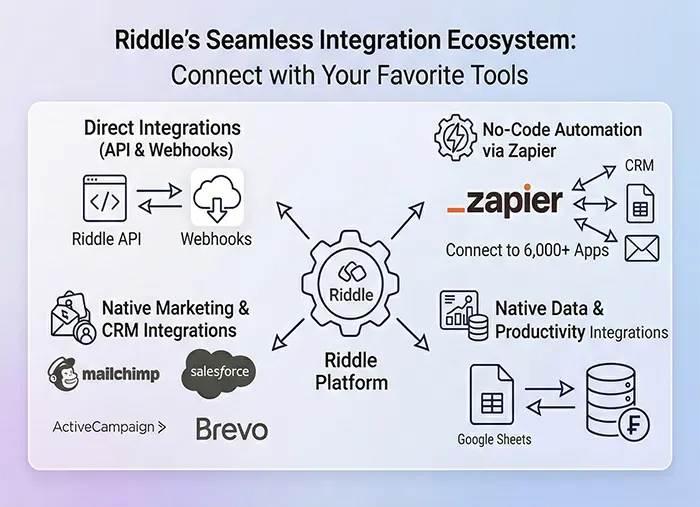
Publishers can use this in two ways:
- Advertiser product – offer lead generation at a cost-per-lead rate, with lead form fields, consent language, and data destination all configurable per campaign, so each activation is fully tailored to the advertiser
- Own growth – drive subscriber and newsletter sign-ups directly
On the data-out side: Riddle connects natively to Salesforce, MailChimp, ActiveCampaign, and most major CRM and email platforms – sending back not just name and email, but the full quiz response data alongside each lead. Anything not natively supported connects via Zapier, webhook, or API.
5. Sell sponsored and branded activations
Time to launch: 3–4 weeks. Revenue model: sponsorship fee, CPE.
This is the highest-value publisher revenue option in the toolkit – and the one that opens up entirely new commercial conversations with advertisers.
Branded activations are custom interactive experiences built around an advertiser’s campaign:
- A car brand sponsors a “Which car suits your lifestyle?” personality quiz
- A bank sponsors a financial health assessment
- A retailer sponsors a seasonal gift recommender
Each activation is fully themed to the sponsor – logo, brand colours, video ads, and custom results pages.
Built entirely inside Riddle – no agency, no dev team:
- Your content or commercial team builds directly in the platform
- Set up a Project Preset in the sponsor’s branding once
- Duplicate it for every subsequent campaign with that advertiser in minutes
For ad sales teams, sponsored interactives are a strong commercial product: high engagement, premium brand association, measurable outcomes (completions, leads, shares, time-on-content) all available through Riddle’s stats dashboard – or via automated campaign reporting via Riddle’s Looker Studio integration.
6. Fully automated contests – and the ‘you didn’t win’ email mechanic sponsors love
Contests are one of the most commercially versatile formats in the interactive toolkit – and Riddle automates the entire quiz contest process end to end. You set the schedule, the entry conditions, and the winner criteria. Riddle handles everything from opening and closing the contest at the right time, to picking a winner based on your rules, to sending winner and non-winner emails automatically.
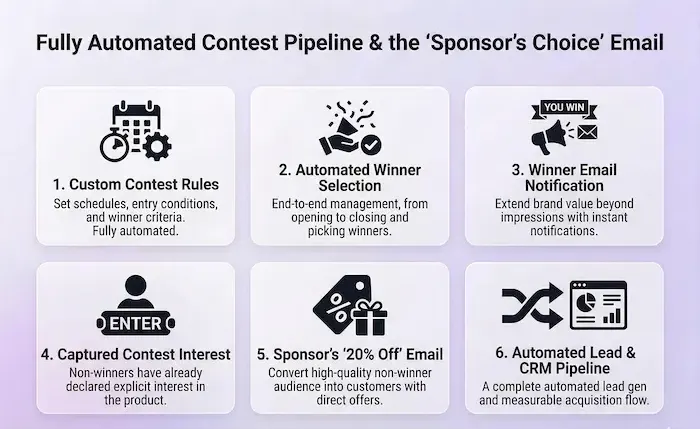
The non-winner email is the mechanic that tends to catch sponsors’ attention. Anyone who entered a contest for a prize has already declared their interest in that prize – explicitly, by entering.
A non-winner email from the sponsor (“you didn’t win, but here’s 20% off”) lands in the inbox of someone who has just raised their hand and said they want that product. That’s a fundamentally different audience quality than a standard email campaign – and sponsors recognise it.
For ad sales teams, it upgrades the conversation:
- You’re not just selling an ad placement or a branded quiz
- You’re offering a fully automated lead generation and CRM pipeline
- Built-in post-contest email flows extend campaign value beyond the contest itself
- The sponsor gets measurable acquisition outcomes, not just impressions
That’s a different line item on a rate card – and a stronger reason to renew.
How to roll this out in 2026: a practical timeline
A phased approach works best. Each stage builds on the last and opens the next publisher revenue stream:
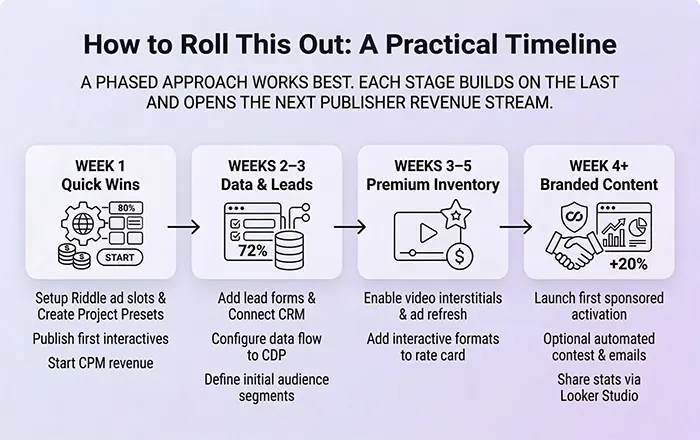
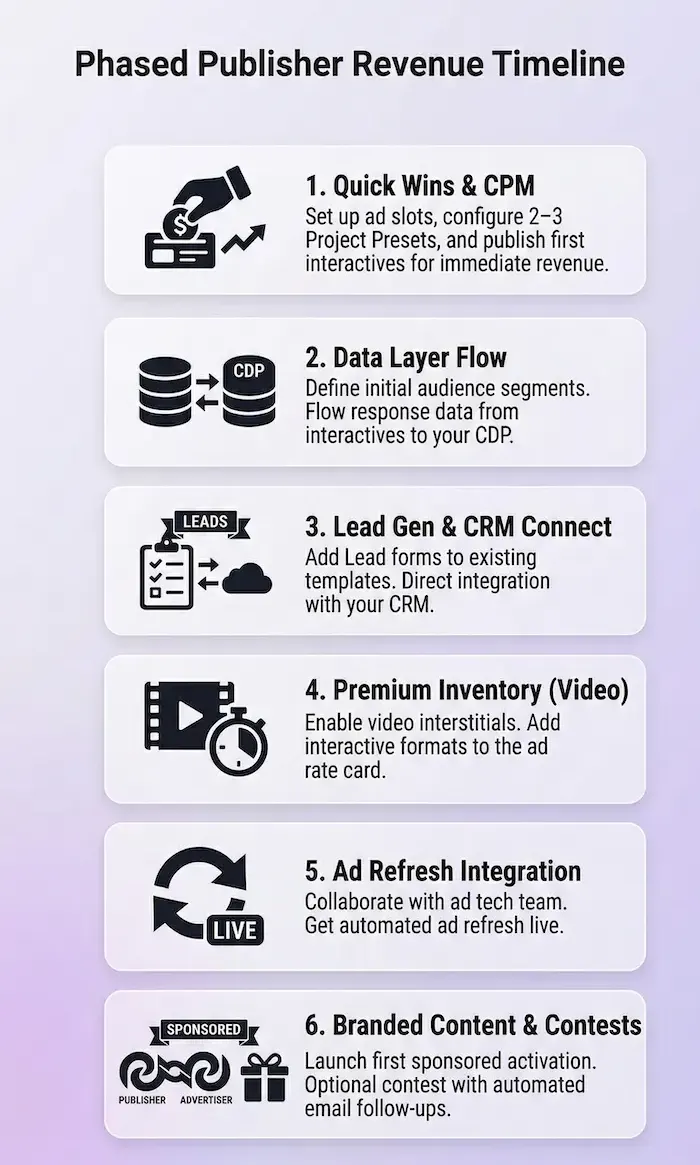
Week 1 – quick wins: Set up ad slots in Riddle, create 2–3 Project Presets with ad blocks configured, publish first interactives on high-traffic pages. CPM revenue starts immediately.
Weeks 2–3 – data and leads: Add lead forms to existing templates. Connect to your CRM. Configure webhook or Data Layer to flow response data to your CDP. Define first audience segments.
Weeks 3–5 – premium inventory: Enable video interstitials. Get ad refresh live with your ad tech team. Brief ad sales team – add interactive formats to the rate card.
Week 4+ – branded content: Create first advertiser workspace and Project Preset. Build and launch first sponsored activation – optionally with an automated contest, including follow-up emails to the winner and discount-code emails to non-winners to drive sales. Share stats from Riddle’s stats dashboard or auto-generate campaign report via Riddle’s Looker Studio integration.
How to Scale Publisher Revenue: Project Presets and Templates
The biggest friction in turning interactive content into a reliable revenue channel is usually operational, not technical – getting editorial teams to consistently use the right ad slots, branding, and settings on every piece of content, across large teams or multiple properties.
The answer is combining two things: project presets and saved templates. They work at different levels and are stronger together.
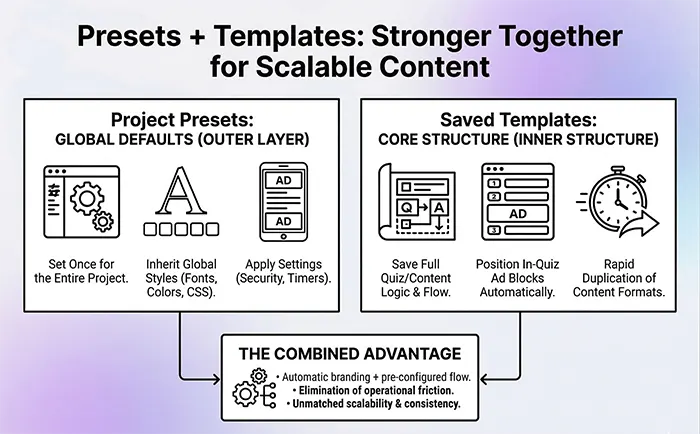
Project Presets handle the project-level defaults:
- Brand styles, fonts, and CSS
- Settings like timers, security, and branding
- Ad slots configured to appear above and below each embed
- Set once — every Riddle created in that project inherits the correct branding and ad inventory automatically
Templates go further, saving the full structure of a specific content format – including any in-quiz ad blocks. A concrete example:
- Create a “Weekly Quiz” template with 8 questions, 3 result types, and an interstitial ad block already positioned before the results screen
- The ad block points to your existing ad slots
- A team member opens the template on Monday, swaps in that week’s questions, and publishes
- The interstitial is already live and configured – nothing to set up, nothing to forget
You can also use Riddle’s global preset feature to automatically save your tracking, data collection, embed structure, and other key settings – for easier brand consistency and governance.
Setting up a preset takes around 20 minutes. Building a template for your most common format takes another 20. After that, every piece of content your team publishes is correctly monetised from the moment it goes live – with no editorial overhead per piece.
AI-Powered Publisher Revenue: Faster Content, Automated Workflows
One practical constraint on scaling interactive content for publisher revenue is time. Editorial teams are already stretched – asking them to manually build quizzes, polls, and mini-games on top of their existing workload isn’t realistic at scale.
Riddle’s AI quiz generator removes much of that constraint. Enter a topic, a headline, or paste in a URL and Riddle builds a complete interactive in seconds – questions, answer options, result copy, ready to review. Your team edits and publishes rather than starting from scratch.
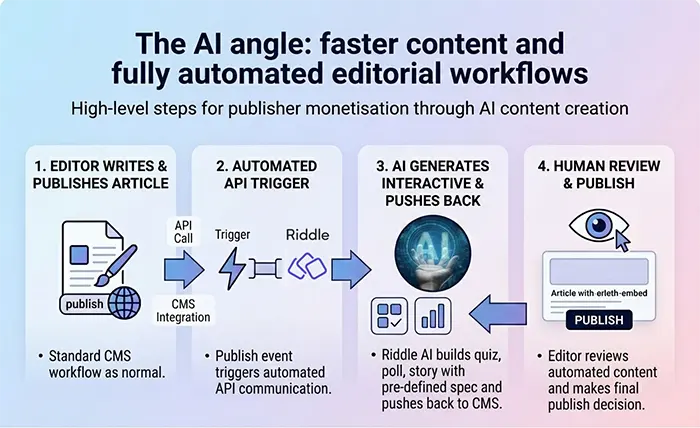
But the more powerful version of this is a fully connected editorial pipeline – and publishers can build exactly that using Riddle’s API. The workflow looks like this:
- Your editor writes and publishes article to CMS as normal
- Publishing the article triggers Riddle’s AI + API builder
- Riddle generates a related interactive to a pre-defined spec — question count, format, result structure, ad block placement
- Completed interactive is pushed back into your CMS automatically, sitting alongside the article
- Editor reviews, tweaks if needed, and publishes — saving significant editorial time while maintaining high quality
The result is interactive content that scales with editorial output rather than competing with it. Every article can have a related interactive – from quiz or poll to personality test and mini-game).
And the best part? Every interactive is already correctly structured, branded, and monetised via Riddle’s project presets. Your editors stay in control without doing the build work – the pipeline handles that.
For publishers with high content volume, this fully automated interactive creation workflow is the difference between interactive content being a special project and being a standard part of the production process.
Riddle MCP connector: Create Riddles via prompt
Now, your teams can also use Riddle’s MCP connector to connect to Claude and other AI tools. Now, your editors can build interactive content using prompts– specifying the format, types of questions, styling, and more.
The time savings are significant – allowing rapid content creation with human moderation, without additional headcount or resources.
Does this require development work?
No – and that’s a deliberate design choice.
Every publisher revenue strategy described in this post is available without writing a line of code, commissioning an agency, or involving your development team. The drag-and-drop creator, built-in ad serving, lead forms, data integrations, and branded content tools are all included in Riddle and ready from day one.
Embedding Riddle content into your CMS – WordPress, Sitecore, Drupal, Adobe Experience Manager, or anything else – is a standard iframe paste. The one exception is the page ad refresh setup, which takes around an hour of work from your ad tech team. But that’s a one-time job, not an ongoing requirement.
The Riddle team (including the co-founders) staffs the in-platform support chat directly, so if anything needs a second pair of eyes during setup, you’ll hear back fast.
Getting started
The fastest way to get a feel for what’s possible is to build something. Start a free trial at riddle.com – no credit card needed – and you can have a monetised quiz live on your site today.
For publisher teams looking to map out the full publisher revenue opportunity across their properties, riddle.com/solutions/for-publishers is the best starting point. And Riddle’s account team is available for strategy sessions to help you identify the highest-impact options for your specific setup.
- Help centre: step-by-step guides and video walkthroughs at riddle.com/help
- Video tutorials: free masterclasses at riddle.com/academy
- 20min.ch case study: how 20min.ch achieved a 20% CPM lift from ads placed inside a Riddle
Download the Riddle Content Monetization Whitepaper (PDF)
Ready to go deeper? Download the full PDF of the ‘Riddle Monetization Playbook’ – with benchmarks, case studies, technical setup guides, and the complete launch sequence.
FAQs for publisher revenue from interactive content in 2026
How do quizzes and polls actually generate publisher revenue?
Publishers can increase revenue through ad units served inside the interactive itself, page ad slot refreshes triggered by engagement, qualified lead capture forms (averaging 32.83% opt-in), and first-party audience data that supports premium inventory deals. The highest-value option is selling fully branded sponsorship activations to advertisers as standalone commercial products.
What’s the fastest publisher revenue strategy to get live – using interactive content?
Serving ads inside interactive content using your existing GAM/DFP setup can go live the same day. Simply add your ad tags in Riddle’s project settings, drop an ad block into a quiz or poll, embed on a high-traffic page, and programmatic impressions start immediately – no new ad products or development work required.
Does scaling publisher revenue with interactive content require a development team?
No. Every publisher revenue strategy in Riddle – ad serving, lead capture, data collection, branded activations – requires no development work or agency involvement. Embedding into any CMS is a standard iframe paste. The only exception is page ad refresh, which needs a one-time JavaScript listener setup from your ad tech team – roughly an hour’s work to modify our sample code.
How does zero-party and first-party data from quizzes support publisher revenue?
Quiz and poll responses are declared signals – users tell you directly what they prefer and intend, which is more reliable than inferred behavioural data. Publishers use these segments to build premium programmatic deals and direct advertiser packages: sports fans by team, travel intent, purchase behaviour – audience data generated voluntarily, inside engaging content.
How can a publisher’s ad sales teams sell (and deliver) a sponsored interactive activation?
A sponsored activation is a fully branded interactive built around an advertiser’s campaign – their logo, colours, fonts, video ads, and custom result pages – sold on a sponsorship fee or cost-per-engagement basis. Ad sales teams configure a project preset per advertiser, build in Riddle’s creator, and deliver campaign performance data (completions, leads, shares, time-on-content) from Riddle’s stats dashboard or via Looker Studio. No agency or development work required.
How does Riddle’s AI generator help with publisher revenue at scale?
Riddle’s AI quiz generator produces a complete interactive from a topic, headline, or URL in seconds – editors review and publish rather than build from scratch. Publishers can also connect their CMS directly to Riddle’s API: an editor publishes an article, Riddle’s AI generates a relevant interactive automatically and pushes it back into the CMS, and the editor polishes and publishes. Combined with project presets and templates that auto-apply ad slots and branding, every piece of content is correctly monetised from the moment it goes live.
Is interactive content publisher revenue with Riddle GDPR-compliant?
Yes. Riddle stores all data on GDPR-compliant EU servers in Germany and Luxembourg. Lead forms include configurable consent checkboxes and double opt-in confirmation. For anonymous data collection, Riddle’s Data Layer accepts an anonymous user ID from your own system so you can match responses to user profiles without passing any PII to Riddle.