We Ran the Numbers on Mid-Quiz and Pre-Result Ads
Experiment: If you run a single ad inside a quiz, how much does it actually cost you in lost completions – and does it matter whether the ad sits mid-quiz or right before the results? We tested both placements head to head and dug into the funnel to separate what the ad really does from what just looks like its effect.
Quizzes are some of the best-performing interactive content you can put on a page – more time on site, more clicks per session, more reasons for a reader to stick around – as our 2025 Quiz Marketing Report documents, across 3.13 billion answered questions.
They’re also valuable ad inventory. So the practical question for most publishers isn’t whether to run an ad in a quiz, it’s how much that ad costs in lost completions, and whether the placement changes that cost.
Introduction
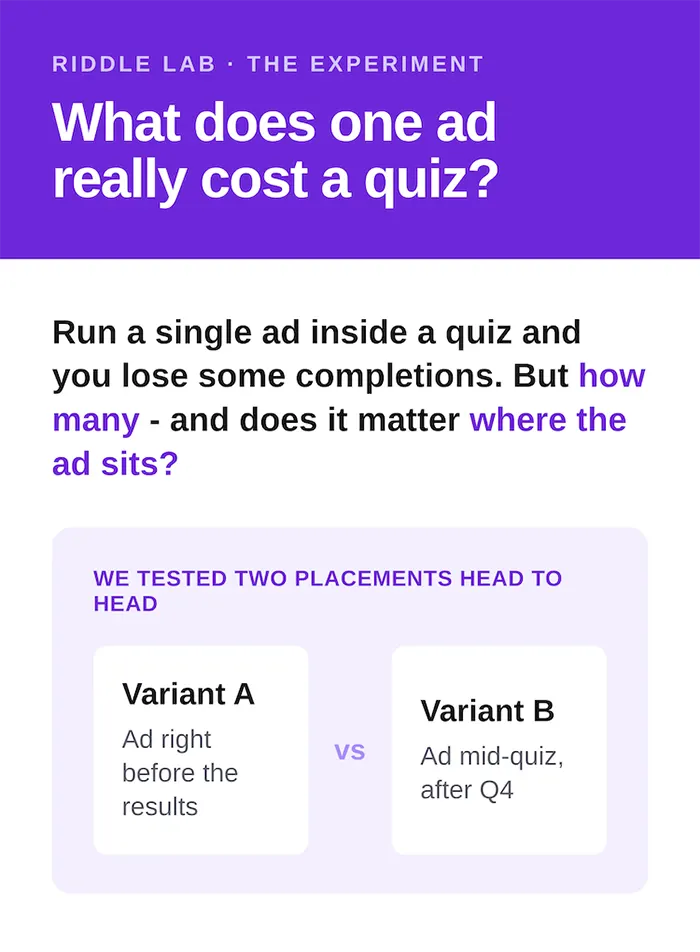
To find out, we took used Riddle’s quiz maker to create a seven-question landmarks quiz, “Do You Know the World’s Most Iconic Landmarks?” – and ran two monetized versions of it side by side. Same everything – questions, answer options, results, and one identical quiz ad.
The only thing that changed was where the quiz ad sat:
- Variant A – the ad placed right before the results, after the final question (view quiz – ad before results)
- Variant B – the ad placed in the middle of the quiz, after question 4 (view quiz – ad after question 4)
We drove comparable traffic to both. But before trusting the headline completion numbers, we did something important: we went into the block-by-block funnel to check where people actually dropped off – because, as it turned out, the obvious read of the data was the wrong one.
What do you think? How much does an ad cost a quiz?
Before you read our results, cast your vote. When you drop a single ad into a quiz, what share of the people who see it do you think keep going? Vote first, then read on.
Reader poll
Of the people who see an ad inside a quiz, how many do you think continue afterwards?
A note on the completion rates below
The overall completion rates here (around 28–32%) are much lower than what Riddles normally achieve. Our 2025 Quiz Marketing Report, based on 3.13 billion questions answered, puts the average completion rate across all formats at 73.4%. That benchmark reflects the normal setup – a quiz embedded on a relevant page, with surrounding context and an audience that arrived for the topic.
The quizzes in this test were deliberately simple and standalone, served cold with no page context, so the baseline is lower by design. That’s fine for our purposes: this test is about the effect of the ad, measured at the ad step itself, and that effect carries over to any baseline.
The trap in the headline numbers
At first glance the top-line looked clean. Variant A finished at 31.8%, Variant B at 27.5%, and A served more ad impressions (527 vs 455). The tempting conclusion: the end-placed ad is better – it completes higher and monetises more.
But that conclusion is wrong, and the funnel shows why.
An ad only counts an impression if the reader reaches it. B’s quiz ad sits after question 4 – the middle of the quiz – where, by simple funnel logic, more people should pass through than reach the end. If B served fewer impressions than A’s end-placed ad, that can only mean one thing: fewer people got to the midpoint of B in the first place. And that has nothing to do with the ad.
The drop-off happens before the ad
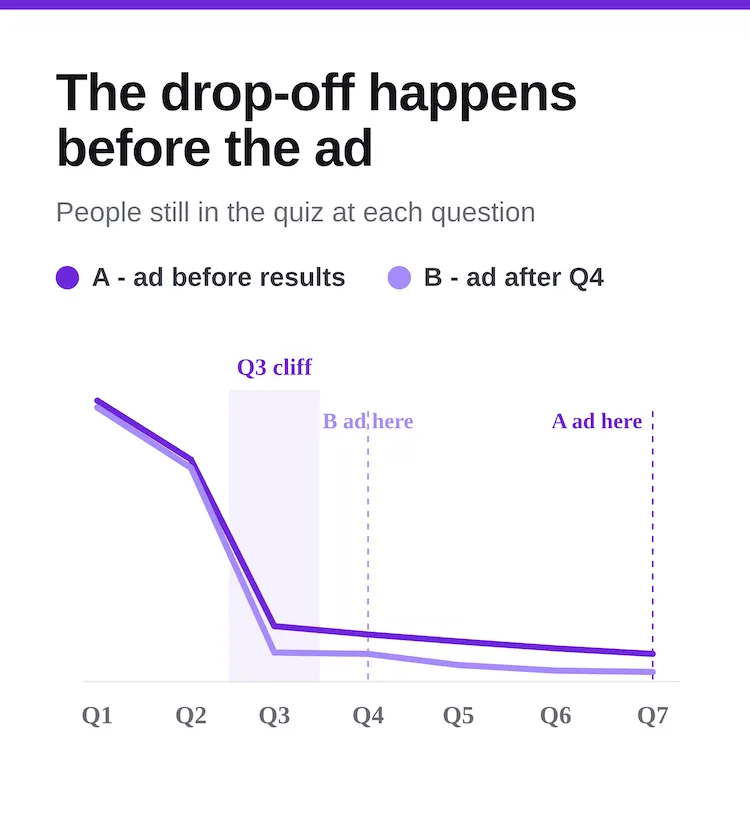
Both variants shed most of their audience at question 3 (the Big Ben question) – long before B’s ad runs after question 4. In Variant A, 572 people reached the midpoint; in Variant B, only 455 did. That gap opened up upstream of B’s ad, so the ad cannot be the cause.
B’s run simply started thinner through the early questions – an artefact of traffic and sample variance on this particular run, not a placement effect.
This matters because that same early gap is what drags B’s overall completion rate below A’s. Comparing the two raw completion figures and crediting the difference to ad placement would be measuring the wrong thing entirely.
The fair comparison: what the quiz ad itself costs
To isolate the quiz ad’s real effect, you have to look only at the step where the ad actually appears: of the people who reached the ad, how many continued to the next screen? That strips out everything that happened before the ad and measures the one thing placement controls.
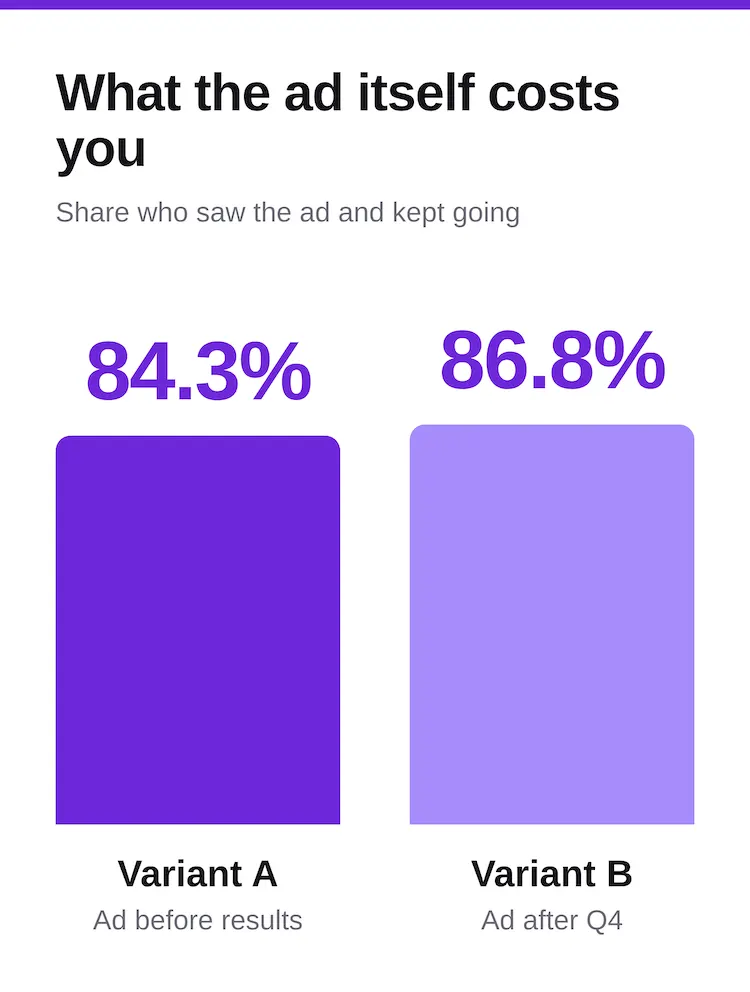
Measured this way, the two placements are almost identical – and if anything the mid-quiz ad does slightly better. In Variant B, 86.8% of the people who saw the ad continued to the next question. In Variant A, 84.3% of those who saw the ad went on to the result. In other words, a single ad costs you somewhere in the region of 13–16% of the people who reach it, and that cost barely moved whether the ad sat in the middle or at the end.
That 13–16% is the useful, transferable number for the publisher.
It’s measured at the ad step, so it doesn’t depend on this experiment’s unusually low baseline – it’s the toll a single quiz ad takes on the people who actually encounter it, and you’d expect a similar toll on a quiz completing at the 73.4% platform average on your own page.
Putting the two views side by side
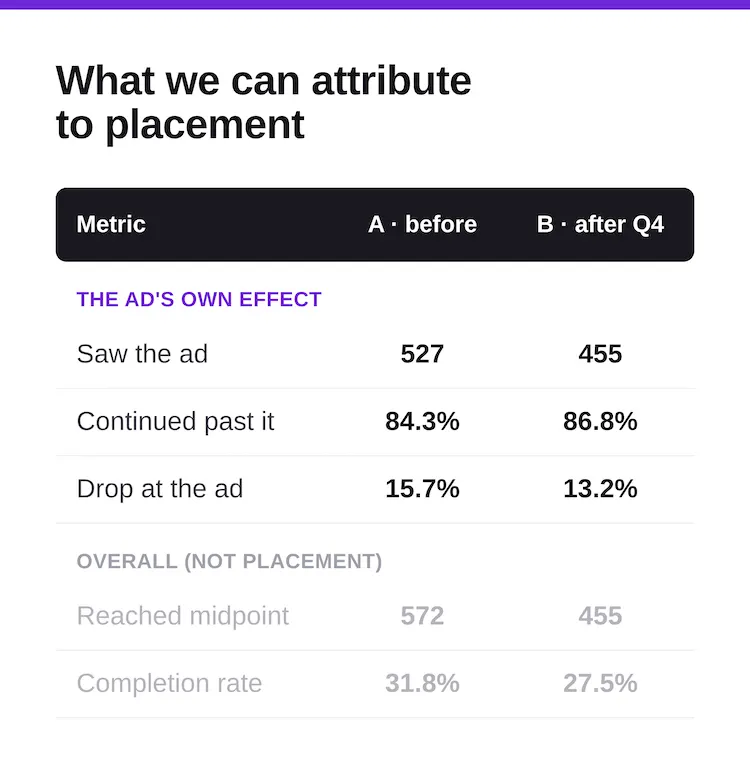
The split here is the whole point.
The top section – the quiz ad’s own effect – is a fair, like-for-like comparison, and it shows placement made little difference. The bottom section – overall completion and total impressions – is confounded by the different early drop-off between the two runs, so those numbers can’t be attributed to where the ad was placed. Keeping the two apart is what stops you drawing the wrong conclusion.
Conclusion
Three key takeaways from this experiment.
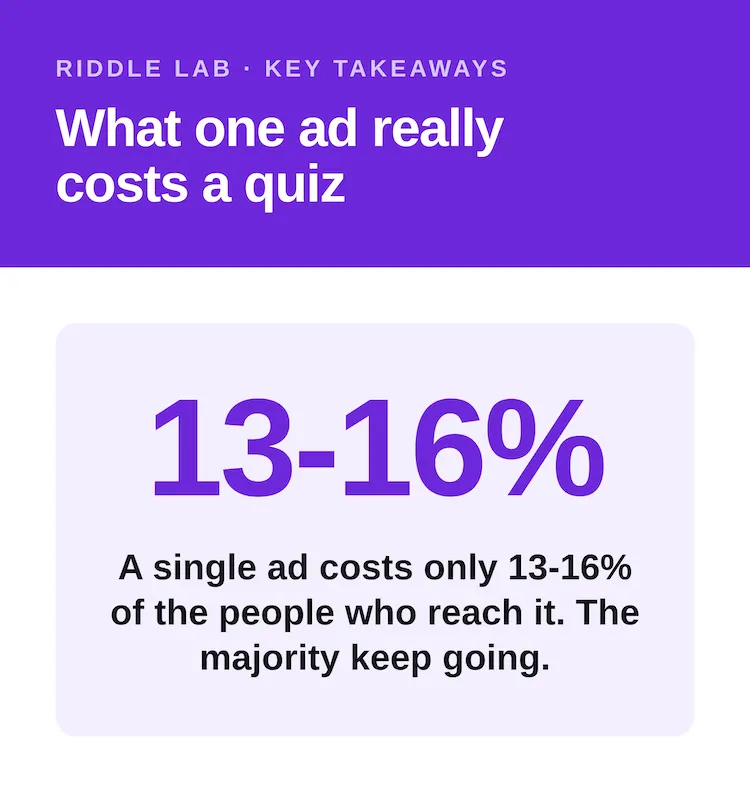
A single quiz ad costs only about 13–16% of the people who reach it. That’s the headline finding, and it’s good news for publishers: dropping one ad into a quiz does not gut your completions. The large majority of people who hit the ad keep going. For an inventory unit that earns real revenue, that’s a strong trade.
Placement makes little difference to the ad’s own cost. Mid-quiz and pre-results performed within a couple of points of each other at the ad step, with the mid-quiz position marginally ahead.
The common instinct to always bury the ad at the very end isn’t borne out – a mid-quiz ad holds its audience just as well, and reaches more people by virtue of sitting earlier in the funnel. If anything, that makes the middle the smarter default.
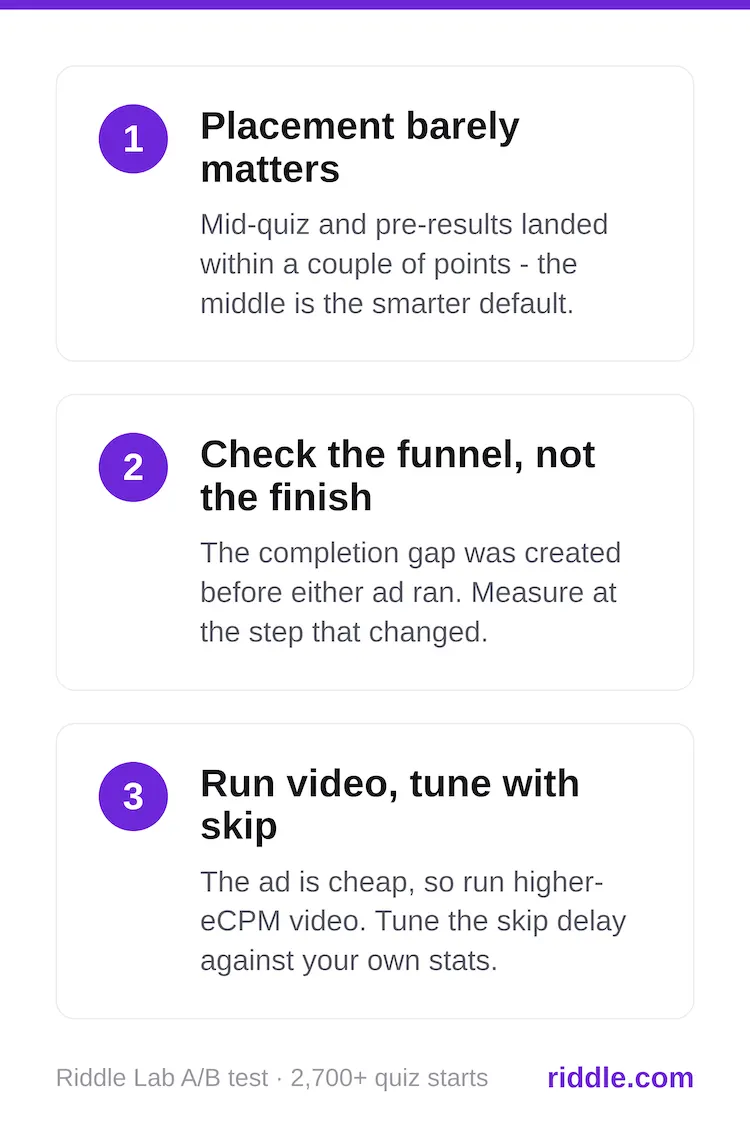
Don’t trust raw completion gaps between variants without checking the funnel.
The most important lesson from this test is methodological. The top-line numbers seemed to tell a clean story – A completes better, A monetises better – but the block-level data showed that gap was created before either ad ran. If you’re A/B testing placements on your own quizzes, measure the effect at the step that changed, not at the finish line, or you’ll credit the ad for drop-off it never caused.
One note on this run: traffic skewed heavily mobile and toward the US, UK, India, and the Philippines, and the two variants drew slightly different audiences – which is exactly why their early funnels diverged and why we measured the quiz ad’s effect at the ad step rather than at the finish line.
Measured correctly, the result is clear and consistent: a single quiz ad costs roughly 13–16% of the people who reach it, and placement does not meaningfully change that. That’s the finding, and it’s what we act on.
Our recommendation: pair video ads with skip controls
If a single ad only costs you around 13–16% of the people who reach it, the next question is how to make that ad worth the most. For publishers, the answer is usually video.
Video interstitials command far higher eCPMs than static banners – accounting for 26.5% of all online ad spending in 2025. A quiz is one of the few places a video ad runs inside a moment of genuine focus rather than fighting banner blindness. Our 2025 Quiz Marketing Report found Swiss publisher 20min.ch earned a 20% higher CPM on ad units placed inside a Riddle versus comparable units elsewhere on their site.
Riddle’s in-quiz ad block is an Enterprise feature. The catch with video is the obvious one: a clip that forces every viewer to wait costs you more completions than a banner. This is where the ad block’s two controls let you tune the revenue-versus-completion balance directly, rather than guess at it.
Both live in the ad block’s options:
- Skip ad button – lets the viewer skip the quiz ad whenever they choose. This protects completion: anyone who isn’t interested moves straight on, so the ad takes the smallest possible bite out of your funnel. The trade-off is shorter average view time, which can soften the rate a buyer will pay.
- Delay skip button – keeps the skip option hidden for a set number of seconds that you define, so every viewer watches a guaranteed minimum before they can move on. That guaranteed view window is exactly what lifts video viewability and eCPM, at the cost of a few more drop-offs from people unwilling to wait.
Read together with this experiment, the practical play is straightforward. Because the ad itself is cheap – you keep the large majority of people who reach it – you have room to run the higher-value video format rather than a banner. From there:
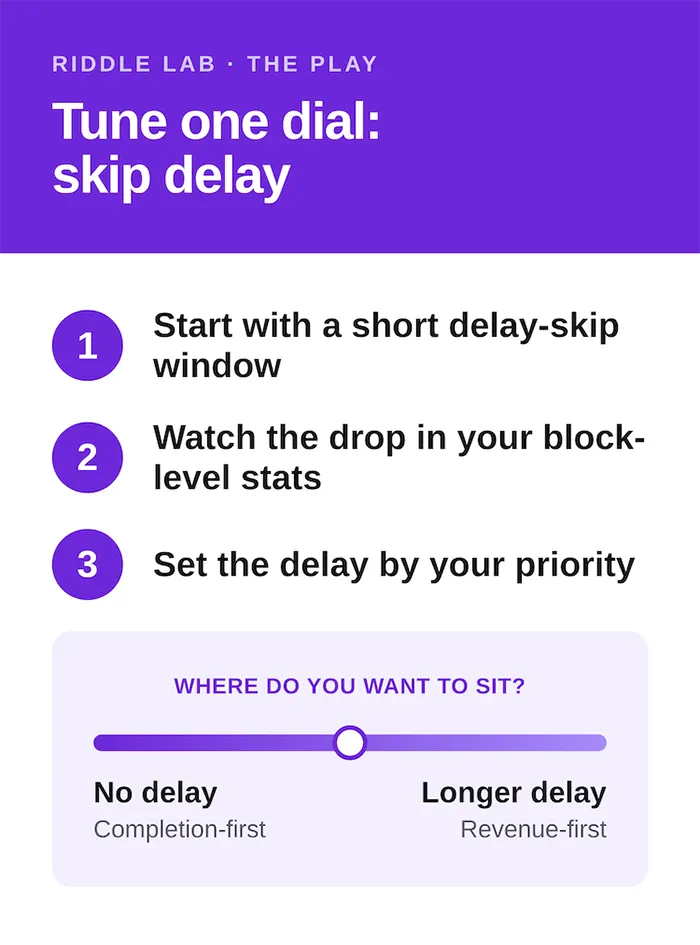
- Start with a short delay-skip window. A few seconds is enough to secure a viewable impression.
- Watch the drop at the ad step in your block-level stats, then lengthen or shorten the delay until the revenue gain and the completion cost sit where you want them.
- Pick your setting by priority: skip with no delay is completion-first; a longer delay is revenue-first. The right point between them is now something you can measure on your own content rather than leave to instinct.
For the wider picture – lead forms, sponsored content, and first-party data alongside ads – our white paper The Publisher’s Guide to Content Monetization with Interactive Content works through the full set of publisher revenue strategies in depth.
What we’d test next
This experiment settled the question we set out to answer: a single quiz ad is cheap, and where you put it barely matters. The natural extensions build on that rather than revisit it.
Does a second ad compound the ~15% cost, or is most of it already paid by the first? Does an ad placed between the result and a lead-capture form behave differently again? And how does the picture change for longer quizzes or different content types? We’ll get to those in future Lab posts.
Related reading
Riddle Lab: the form skip option – the same skip mechanic tested on lead forms.
Riddle Lab: pop-up vs quiz conversion rates – a sibling experiment on lead capture.
2025 Quiz Marketing Report – the platform-wide benchmarks behind this post.
How quizzes drove 20% more ad revenue for 20 Minuten – in-quiz ads in production.
Want to try ad placements in your own Riddles?
With our Enterprise plan, Riddle’s monetisation block lets you drop your own video or banner ads in at any point in a quiz (and keep 100% of the revenue) – with skip and delay-skip controls to balance revenue against completion, plus block-level stats so you can measure the effect properly.
Try Riddle free at riddle.com – no credit card required. All features are unlocked – with no traffic limits. You can run test campaigns on your site risk-free. Or book a 1:1 demo to talk through what this looks like for your setup.
How much do quiz ads cost in lost completions?
A single quiz ad costs roughly 13-16% of the readers who reach it. For a quiz completing at the platform average of 73.4%, you’d still expect around 62-64% of your original audience to complete it after a single ad.
Does quiz ad placement affect completion rates?
Barely. Riddle Lab’s A/B test found mid-quiz and pre-results placements performed within 2.5 percentage points of each other at the ad step itself – 86.8% continued after the mid-quiz ad vs 84.3% after the pre-results ad.
Is it better to place a quiz ad in the middle or at the end?
Mid-quiz is arguably the smarter default. It reaches more readers by sitting earlier in the funnel, and holds its audience just as well as a pre-results placement. The common instinct to bury ads at the very end isn’t supported by the data.
How do you measure the real impact of a quiz ad?
Measure at the ad step itself – what share of readers who saw the ad continued to the next screen. Looking at overall completion rates across variants is misleading, because early funnel drop-off (unrelated to the ad) skews the headline numbers.
What type of quiz ads perform best for publishers?
Video ads typically command higher eCPMs than static banners. Riddle’s skip and delay-skip controls let you tune the trade-off between revenue and completion – a short delay-skip window secures a viewable impression while keeping drop-off low.
Do quiz ads affect time on site?
Not significantly when a single ad is used. Given that quizzes already drive higher time on site than static content, a single ad with a 13-16% completion cost still leaves most of that engagement value intact.