We ran the same quiz three ways to find out.
A quiz timer is one of the simplest ways to lift completion rate and time on content – but only the right kind. We published one landmarks quiz with three timer settings and measured what each did to quiz completion, dwell time, and audience engagement across nearly 2,650 quiz starts.
Format: A/B/C test | Sample: 2,646 starts | Metric: Completion rate
Do quiz timers work? The short version:
- A per-question (block) timer won decisively – completion jumped from 36.8% to 52.1%, about 41% more finishers than no timer at all.
- A single quiz-wide timer only modestly helped – 40.4% completion, beating no timer but creating “deadline” pressure that rushed players.
- “No pressure” finished last – the no-timer version had both the lowest completion and the lowest time per player.
- Bottom line: short, resettable pressure beats both no pressure and one long countdown. Use the block timer by default.
1. The question we wanted to answer
The quiz timer is one of the most debated settings in interactive content. The argument for using a countdown timer is simple – it adds a little pressure, makes the quiz feel like a game, and nudges people to keep moving, which should lift completion rate and dwell time. The argument against is just as simple – pressure stresses people out, and stressed people quit.
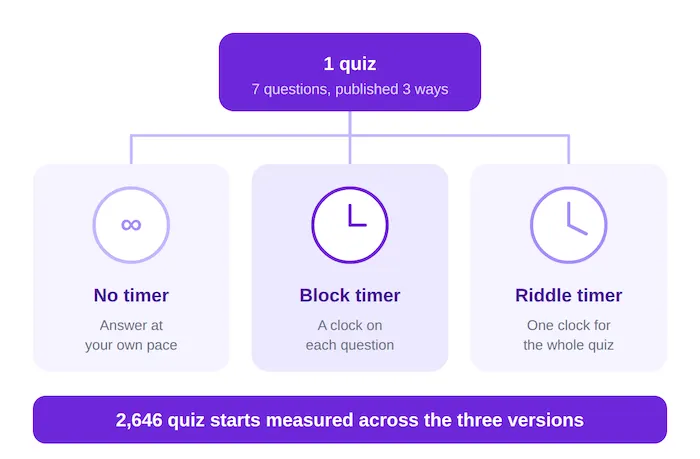
Both sound reasonable, which is exactly why we wanted real numbers rather than opinions – especially for publishers and marketers who care about time on content and ad viewability. So we took one of our most-played quizzes, “Do You Know the World’s Most Iconic Landmarks?”, and published it three times. Same seven questions, same answer options, same result pages. The only thing we changed was the quiz timer setting.
- No timer – people answer at their own pace, no clock anywhere.
- Block timer – a separate countdown on each individual question.
- Riddle-wide timer – a single countdown that runs across the whole quiz from start to finish.
We drove comparable traffic to all three versions and tracked the results. Going in, we expected the no-timer version to win – here is what actually happened.
Our assumption: we thought the no-timer version would win on completion. No pressure, no reason to quit. We expected both timer versions to scare people off and finish behind.
2. The headline result
We were wrong. The version with a timer on every question completed at a far higher rate than the relaxed, no-timer version. Below is the completion rate for each, measured as the share of people who started the quiz and reached the final question.
| Version | Completion rate | Finishers |
|---|---|---|
| No timer | 36.8% | 317 of 861 |
| Block timer | 52.1% | 537 of 1,030 |
| Riddle-wide timer | 40.4% | 305 of 755 |
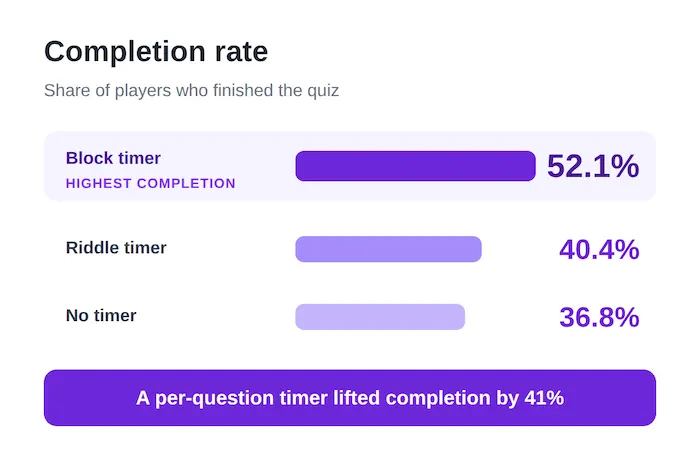
Adding a per-question timer lifted completion by about 41% over the no-timer version, rising from 36.8% to 52.1%. The single quiz-wide timer also helped, but far more modestly, reaching 40.4%.
3. Why the block timer wins (and the Riddle timer does not)
The two timer types look similar on a settings screen, but they create very different experiences for the player – and that difference shows up clearly in the numbers.
A block timer keeps the momentum local
With a countdown on each individual question, the pressure resets every time. You are never racing a clock that has been ticking for two minutes – you are just answering this one question before this one short timer runs out. That keeps the quiz feeling like a series of quick, winnable rounds rather than one long exam. People stay in a rhythm, and rhythm is what carries them to the finish.
A single quiz-wide timer can feel like a deadline
The Riddle-wide timer behaves differently. One clock runs for the entire quiz, so as it drains, the remaining time starts to feel scarce. For some players that is motivating – but for others it reframes the quiz from “fun” to “I might not make it.” That ambient pressure is milder than per-question pressure on any single screen, which is why it still beat no timer, but it lacks the repeated little wins that keep the block-timer version moving.
The pattern: short, repeated, resettable pressure (block timer) outperforms both no pressure at all and one long continuous countdown (Riddle timer).
4. Where people drop off
Completion is the headline, but it is worth looking at where along the quiz people leave. We tracked how many players were still answering at each question, indexed to the first question so the three versions can be compared on the same scale.
Two things stand out. First, this quiz lost its biggest chunk of players early, in the first third – though where the steepest drop falls will depend on each quiz’s own difficulty curve, so do not read the exact shape here as a universal rule.
You can use the Breakdown tab in Riddle’s detailed Analytics module to optimize your own Riddles – and edit/delete any low-performing questions.
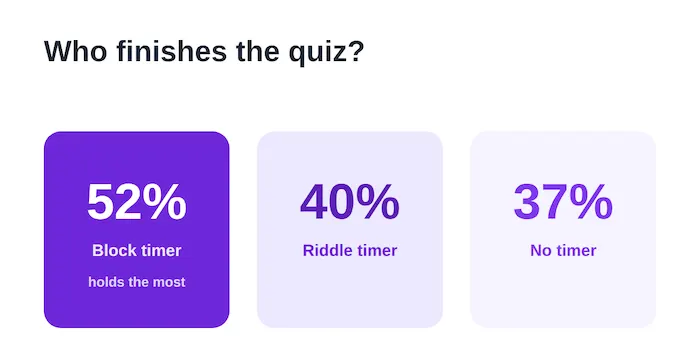
Second, once players are past that early cliff the block-timer version keeps far more of them engaged all the way to the end. By the final question it is still holding 52% of starters, against 37% for the no-timer version – and the block timer sits above the other two at every step, wherever a given quiz happens to shed players.
The lesson for quiz design matches what we see across our other Lab tests – your front-loaded questions do the heavy lifting on retention, and a per-question timer makes that early stretch feel like a game you can win rather than a chore you can abandon.
5. What happens to time on content
Completion is not the only thing publishers care about. For media sites and brands running ads, time on content is money – more engaged minutes means more impressions and a stickier page. To compare fairly, we look at time per player, since each version drew a different number of quiz takers. On that basis the block timer comes out ahead.
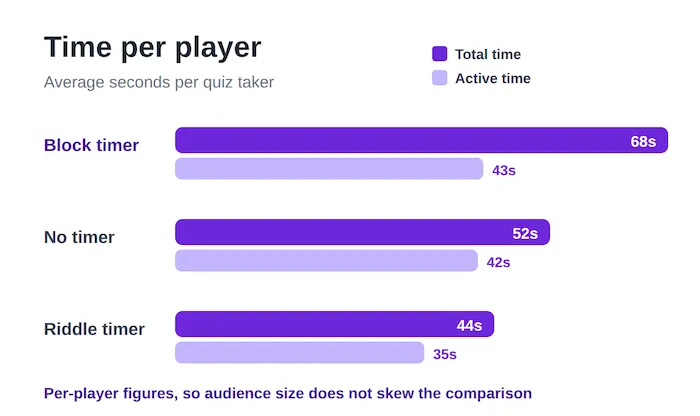
Measured per player – which is the fair comparison, since each version drew a different number of quiz takers – the block timer averaged about 68 seconds of total time per player, against 52 for no timer and 44 for the Riddle timer. So even allowing for audience size, the per-question timer kept each individual player on the content longer.
For context, the Nielsen Norman Group finds most users abandon a page within 10-20 seconds – making the block timer’s 68 seconds per player a significant improvement on the average page visit.
Active time tells a more careful story. Stripping out idle seconds, the block timer (43s) and no timer (42s) are nearly level, while the Riddle timer trails at 35 seconds.
This means:
- A per-question timer adds dwell time without reducing genuine engagement.
- Single quiz-wide clocks push players to rush and pulls active time down.
If raw dwell time is your goal, the block timer is the strongest setting; if you are chasing active engagement, it at least does no harm.
6. The numbers in one place
| Metric | No timer | Block timer | Riddle timer |
|---|---|---|---|
| Quiz starts | 861 | 1,030 | 755 |
| Completion rate | 36.8% | 52.1% | 40.4% |
| Finishers | 317 | 537 | 305 |
| Avg total time per player | 51.9 s | 68.4 s | 44.2 s |
| Avg active time per player | 42.0 s | 42.7 s | 34.5 s |
An important note on the block-timer version – about 38% of players had the per-question timer expire on at least one question, yet completion was still the highest of the three. Running out of time on a single question did not push people to quit the quiz.
7. What this means for your quizzes
The type of timer is what matters here, not whether to use one at all. Based on this experiment, here is how we would put it to work:
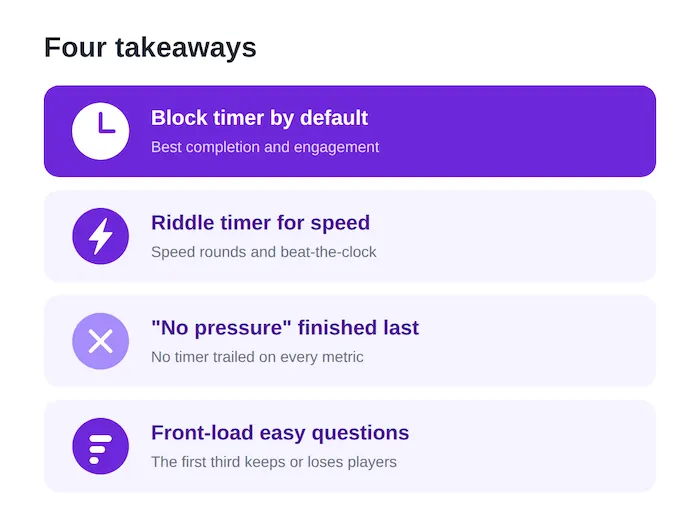
- Reach for a per-question (block) timer first. It delivered the highest completion and the most engaged time without scaring people off, which makes it a solid default for trivia and knowledge quizzes.
- Use a single quiz-wide (Riddle) timer for speed challenges. Think speed rounds, beat-the-clock formats, or leaderboards where finishing fast is the game. It still beats no timer on completion, but it compresses time on content.
- Do not assume “no pressure” is the friendly choice. The relaxed, no-timer version finished last on both completion and total time. A gentle, well-paced timer gives players structure, and structure helps them finish.
- Front-load your easy questions. Whatever timer you choose, the first third of the quiz is where you keep or lose most players. Start approachable and build difficulty from there.
A short timer that resets each question turns a quiz into a string of quick, winnable rounds. That sense of rhythm is what carried more players to the finish line.
8. How we ran the test
We published the same quiz – “Do You Know the World’s Most Iconic Landmarks?” – three times, identical in every respect except the timer setting. Each version had the same intro screen, the same seven questions in the same order, the same answer options, and the same three result tiers. Traffic was driven to all three versions over the same period, predominantly to mobile players across the US, UK, India, and the Philippines.
A quick word on the baseline numbers. Both the completion rates (roughly 37-52%) and the time per player (under a minute on average) in this study sit well below what Riddles normally reach. Our 2025 Quiz Marketing Report, drawn from 3.13 billion answered questions, puts the cross-format completion average at 73.4% and the typical quiz session at 2 minutes 48 seconds. Those benchmarks come from quizzes in their natural habitat – embedded in a relevant article, surrounded by context, reaching readers who came for the subject.
The quizzes here were built bare on purpose: short, standalone, and served cold with no page around them, which drags both the completion rate and the dwell time down by design. For this experiment that is exactly what we want. We are isolating one variable – the timer – and a difference that shows up against a deliberately plain baseline will hold up against a richer one too.
Completion rate is defined as finishers divided by starts. Time on content is the total recorded session time across all players for each version. The retention curve indexes the number of players still answering at each question to the count at the first question, so the three versions sit on a common scale. One question is a quick single-tap question that records submissions differently from the multiple-choice questions, so for the retention curve we read across it rather than treating its raw submit count as a drop-off – the finisher counts, which are unaffected, remain the basis for the headline completion figures.
If dwell time and ad viewability are what you are optimising for, the result lines up with our wider data and our 2025 Quiz Marketing Report – interactive content keeps audiences on the page far longer than static articles, and the right timer setting adds to that effect.
9. Quiz timers: what the data means for publishers
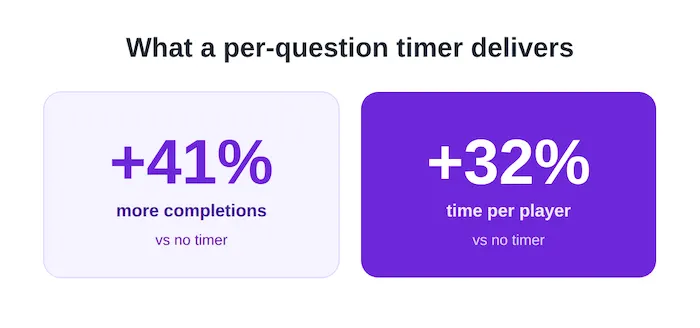
The data here is clear enough to act on. A per-question timer lifted completion by 41% and kept each player on the content 32% longer than no timer. The quiz-wide timer also beat no timer, but by a smaller margin and at the cost of dwell time.
Most major publishers have gone timer-free by default. The Washington Post’s On the Record, the New York Times’ Friday quiz, and Bloomberg’s Pointed all run without a countdown – which makes this experiment relevant: if the industry default is no timer, the question is whether that choice is costing completion rate. Our data suggests it is, and the fix is a single settings change.
Reach for the block timer first. Check your completion curve, and go from there.
Related Riddle Lab experiments
- Quiz ads and completion rates – what in-quiz ad placement costs in completion, a sibling study on the same metric.
- Pop-up vs. quiz conversion rates – how quiz momentum beats interruptive pop-ups for lead capture.
- All Riddle Lab experiments – the full library of data-driven interactive content tests.
Want to try a timer on your own quiz?
Every timer setting in this study is built in to Riddle’s interactive content platform – turn one on in seconds and watch your completion rate. Try Riddle for free – 35+ formats from quizzes to mini-games, surveys, polls, leaderboards, and more.
Frequently asked questions about quiz timers and dwell time
Do quiz timers increase completion rates?
Yes. In this test, adding a per-question timer raised quiz completion from 36.8% to 52.1% – about 41% more completions – versus the same quiz with no timer. The type of timer matters, though: a single quiz-wide timer helped far less.
Which quiz timer is best for dwell time and time on content?
The per-question (block) timer. Measured per player, to account for different audience sizes, it averaged about 68 seconds of total time versus 52 for no timer – roughly 32% more. A quiz-wide timer produced the least dwell time, since one shrinking clock encourages people to rush.
What is the difference between a block timer and a quiz-wide timer?
A block timer runs a separate countdown on each individual question, so the pressure resets every time. A quiz-wide timer runs one countdown across the entire quiz, which can start to feel like a deadline as it drains. Quiz makers designed for publishers (like Riddle) should support these timer options. In this study the block timer outperformed the quiz-wide timer on both completion and time on content.
How do quizzes help media companies meet engagement and retention goals?
Interactive content holds attention in a way static articles struggle to. Riddle’s 2025 Quiz Marketing Report, based on 3.13 billion answered questions, puts the average quiz session at 2 minutes 48 seconds and the cross-format completion rate at 73.4% – both far above a typical scroll-through. Quizzes also surface zero-party data (what your audience tells you directly), which publishers use for audience insight, newsletter sign-ups, and ad targeting without relying on cookies.
Does a countdown timer make people quit a quiz?
Not when it resets each question. About 38% of players had a per-question timer expire on at least one question, yet that version still had the highest completion rate. Short, resettable pressure kept players in a rhythm rather than driving them off.
For publishers, do quiz timers improve dwell time and ad revenue?
They can. Dwell time is what most publisher ad models reward – more engaged minutes on the page means more impressions and better viewability. In this Riddle test a per-question timer kept each player on the content about 32% longer than no timer, and because the quiz itself sits on your article page, that extra time accrues to your page, not a third party. For media companies running interactive content with Riddle, the timer setting is a one-click lever on that dwell-time number.