

Riddle vs. SurveyMonkey in 2025
A Feature-by-Feature Comparison for Publishers, Brands, and Media Companies
Interactive content has evolved far beyond simple surveys. In 2025, publishers, brands, and media companies are expected to deliver experiences that are engaging, privacy-conscious, and flexible enough to support multiple business goals – from audience growth to first-party data collection.
Two platforms that often come up in this context are Riddle and SurveyMonkey. While both support audience input and data collection, they are built with very different priorities in mind. This article takes a detailed look at how Riddle and SurveyMonkey compare in 2025, focusing on feature sets, use cases, and long-term value for organizations that rely on interactive content as part of their digital strategy.
Platform Overview and Philosophy
SurveyMonkey: Structured Feedback at Scale
SurveyMonkey has long been recognized as a leader in online surveys and forms. Founded way back in 1999, its platform is designed primarily for structured data collection, professional research workflows, and internal or external feedback programs. Over the years, SurveyMonkey has expanded into areas like market research, employee engagement, and customer experience measurement.
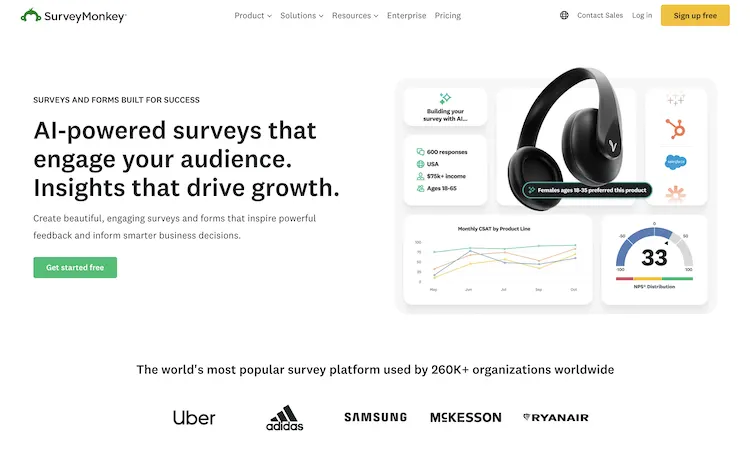
The platform’s design philosophy centers on accuracy, reliability, and scalability. It excels when teams need to ask well-defined questions, analyze responses statistically, and integrate results into broader business systems. In 2025, SurveyMonkey is a data-focused survey tool, designed for enterprises, HR teams, and researchers who value depth of insight over creative expression.
Riddle: Engagement-First Interactive Content
Riddle approaches audience interaction from a different angle. Rather than focusing solely on surveys, Riddle’s quiz maker is built as an interactive content platform. Its core goal is to help publishers, brands, and media teams create experiences that people actively want to engage with.
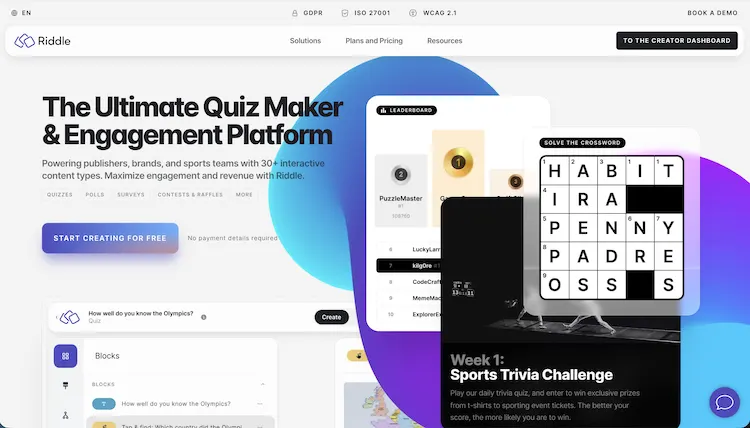
Launched in 2014, Riddle’s philosophy is rooted in engagement, privacy, and creative flexibility. Instead of limiting users to a single content type like surveys, the platform supports a wide range of interactive formats designed to increase time on site, encourage sharing, and support first-party data strategies.
This makes Riddle particularly appealing to organizations that treat interactive content as part of their editorial or marketing output rather than as a standalone research activity.
Quick Feature Comparison Chart
| Feature Area | Riddle | SurveyMonkey |
| Primary Focus | Interactive content and engagement | Surveys and structured feedback |
| Content Formats | 30+ formats including quizzes, polls, mini-games, leaderboards, predictors | Surveys, forms, questionnaires |
| Data integrations | Flexible API and webhooks plus native integrations | Excellent range of native integrations to most popular programs |
| Audience Engagement | High, designed for repeat interaction | Moderate, focused on completion |
| Privacy Approach | Privacy-first, no third-party trackers | Enterprise-grade compliance and controls |
| Best For | Publishers, brands, media companies | Researchers, internal teams (like HR) |
| Customization | Strong visual and interactive customization | Minimal customization |
Content Formats and Creative Flexibility
SurveyMonkey’s Approach to Content Creation
SurveyMonkey’s content creation tools revolve around surveys. Users can choose from a wide library of templates, add different question types, and apply logic such as branching and skip patterns. This makes it easy to build complex questionnaires that adapt based on user responses.
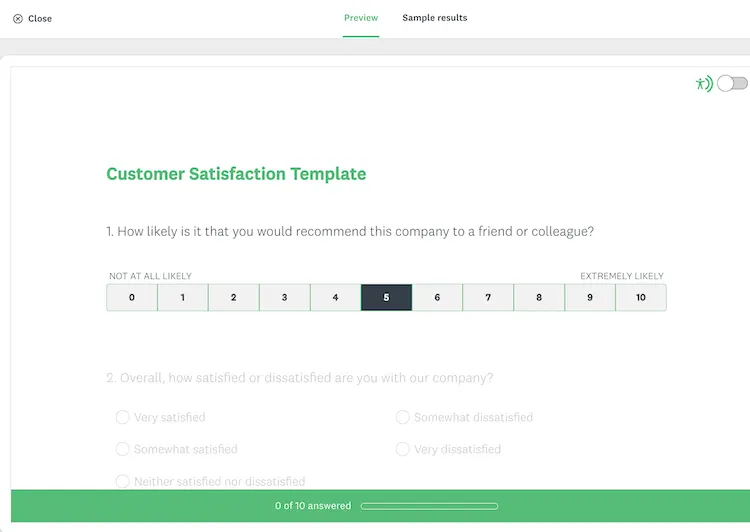
In 2025, SurveyMonkey also includes AI-assisted question generation and survey optimization features. These tools help teams refine wording, reduce bias, and improve completion rates. However, the output remains firmly rooted in the traditional survey format.
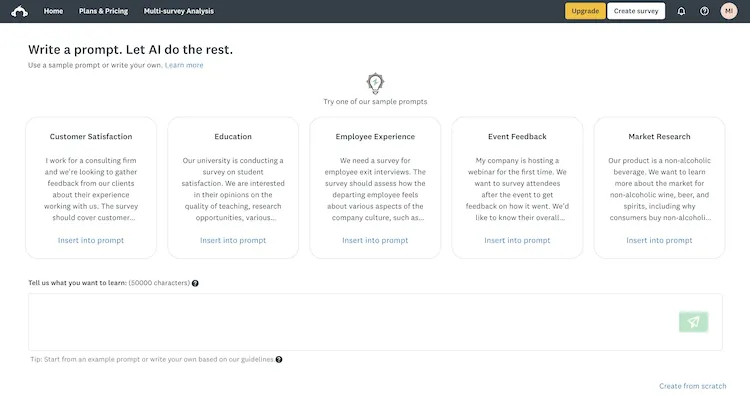
For organizations focused on collecting structured responses, this approach works very well. However, teams aiming to create interactive editorial experiences or playful, game-like content may find the creative ceiling for audience engagement relatively limited.
Riddle’s Multi-Format Ecosystem
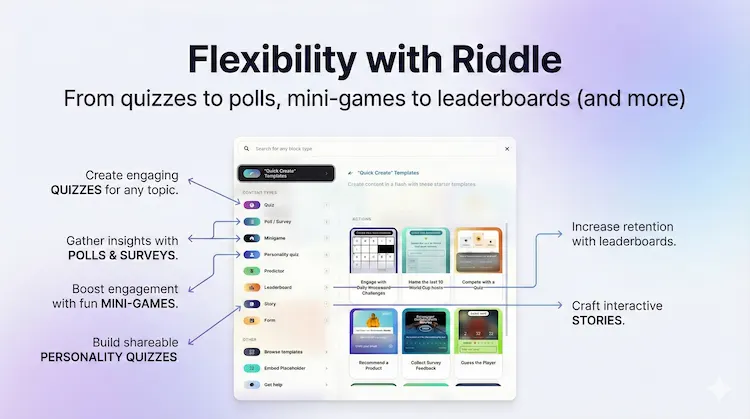
Riddle stands out for the sheer variety (30+) of interactive formats it supports. In addition to surveys and polls, Riddle enables the creation of quizzes, personality tests, trivia, score predictors, leaderboards, competitions, and mini-games like Sudoku and crosswords.
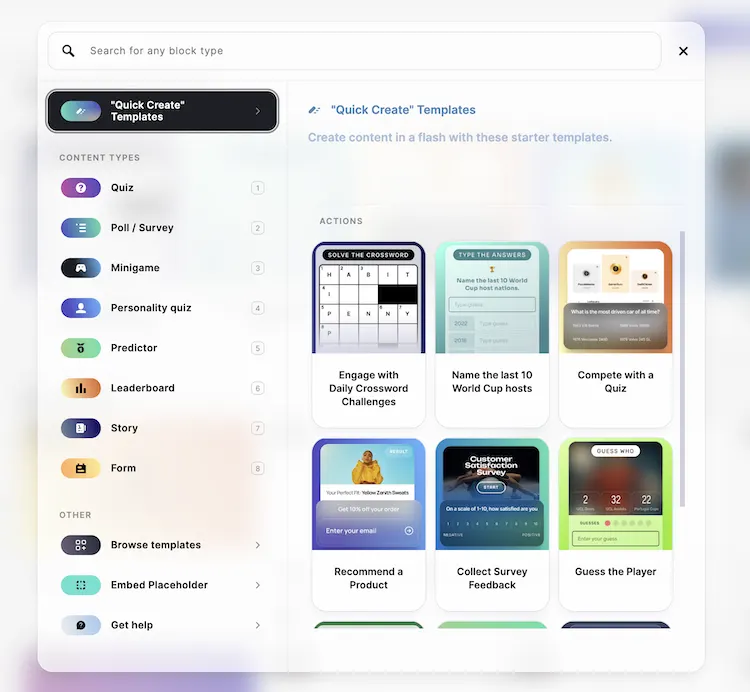
This diversity allows content teams to experiment with different interaction styles depending on audience expectations and campaign goals. A media company might use a quiz to drive social sharing, a leaderboard to encourage repeat visits, and a poll to collect opinions on a breaking news topic – all within the same platform.
Riddle also features robust AI creation capabilities, built around content creation and editorial scalability rather than survey optimization. Editors can generate interactive content by topic, create quizzes and other formats directly from a provided URL, or use Riddle’s API-based AI builder to automatically create and link interactive experiences to a publisher’s latest articles.
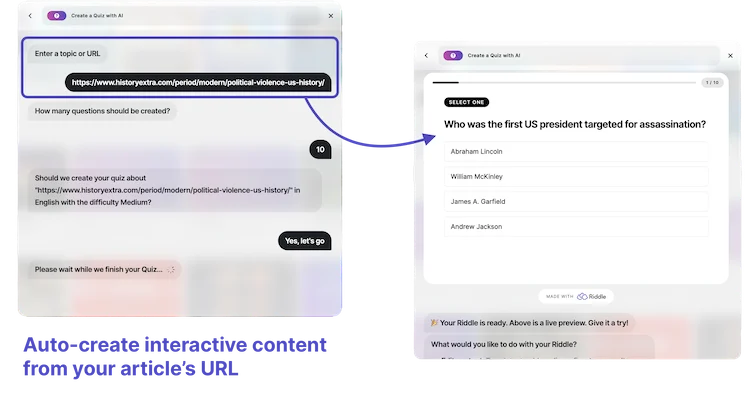
This makes it possible to deploy relevant, privacy-first interactive content at scale while keeping full control over structure, tone, and audience fit – a markedly different approach from AI tools designed primarily for survey design and response analysis.
Engagement, Retention, and Audience Value
SurveyMonkey: Optimized for Completion
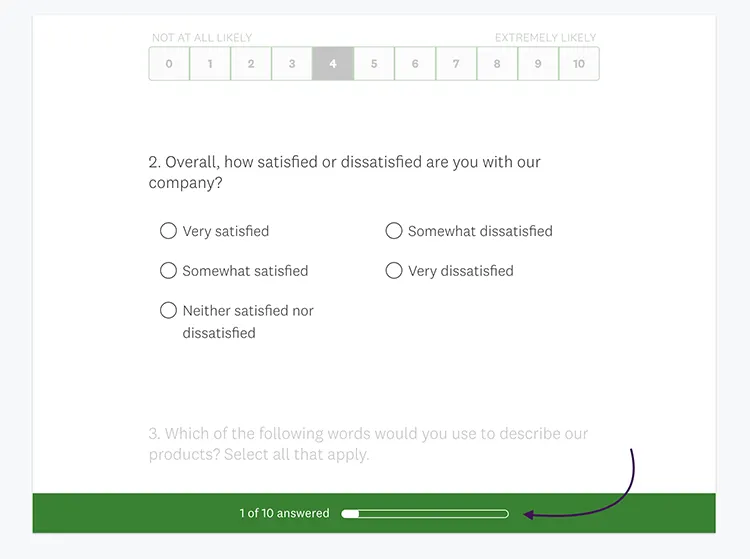
SurveyMonkey’s user experience is optimized around helping respondents complete surveys accurately and efficiently. Features such as progress indicators, mobile optimization, and accessibility support are designed to reduce friction.
While this is ideal for research and feedback scenarios, engagement typically ends once the survey is completed. There is limited emphasis on encouraging users to return (retention) or share the experience organically.
Riddle: Designed for Ongoing Interaction
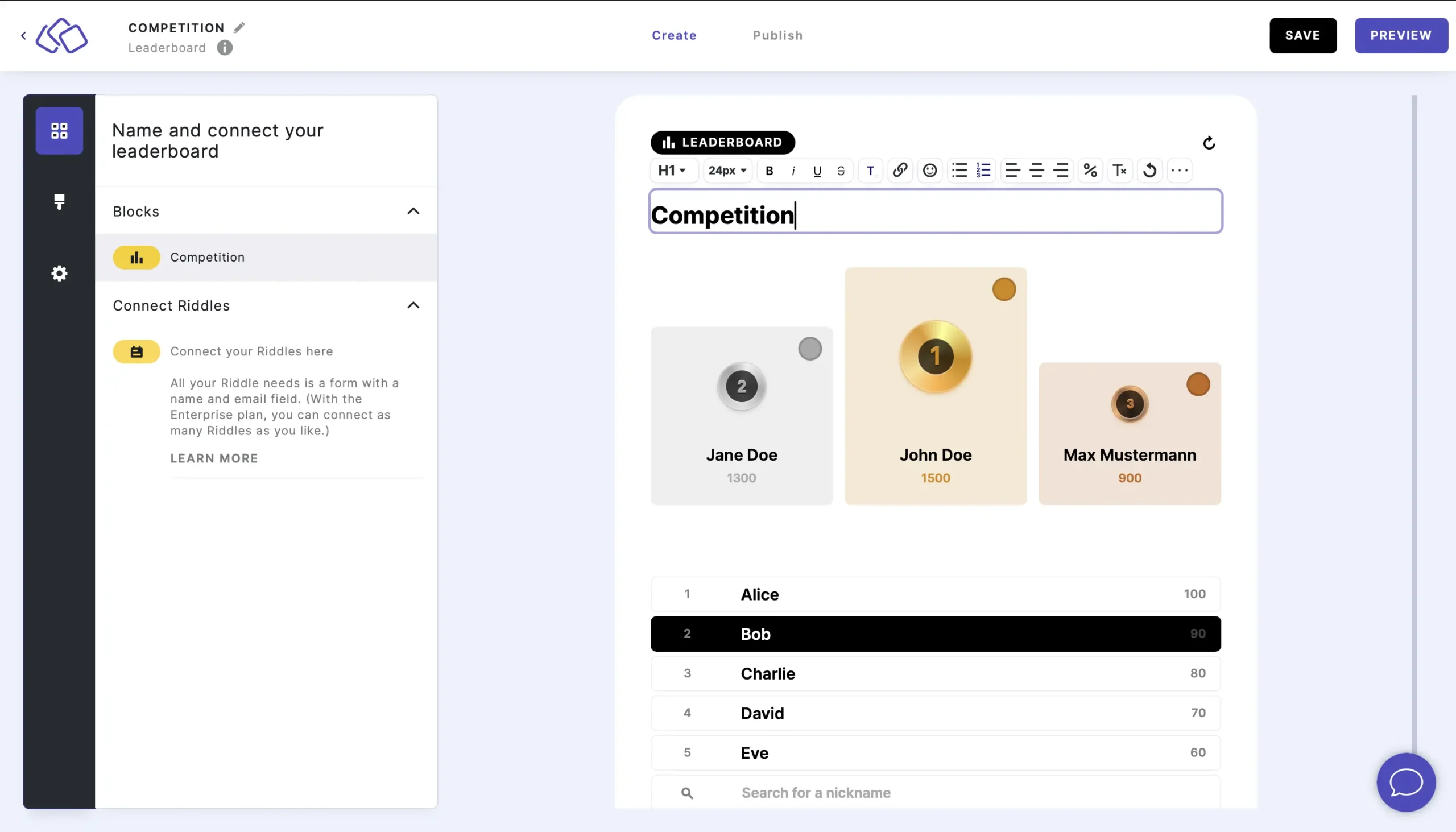
Riddle places engagement at the center of its product design. Interactive elements such as instant feedback, scoring, and competitive components help keep users interested throughout the experience.

Leaderboards and competitions add a social, repeat-engagement layer that is especially valuable for publishers and brands. Rather than a one-time interaction, audiences are encouraged to return, compare results, and participate again, as demonstrated in the Club Med case study.
Over time, this approach helps build stronger audience relationships rather than isolated data points.
Data Collection and Privacy in a Cookieless World
SurveyMonkey: Compliance and Cloud Storage Controls
SurveyMonkey operates as a cloud-based SaaS platform with data hosted primarily on AWS infrastructure. Depending on plan and configuration, customer data may be stored in the United States, Canada, or the European Union, with EU data residency available for enterprise customers.
The platform applies standard enterprise security measures, including AES-256 encryption at rest, TLS encryption in transit, and certifications such as SOC 2 and ISO 27001. SurveyMonkey supports major regulatory frameworks including the EU’s GDPR and California’s CCPA, with HIPAA compliance offered on select enterprise plans.

As an American-founded company using global cloud infrastructure, SurveyMonkey’s model works well for many organizations. However, it may require additional review for publishers or media organizations with strict data residency or privacy constraints.
Riddle: Privacy-First with No Third-Party Trackers
Riddle’s ISO 27001-certified platform architecture is a fully GDPR-compliant quiz maker, designed from the ground up around privacy-first data collection. Unlike many SaaS tools that rely on third-party tracking scripts or external analytics services, Riddle avoids embedding third-party trackers that can compromise user privacy or create additional compliance complexity.
This approach supports direct first-party data capture, aligning well with cookieless web strategies and evolving privacy expectations. For publishers and brands, this means interactive content can be deployed without introducing hidden tracking layers or dependencies on external ad-tech ecosystems.

Riddle is a 100% EU-based company, running its own servers located exclusively in Germany and Luxembourg, ensuring that all data remains within the European Union at all times. Because Riddle is a German company governed by EU law, it aligns closely with GDPR requirements and often simplifies data privacy reviews and approvals for European organizations, publishers, and media groups that require strict data residency and sovereignty guarantees.
Analytics and Performance Measurement
SurveyMonkey Analytics
SurveyMonkey’s analytics are built primarily around survey responses and structured data analysis. Users can filter results, apply cross-tabulation, segment respondents, and visualize distributions directly within the platform. These tools are well suited for extracting statistical insight from large datasets and identifying trends across respondent groups.
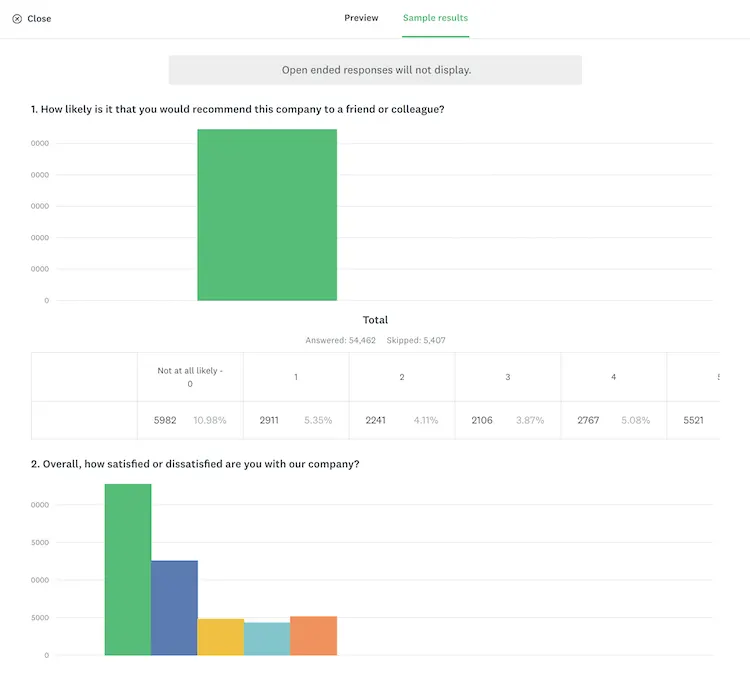
For advanced use cases, SurveyMonkey allows data export via CSV and API access, enabling organizations to move survey data into external BI platforms or data warehouses. While powerful, these workflows are often designed for analysts and data specialists rather than editorial or marketing teams focused on content performance.
Riddle Analytics, Looker Studio, and Enterprise APIs
Riddle’s analytics focus on how audiences interact with content rather than only what they answer. Metrics such as completion rates, time spent, engagement by format, and drop-off behavior provide a clear picture of how interactive experiences perform in real-world publishing environments.
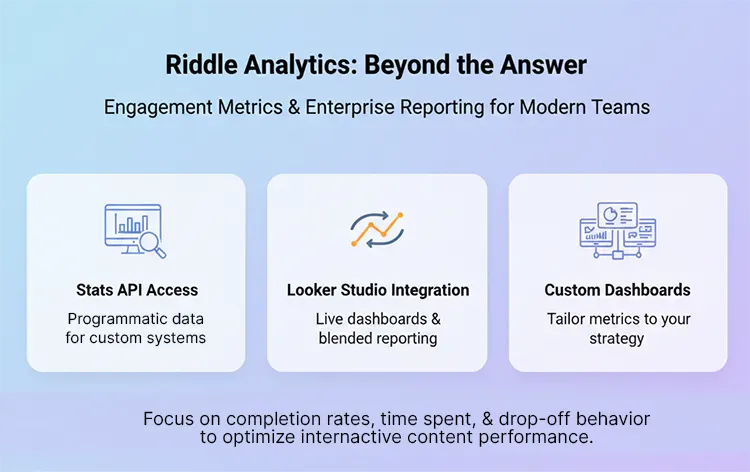
For enterprise reporting, Riddle integrates directly with Google Looker Studio, allowing teams to build live dashboards that combine interactive content metrics with other marketing or audience data sources. This supports centralized reporting without manual exports.
In addition, Riddle offers a Statistics API that enables organizations to pull engagement data programmatically into internal dashboards or BI systems. This API-driven approach supports automated reporting and enterprise-grade analytics workflows, making Riddle well suited for large publishers and brands that require scalable performance monitoring.
Builder Experience and Embedding
SurveyMonkey: Powerful but Complex
SurveyMonkey’s builder is designed for precision and control in survey logic – compared to ease of use and engaging audience-facing embeds. It offers basic visual customization options alongside branching rules and validation settings that appeal to data analysts and research professionals focused on structured data collection.
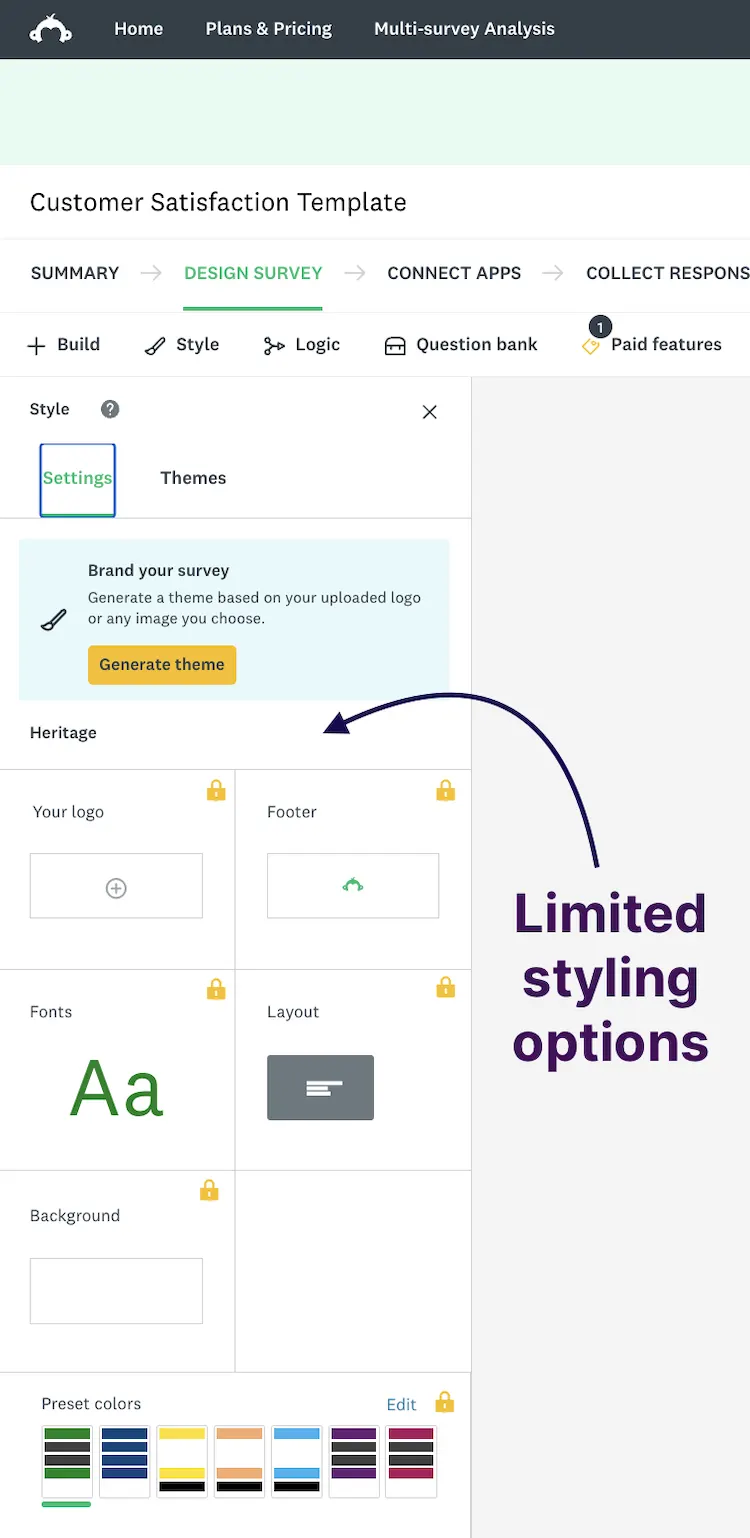
That depth can make the interface feel complex for non-technical users. Creating visually engaging experiences often requires navigating multiple configuration panels, and the overall workflow prioritizes data accuracy over creative presentation. Embedding is functional, but typically results in form-based experiences that feel separate from surrounding editorial content.
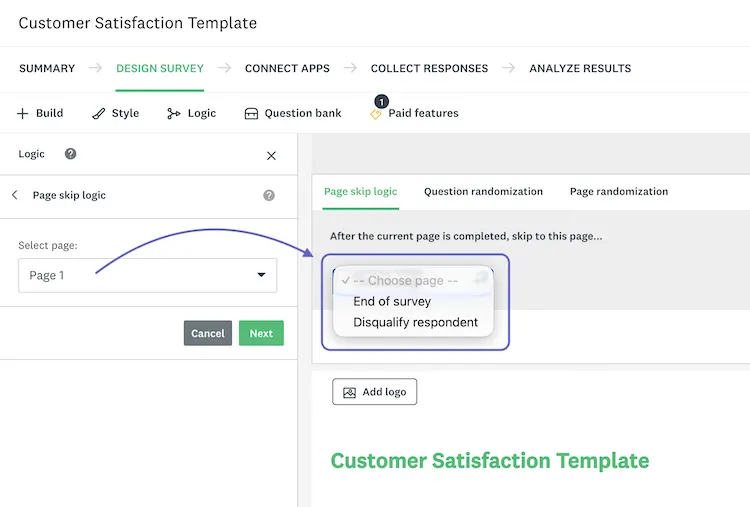
Branching logic in SurveyMonkey is relatively straightforward, relying primarily on answer-based conditions. While it includes useful features such as respondent disqualification and screening logic, it does not support score-based flows or advanced conditional display driven by external data layers. This makes it well suited for surveys and research workflows, but less flexible for interactive or game-like content experiences.
Riddle: Modern, Visual, and Publisher-Friendly
Riddle’s builder is designed to be approachable for a wide range of users, from editors and marketers to product and audience teams. The interface emphasizes visual feedback, intuitive controls, and fast iteration, making it easy to create engaging interactive content without technical expertise.
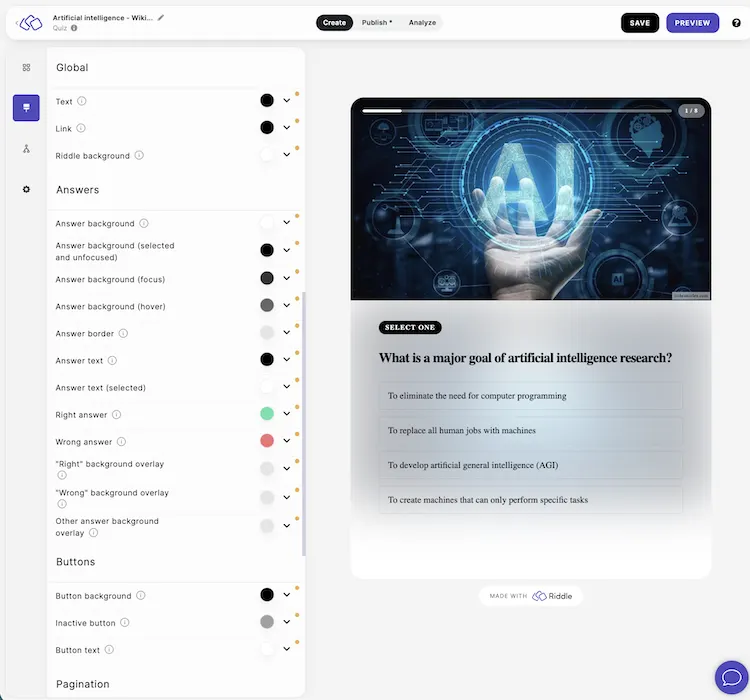
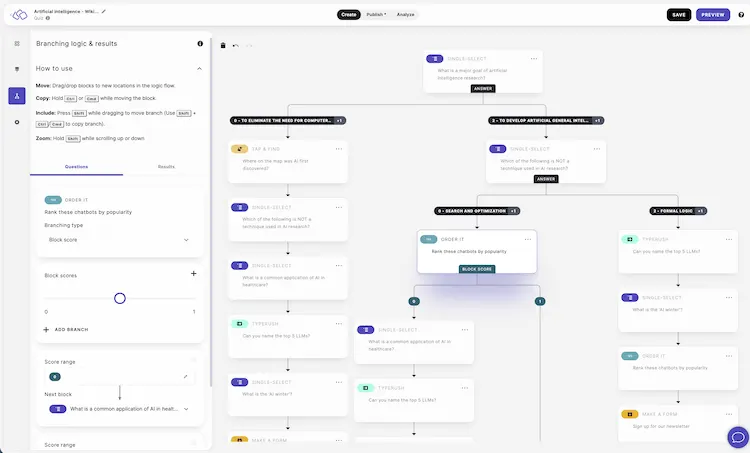
Branching logic in Riddle is flexible and easy to implement, allowing creators to guide users through different paths based on their answers without complex setup. Logic rules can be applied visually, making it simple to personalize outcomes, control content flow, and tailor results to different audience segments. This enables sophisticated interactive experiences without requiring technical or data-specialist expertise.
Embedding is a core strength. Riddle content can be seamlessly embedded directly into articles, landing pages, and CMS environments, allowing interactions to feel like a natural extension of the surrounding content. This makes Riddle especially appealing for publishers and media companies where design consistency and user experience matter.
Media Types and Visual Flexibility
SurveyMonkey: Primarily Text-Based
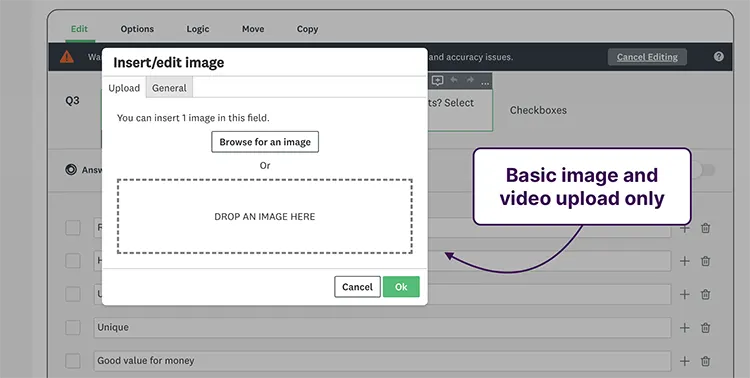
SurveyMonkey supports basic media inclusion such as images within surveys, but its overall experience remains largely text-driven. Media elements are typically used to support questions rather than to create immersive or dynamic experiences.
This approach works well for traditional survey contexts but limits creative expression for teams looking to build visually rich or multimedia content.
Riddle: Rich Media Support Across Formats
Riddle supports a wide range of media types, including images, GIFs, and video, across its interactive formats. These media elements can be integrated directly into questions, results pages, and interactive flows.

This flexibility allows content creators to build experiences that feel dynamic and modern, aligning with editorial and brand design standards. For publishers and brands, the ability to combine rich media with interaction helps increase engagement and storytelling potential.

Use Case Comparison: SurveyMonkey vs. Riddle
When SurveyMonkey Is the Better Fit
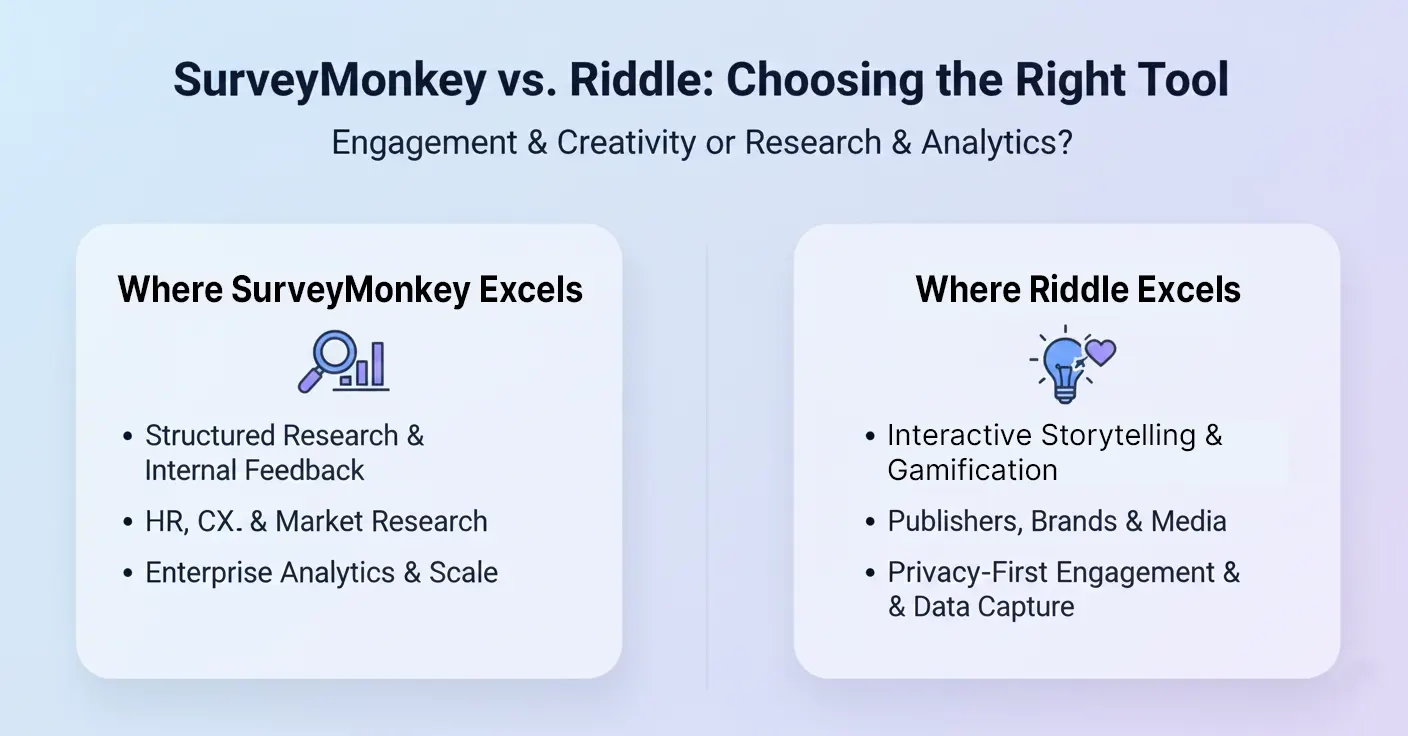
SurveyMonkey is a strong choice for organizations that prioritize structured research, internal feedback, and enterprise-scale data collection. HR surveys, customer satisfaction tracking, and market research studies benefit from its analytical depth.
When Riddle Is the Better Fit
Riddle excels when engagement, creativity, and privacy are central concerns. Publishers, brands, and media companies that rely on interactive storytelling, gamification, and audience participation will find Riddle more aligned with their goals.
Final Thoughts: Choosing the Right Platform in 2025
Riddle and SurveyMonkey are both mature, capable platforms, but they serve different needs. SurveyMonkey continues to lead in structured survey research and enterprise analytics. Riddle stands out as a versatile interactive content platform designed for engagement, privacy-first data collection, and creative freedom.
For organizations looking to move beyond traditional surveys and create interactive experiences that audiences genuinely enjoy, Riddle offers a compelling alternative in 2025.
What’s the difference between Riddle and SurveyMonkey?
SurveyMonkey is a popular general-purpose survey tool. Riddle, on the other hand, is built specifically for publishers, brands, and media companies that want to create engaging, on-brand quizzes, surveys, and forms while collecting first-party data. If you’re focused on engagement and lead generation – not just research – Riddle offers far more flexibility.
Can I fully white label and brand my quizzes?
Yes, with Riddle’s Business and Enterprise plans, you get complete white labeling – your logo, your domain, your fonts, your CSS. SurveyMonkey offers limited branding on higher tiers, but it typically includes their branding unless you upgrade to their enterprise plans. For publishers, brand control is essential – Riddle gets that.
Which platform offers more customization – Riddle or SurveyMonkey?
Riddle offers full white labeling and CSS customization, making it ideal for publishers and media brands who need content that looks 100% native. SurveyMonkey has limited branding options unless you’re on an expensive enterprise plan.
What should I look for in a survey tool for branded content?
Look for full branding control, fast performance, and audience data ownership. Riddle delivers on all three, making it ideal for sponsored content or branded campaigns. SurveyMonkey is more research-focused, with limited visual customization and less emphasis on immersive content.
Which tool is better for lead generation – SurveyMonkey or Riddle?
Riddle is purpose-built for lead generation. It includes fully customizable lead forms, logic-based redirects, and deep integrations with tools like HubSpot, Mailchimp, and Zapier. SurveyMonkey does offer lead forms, but they’re more limited and not optimized for content engagement.
Is Riddle a GDPR-compliant alternative to SurveyMonkey?
Yes. Riddle is fully GDPR-compliant, with all data stored and processed in the EU. For publishers working in Europe or with European audiences, this is a major advantage over US-based tools like SurveyMonkey, which may process data across multiple jurisdictions.