We’re often asked “Can I create a WhatsApp quiz with Riddle?” Like a lot of good questions, there’s a short answer and a more useful one.
The short version: yes, and the fastest way to do it has changed. You no longer build the quiz by hand. Paste an article URL or a topic into Riddle’s AI, and it drafts the questions, answers, and results for you in a couple of minutes. You tidy it up, publish, and share the link on WhatsApp. That’s the five-minute WhatsApp quiz this blog post’s title promises – and it’s where the rest of this guide is heading.
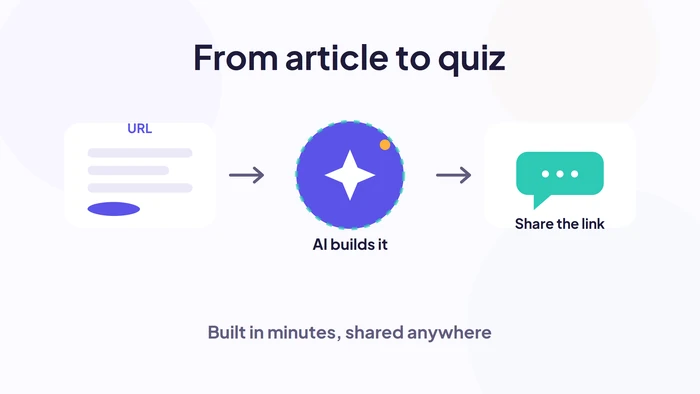
The more useful version is about where the quiz should actually live. WhatsApp’s reach is the obvious draw – it now has more than 3 billion monthly active users, so it’s a natural place to put interactive content in front of people. You can build a quiz inside WhatsApp itself, but the platform is expensive and creatively boxed in, and you don’t own the channel.
The better model is to host the quiz on your own site and use WhatsApp as the doorway. We’ll cover both, and why the second one wins for anything beyond a one-off.
The thing to remember:
- Use WhatsApp as the delivery channel.
- Use Riddle’s quiz maker as the quiz engine – now with AI doing the heavy lifting on the build.
Let’s get into it.
Build your quiz in 5 minutes with AI
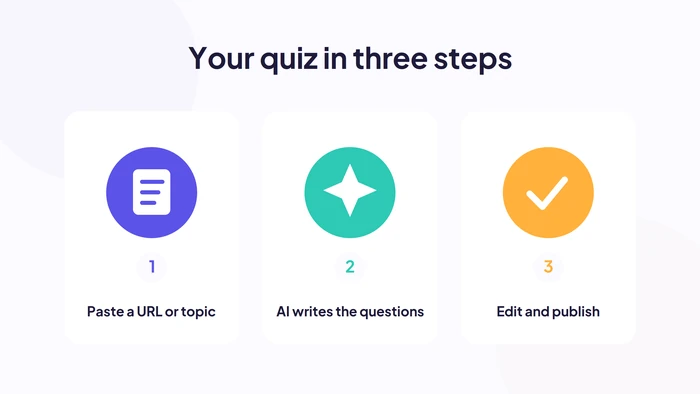
This is the part that used to take an afternoon and now takes minutes. Riddle’s AI builder turns an existing article or a single topic line into a working quiz:
- Paste a URL or topic. In the Riddle Creator, choose Create from URL with AI (or from a topic). Point it at one of your own articles, pick the format, the number of questions, and a difficulty.
- AI writes the questions. It reads the source and drafts questions, answer options, and result pages – the structure of a real quiz, not a blank canvas. It’s still worth sharpening the title yourself, since that’s what earns the click (143 proven quiz titles is a good starting point).
- Edit and publish. Adjust the wording, drop in your images, set your colours and logo, then publish and copy the link.
For editorial teams this is the unlock: any story you’ve already published can become an interactive quiz in the time it takes to make a coffee. The AI build is available on every plan, with a monthly allowance that scales by tier.
Make a WhatsApp quiz using Claude, ChatGPT, or other LLMS
Prefer to work in the AI tool you already use? You can also connect Riddle to Claude, ChatGPT, or AI tools over MCP, then build straight from a plain-English prompt – something like “build me a five-question quiz on solar panels” – and have it created in your Riddle account ready to edit and publish.
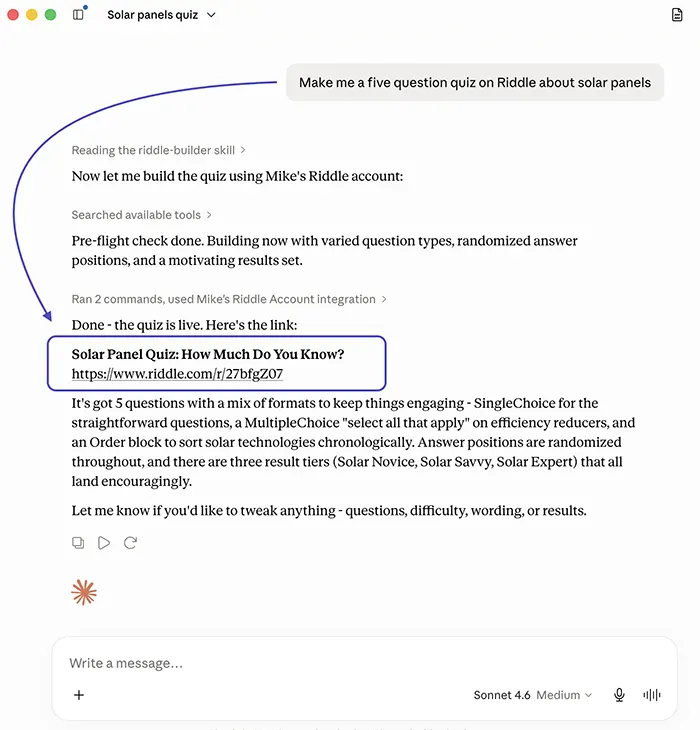
That covers the five minutes. Now to the question of where the quiz should live – because building it fast only helps if you put it somewhere that pays off.
Yes, you can build a quiz inside WhatsApp
It’s technically possible to run a quiz natively in WhatsApp, and it’s within reach of most marketers. You’ll need a business, not personal, account.
- Create and publish your quiz on Riddle (14-day trial, fully unlocked, no card required).
- Copy the landing page link, e.g. www.riddle.com/view/1234abcd.
- Set up a message template in WhatsApp Business.
- Add up to two buttons – that’s the WhatsApp maximum.
- Point each button at its own URL.
Riddle’s embed-in-email feature lets you catch the answer data from those button taps. It works. But “works” and “worth it” aren’t the same thing, and this is where the native ‘inside WhatsApp’ route starts to cost you.
Why the native route isn’t the one we’d pick
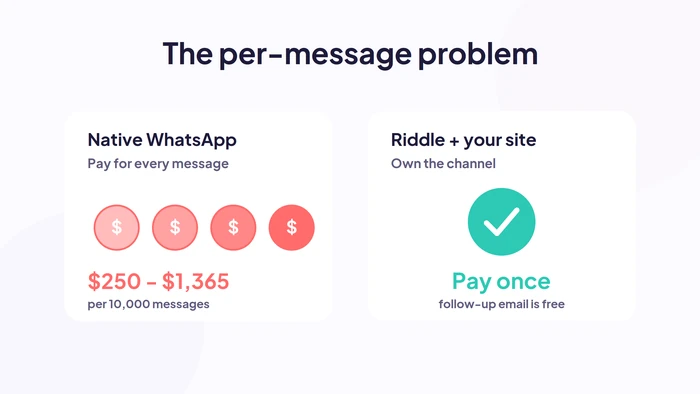
Cost: you pay for every message
A native WhatsApp quiz isn’t cheap, and a change Meta made in 2025 sharpened that. As of July 2025, WhatsApp moved from conversation-based pricing to per-message pricing – so where you once paid once per 24-hour conversation, you now pay for every marketing template message delivered. Check the official WhatsApp pricing for the current detail, but marketing rates vary widely by the recipient’s country.
| Region | Marketing rate per message | Per 10,000 messages |
|---|---|---|
| North America (US and Canada) | ~$0.025 | ~$250 |
| United Kingdom | ~$0.053 | ~$530 |
| Western Europe (e.g. Germany) | ~$0.137 | ~$1,365 |
(Rates are Meta’s marketing-template rates as of last update and change periodically; a Business Solution Provider such as Twilio or MessageBird may add its own fee on top.) Because each message is now billed separately, multi-step campaigns add up faster than they used to – ten messages to one person is ten charges, not one.
Style: text only, two answers
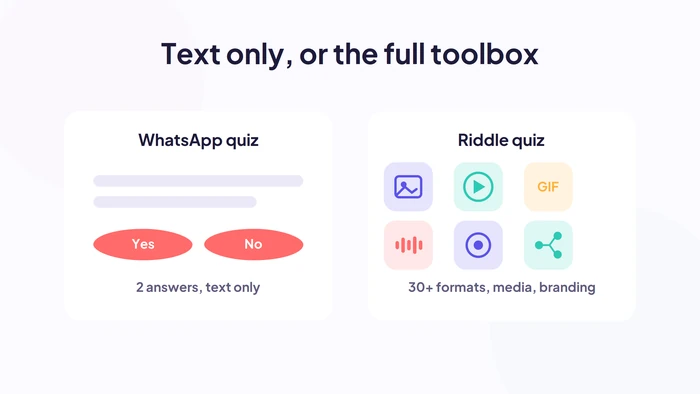
A native WhatsApp quiz is limited to what the platform allows:
- Two answer buttons and text
- No images, no GIFs or video, no fonts, colours, or logo.
- Very stripped-back experience
This might be fine for a small activation, but constraining for any brand or publisher that wants its interactive content to look like its own.
You don’t own the channel
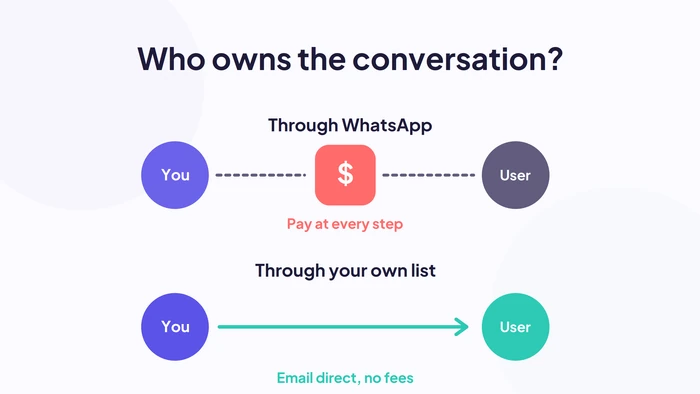
The bigger issue is ownership. On the native route, WhatsApp sits between you and your audience, and you can’t collect emails or leads in a way that lets you message people again without paying.
Picture a fairly normal lifecycle, all through WhatsApp:
- Acquisition: 2 messages
- Onboarding: 2 messages
- Product announcements: 4 messages (one a quarter)
- Account management: 2 messages (twice a year)
That’s 10 messages per person. Under the new per-message model, each one is billed separately, so reaching 10,000 people works out at roughly $2,500 in the US, $5,300 in the UK, or $13,600 in Germany – before any provider fees. Scale that to a large audience and you’re booking time with your CFO.
The better option: host the quiz on your own site
The good news is the alternative is cheaper and easier. Quizzes are a strong lead magnet – people enjoy taking them and learning something about themselves, from trivia to product-match quizzes.
Free to follow up, and the channel is yours
Add a lead form between the last question and the result and you’ll typically get around three in ten quiz-takers to share their details. Add a contest – “score 90% and win a weekend away” – and that can climb much higher. We go deeper on this in our guide to lead generation quizzes and zero-party data.
Once you have the email, you decide how and when to get in touch, and every follow-up is free. Better still, the answers people give you in a quiz are zero-party data – information they share with you intentionally, which is more accurate and more durable than anything inferred from tracking. Build the quiz on Riddle, add a lead form, and route responses to your CRM (Salesforce, HubSpot, Mailchimp, and more) for automatic follow-ups.
Your site, your brand
Hosting on your own site also opens up everything the native route can’t touch:
WhatsApp quiz: two questions, text only.
Riddle quiz: any number of questions, 30+ formats, images, GIFs, video and audio, flexible branching logic, and a long list of other features. If you’re running interactive content across a bigger team, our enterprise quiz maker guide covers doing this at scale.
Retention features that bring people back
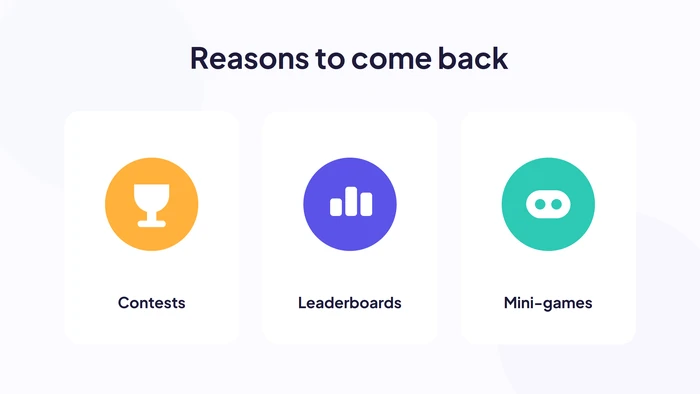
You can also give people a reason to return, using Riddle’s built-in retention tools:
- Contests: quizzes are made for contests – gate the result behind a lead form, collect data, and invite repeat visits with something like a six-week summer challenge.
- Leaderboards: make any quiz or predictor competitive with Riddle’s leaderboards, with bonus points for speed. Pro soccer team FC 08 Homburg saw a 21.73% social share rate on theirs.
- Mini-games: go past quizzes with Sudoku, crosswords, slots, and wheel of fortune for easy email collection and giveaways – here’s how to make a crossword puzzle for your site.
The best choice: WhatsApp as the entry point
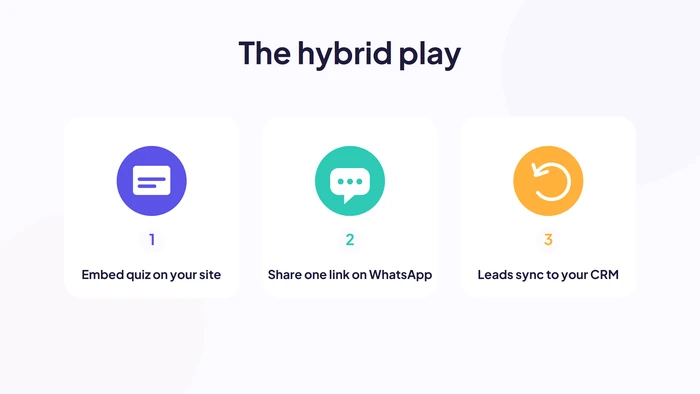
Our recommendation combines both. Use WhatsApp for reach, Riddle for the experience and the data.
- Embed your quiz on your site, with an integrated lead form.
- Send a single WhatsApp message with the quiz link.
- Sync every respondent’s name, email, and answers to your CRM automatically.
- Continue the conversation by email, with no extra WhatsApp fees.
And because the AI builder gets you from article to quiz in minutes, the whole thing – build, publish, share – genuinely fits in a short sitting.
It’s not just WhatsApp – Instagram works the same way
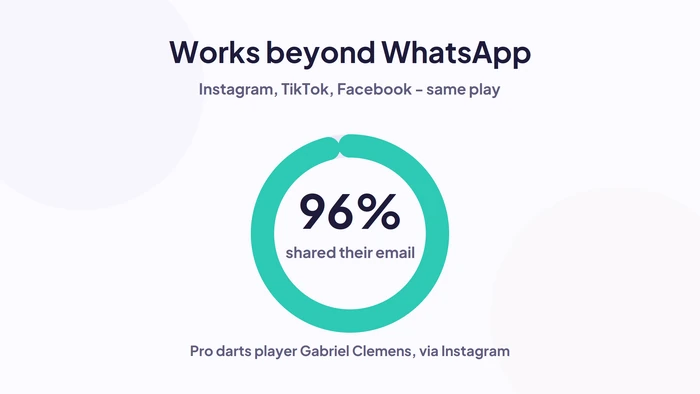
The “own your channel” problem isn’t unique to WhatsApp. Pro darts player Gabriel Clemens faced it on Instagram: he wanted to reach his 257,000 followers, but organic posts only surfaced to 12-15% of them without paid promotion.
He switched to the hybrid model – quizzes on his site, links shared on Instagram. The result: over 96% of his quiz-takers handed over their email. The same approach works on WhatsApp, TikTok, and Facebook too.
Conclusion
So: you can make a quiz inside WhatsApp, but you probably shouldn’t. It’s costly and creatively limited – fine for a small activation, weak at any real scale.
The smarter move is to flip the script. Build the quiz in minutes with Riddle’s AI, host it on your own site, and use WhatsApp to spark the click. You get richer data, full creative control, a better experience for the reader, and no per-message bill. Faster to make, cheaper to run, and it actually works.
You can start building for free at Riddle.com.
FAQ: Creating WhatsApp quizzes with Riddle
Can I create a WhatsApp quiz using Riddle?
Yes, using a couple of different options. You can build a quiz natively in WhatsApp, but it’s text-only, capped at two answer buttons per question, and gets expensive quickly. The better approach is to build the quiz with Riddle – using the AI builder to draft it from an article or topic in minutes – host it on your site, and share the link on WhatsApp.
How do I create a WhatsApp quiz in 5 minutes?
Use Riddle’s AI builder. Paste an article URL or a topic into “Create from URL with AI,” pick the format and number of questions, and the AI drafts the questions, answers, and results. Edit it to fit your brand, publish, then share the landing page link on WhatsApp. The build itself takes a few minutes rather than an afternoon.
How much does it cost to send quizzes via WhatsApp?
Since WhatsApp moved to per-message pricing in July 2025, you pay for every marketing template message delivered, and the rate depends on the recipient’s country – roughly $0.025 each in the US, $0.05 in the UK, and $0.14 in Germany as of early 2026. A 10,000-message send runs from a few hundred to well over a thousand dollars, and multi-step campaigns multiply that. Hosting the quiz on your own site and following up by email removes that per-message cost entirely.
What are the creative limitations of WhatsApp quizzes?
Native WhatsApp quizzes are text-only, with two answer buttons and no images, GIFs, video, or branding. A Riddle quiz on your site supports 30+ formats, from quizzes to mini-games like crosswords and Sudoku, plus full media, branching logic, and your own fonts, colours, and logo.
Can I collect email addresses or leads through a WhatsApp quiz?
Not directly through native WhatsApp – you stay locked into paying per message with no ownership of the relationship. A Riddle quiz with a lead form captures names and emails directly, then routes them to your CRM.
What’s a better alternative to a native WhatsApp quiz?
Build the quiz with Riddle, host it on your own site, and drive traffic to it from a WhatsApp message. You collect emails, own the channel, and pay once rather than per message.
Can I use WhatsApp to promote my Riddle quiz?
Yes, and it’s the recommended play. Use WhatsApp as the hook and send people to a fully featured, branded quiz on your site – the reach of WhatsApp with the flexibility of Riddle.
How do I track responses from WhatsApp quiz links?
Use Riddle’s embed-in-email feature or add tracking parameters to your quiz URLs, so you can attribute responses properly even when the click comes from WhatsApp.
Can I use this strategy with Instagram or other social platforms?
Yes. The hybrid approach works on Instagram, TikTok, and Facebook. Share the quiz link, send people to your site, and collect zero-party data for follow-up on your terms.
What opt-in rate can I expect?
Riddle quizzes typically see around a 30% lead opt-in rate, and a contest or giveaway can push that higher – far better ROI than any per-message platform.