A balanced comparison for teams creating interactive content at scale
Interactive content has become a core part of audience engagement strategies for organizations that publish frequently or rely on digital storytelling. Whether the goal is to grow dwell time, support sponsorship campaigns, or build richer zero-party data profiles, teams need tools that are flexible, reliable, and able to embed seamlessly across sites and channels.
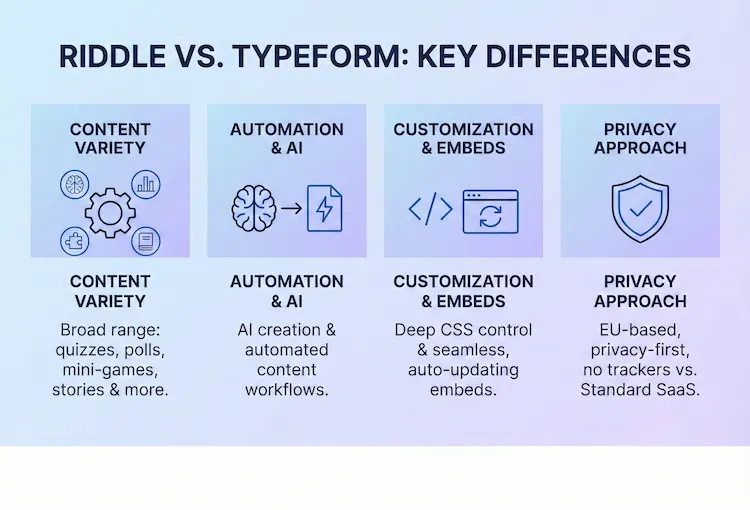
Typeform and Riddle are both strong players in this space, but they serve different needs. Typeform remains a polished and efficient form builder, while Riddle has expanded into a broader interactive content platform with formats, automation features, and data capabilities aimed at content-heavy environments.
This comparison looks at both tools as they stand in 2026, focusing on format variety, workflow efficiency, data and privacy, automation, and real-world use cases.
Format capabilities
Typeform is well known for its smooth, conversational forms and surveys. It works well for one-off polls, feedback questions, and simple quizzes where a linear experience is preferred. For organizations with lighter interactive content needs, this can be more than enough. Launched in 2012 in Barcelona, Typeform has grown rapidly through the years – and now numbers hundreds of employees, with a laser focus on providing easy to create forms, surveys, and other data collection formats.

Riddle has taken a different journey since bursting on the scene in 2014. Based in Saarbrücken, Germany, Riddle’s quiz maker offers a wider range of 30+ formats including:
- Quizzes
- Personality tests
- Polls and surveys (including NPS®)
- Score predictors
- Leaderboards
- Mini-games (crosswords, sudoku, and more)
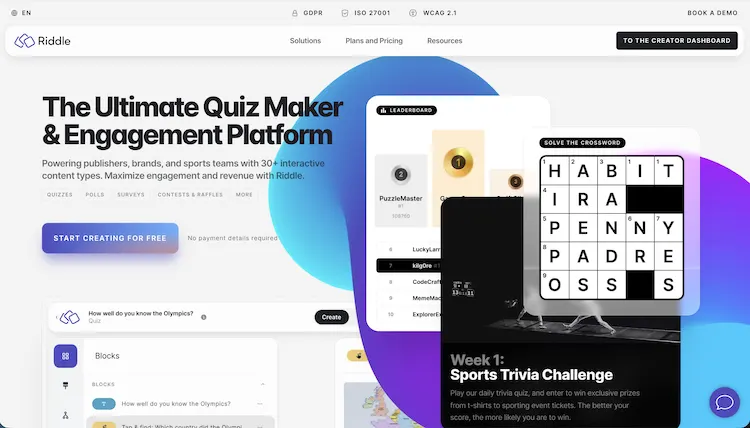
This variety appeals to publishers and brands looking to publish interactive pieces consistently. The ability to combine multiple formats in one experience, through a block-based builder, also makes it easier to create multi-step engagement pieces, sponsored content or contests, or themed content hubs.
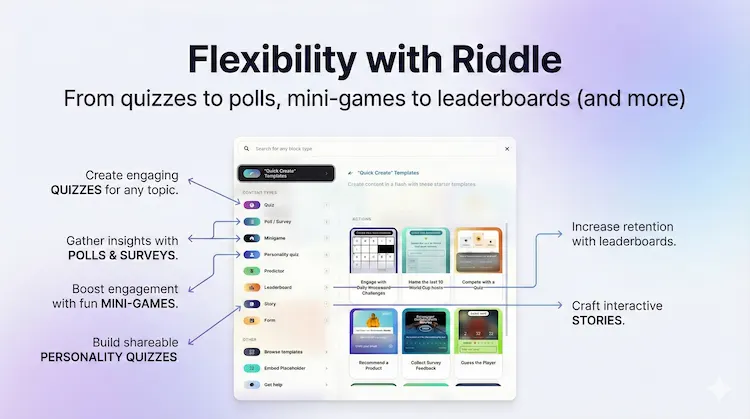
Both tools handle core interactions well, but Riddle offers more room for experimentation and long-term audience engagement.
AI creation tools
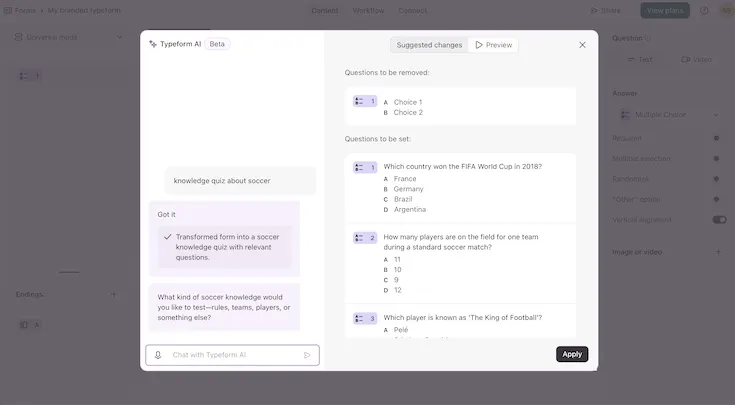
AI is increasingly becoming part of standard content workflows. Typeform uses AI primarily to help generate and refine form structures and survey questions, offering suggestions that can shorten setup time.
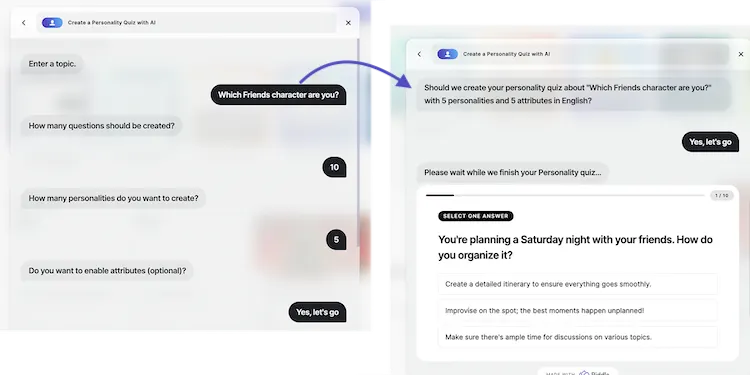
Riddle extends AI into quiz and game-based formats: supplying a topic or entering an article’s URL can generate a draft quiz, poll, or personality test that editors can adjust. This is especially helpful for organizations producing frequent topical content or working under tight deadlines.
Teams that rely heavily on forms will find Typeform’s AI support sufficient. Teams creating varied interactive content may benefit from Riddle’s broader and more flexible AI capabilities.
Content automation and workflow support
Automation matters when interactive content is part of a larger publishing strategy. Both tools offer automation features, but the scope differs.
Typeform supports automation through its API, webhooks, and integrations. It is effective for recurring survey flows, funnel automation, and generating form-based follow-ups. Its automation tends to serve marketing-style workflows.
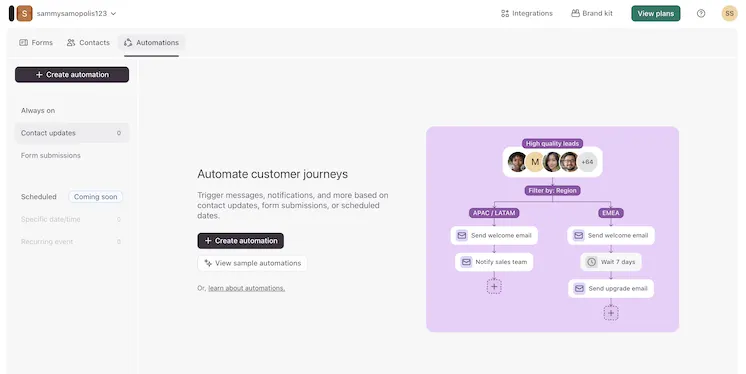
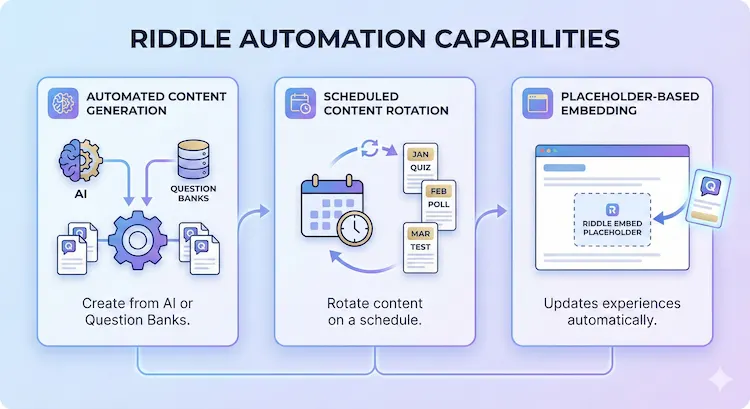
Riddle’s automation focuses on editorial and engagement workflows. It supports automated content generation using question banks or AI, scheduled content rotation, and placeholder-based embedding that updates experiences automatically. The ability to generate and refresh quizzes, polls, or mini-games without manual rebuilding can significantly reduce workload for high-frequency publishing.
Real-world use cases for 2026
How automation, leaderboards, and format variety influence engagement
Below are three practical examples showing how teams use Typeform and Riddle in real publishing and content environments.
1. Daily engagement modules for a news homepage
A news organization wants a recurring interactive element on their homepage to increase dwell time and encourage daily visits.
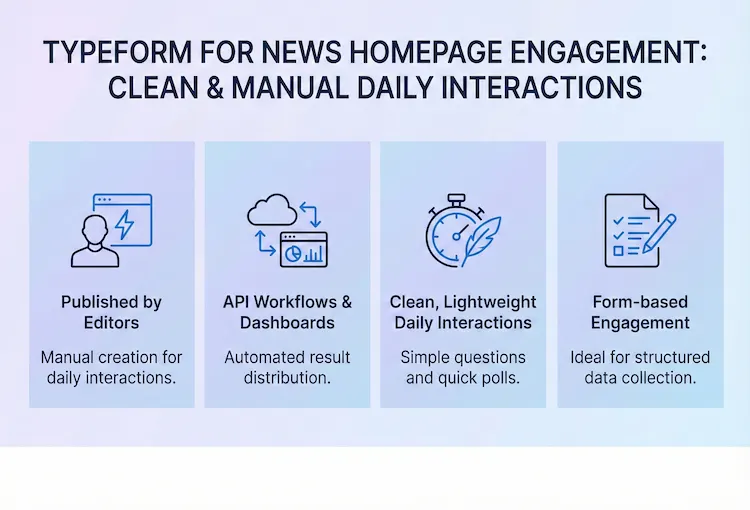
How Typeform supports this:
- Editors can quickly publish simple polls or question-of-the-day forms.
- API workflows allow automated distribution of results into dashboards.
- Works well for clean, lightweight daily interactions.
How Riddle expands possibilities:
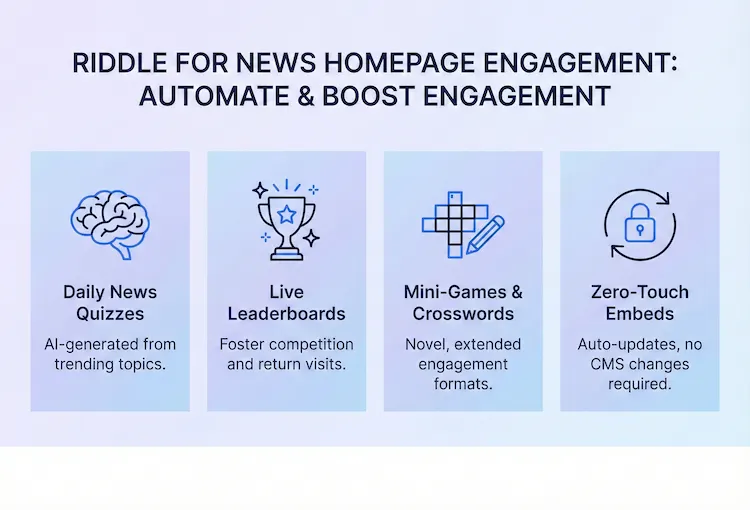
- Automation can generate a fresh quiz or poll each morning from trending news topics.
- Leaderboards give repeat visitors a reason to return and track performance.
- Mini-games and rotating formats help maintain novelty and extend on-page engagement.
- Embeds can auto-update without CMS changes.
Fit:
Typeform suits lightweight daily interactions.
Riddle suits long-term daily engagement strategies with variety and scale.
2. Sports weekend predictions with leaderboards
A sports site wants to run weekly match predictors accompanied by season-long standings.
How Typeform supports this:
- Matchweek predictors can be built with form logic and duplicated weekly.
- Responses can be exported for manual tracking.
- Good for one-off or limited-run predictions.
How Riddle strengthens this use case:
- Sports-specific prediction formats with automated scoring.
- Leaderboards that refresh automatically after each matchweek.
- Mini-games can supplement predictors for extra engagement.
- High-traffic matchdays are fully supported without response limits.
Fit:
Typeform works for basic prediction flows.
Riddle works for multi-week or season-long fan engagement.
3. Entertainment hub with high dwell time content
An entertainment portal wants a constantly refreshed hub of quizzes, trivia, personality tests, and mini-games to keep fans active on the site.
How Typeform helps:
- Quick publishing of simple quizzes or rating forms.
- Effective for collecting opinions, preferences, and fan sentiment.
- Works well when data capture is the priority.
How Riddle enhances this:
- Automated content rotation using placeholders or schedules keeps the hub fresh.
- Mini-games (crosswords, word puzzles, timed challenges) boost dwell time.
- Leaderboards create competitive loops that encourage repeat visits.
- Multi-format rotation prevents interaction fatigue.
Fit:
Typeform is effective for lighter feedback and single quizzes.
Riddle is ideal for building a persistent entertainment hub.
Lead generation, data collection, and integrations
It’s no surprise that Typeform is a strong option for lead generation via forms and surveys. It integrates well with CRM systems, email tools, and marketing platforms. Organizations running simple funnels will find what they need – with a good range of fields and options to collect data.
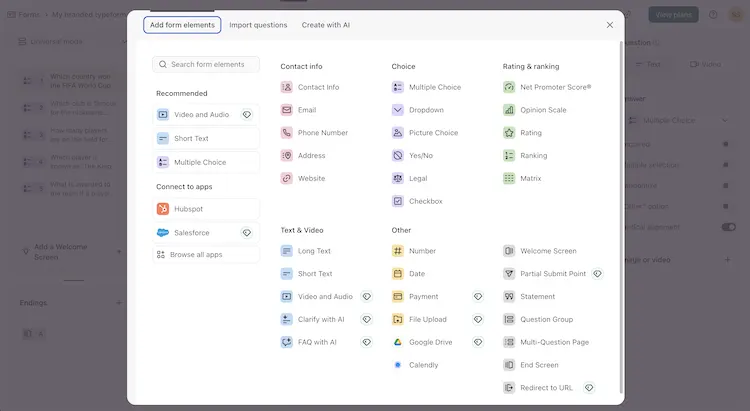
Riddle’s lead generation adapts to more complex workflows. It has a similarly broad set of question formats – including NPS surveys, dropdowns, and more.
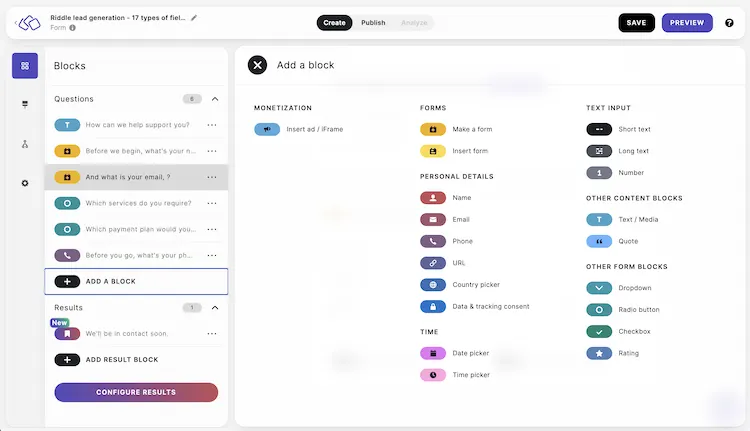
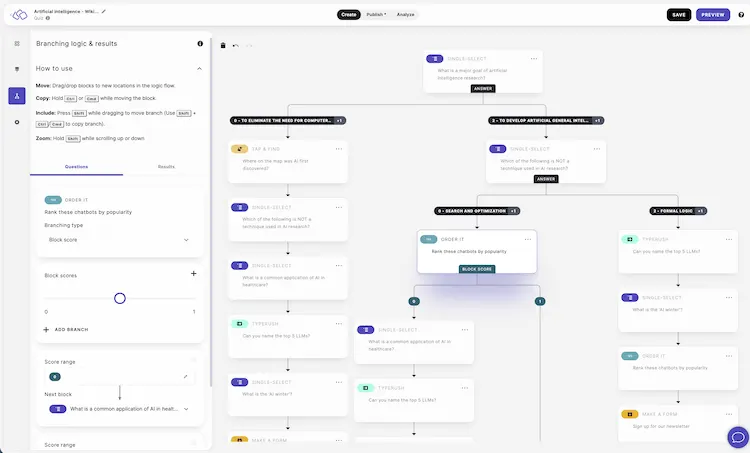
However, teams can place lead forms at various points in an experience, use conditional branching logic, and pass hidden fields into analytics and CRM tools. For recurring engagement modules or sponsored campaigns, this flexibility makes it easier to maintain both editorial and commercial objectives.
Data layer and technical integration
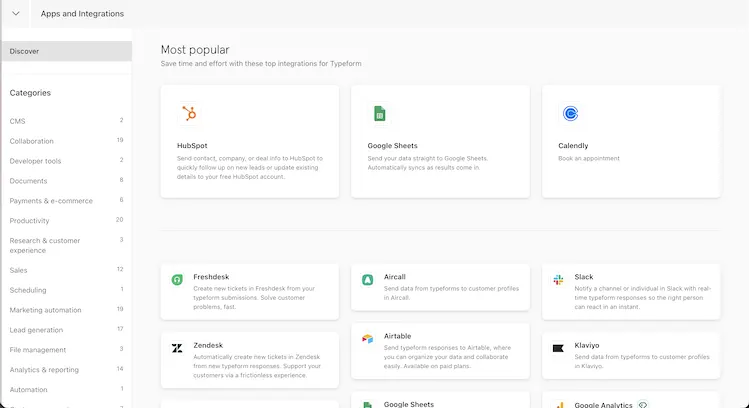
Typeform’s embedding and export capabilities are well suited for straightforward deployments – with an industry-leading extensive range of native integrations. Teams can integrate form submissions into marketing or analytics systems without difficulty, ideal for smaller businesses with basic requirements.
Riddle supports native integrations like Salesforce and Mailchimp, but also features a deeper technical integration option through its data layer. This lets sites pass user IDs, UTM parameters, subscription states, or other metadata directly into an experience and back into internal systems. For organizations managing subscription models or personalization strategies, this can simplify data workflows.
Pricing and data privacy
Typeform (response-based pricing)
- Free plan with a very limited monthly response allowance.
- Basic plan at roughly $25 per month with unlimited forms and questions, capped at around 100 responses monthly.
- Plus plan around $50 per month with higher response limits (about 1,000 responses monthly), removal of Typeform branding, and use of a custom subdomain.
- Business plan around $83 per month with up to roughly 10,000 responses monthly, priority support, analytics features, and multi-user collaboration tools.
- Enterprise plan with custom pricing based on required response volume, seats, and advanced enterprise features.
Implication: Costs scale with usage. Predictable traffic works well; viral or high-volume content may require frequent plan adjustments or monitoring.
Riddle (feature-based pricing with unlimited usage/traffic)
- Essential plan starting at $59 per month with all content formats included plus unlimited content, views, responses, and submissions.
- Pro plan at $119 per month adding white-label branding, custom logos, and tracking integrations.
- Business plan at $249 per month adding custom CSS, custom fonts, API access, advanced tracking, multiple domain support, and ad-serving options.
- Enterprise plan at $749 per month offering multi-quiz leaderboards, custom user roles, advanced integrations, SSO, custom media libraries, and high-concurrency support.
Implication: Flat-rate, unlimited usage removes concerns about traffic spikes or large-scale campaigns and simplifies long-term cost planning across high-volume environments.
Data privacy and GDPR/CCPA-compliance
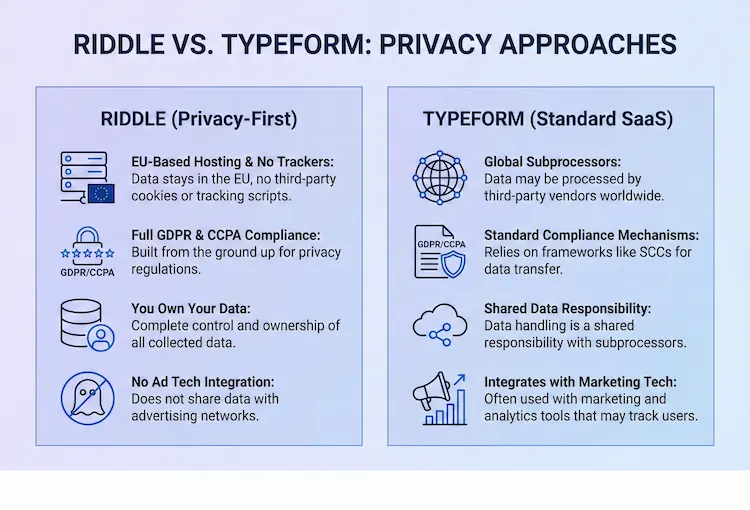
Typeform takes a more conventional approach to data handling. Its infrastructure is based in the United States, and the platform relies on several third-party tools and trackers.
For organizations working under strict privacy or compliance requirements, this setup can add extra steps. Teams may need to run privacy assessments, review subprocessors, and keep a close eye on cross-border data transfers to ensure everything stays compliant. This can introduce ongoing overhead, especially for companies managing sensitive data or operating at scale.
Riddle takes a different path by designing its platform around privacy from the start. All data is hosted within the EU, and the platform avoids using third-party trackers or embedded external scripts.
For businesses operating under GDPR or similar regional regulations, Riddle’s philosophy provides a straightforward and predictable privacy framework. It reduces the need for additional legal checks, simplifies documentation, and offers a cleaner compliance profile as usage grows across departments or high-traffic campaigns.
Riddle vs Typeform: 2026 feature comparison
| Feature / Requirement | Typeform | Riddle |
|---|---|---|
| Supported content formats | Forms, surveys, basic polls or quizzes | More than 30 formats including quizzes, surveys, polls, prediction games, leaderboards, mini-games, and multimedia blocks |
| Mixing multiple formats in one experience | Generally limited to a single flow | Block-based builder allows combining quizzes, polls, forms, and media in one experience |
| AI-powered content creation | AI mainly supports form suggestions | AI generates quizzes, polls, personality tests, or surveys from a topic or URL |
| Data layer and advanced integration | Standard embedding and export | Optional data layer supports user IDs, UTMs, login state, and custom variables for warehouse-level integration |
| Lead generation and CRM connections | Good for basic acquisition workflows | Flexible form placement, branching, hidden fields, CRMs, APIs, and sponsor reporting |
| Usage limits | Plans cap responses and forms | Unlimited content, views, and responses on all plans |
| Branding and white-label | Custom options vary by plan | Full brand control including custom CSS and white-label |
| Data privacy and GDPR alignment | US-based infrastructure can require additional compliance steps | EU-based hosting, no third-party trackers, GDPR-focused setup |
| Fit for teams creating interactive content at scale | Well suited to occasional forms and quick surveys | Designed for frequent publishing, high traffic, and multi-format engagement strategies |
Which platform fits your team?
Typeform is a solid option for teams that just need clean forms, quick surveys, or the occasional quiz. It’s straightforward, fast to use, and great for simple data collection.
Riddle is built for publishers who create interactive content every day, need multiple formats, or rely on automation to keep workflows moving. Its unlimited usage and flexible data tools make it ideal for high-traffic sites and long-term engagement strategies.
Both platforms can work – your publishing cadence and workflow will determine the better fit. With free trials for each, the quickest way to choose is to let their AI tools build a few quizzes, polls, or games, then test how easily you can shape them to your content, branding, and data needs.
In the end, both tools can deliver – but only one will feel right. Create a couple of real examples in each, and you’ll immediately see which platform actually fits the way your team publishes.
What’s the key difference between Typeform and Riddle for publishers creating interactive content?
Typeform focuses on conversational forms and straightforward quizzes, making it a good fit for publishers who only need lightweight interactions. Riddle, by contrast, offers a broader range of formats—quizzes, prediction games, leaderboards, and mini-games—which suits teams producing interactive content at a high frequency.
How do Typeform and Riddle differ in data privacy and compliance for publishers?
Typeform uses US-based infrastructure and third-party tools, which may require additional compliance checks for GDPR-sensitive publishers. Riddle hosts all data in the EU and avoids external trackers, offering a more straightforward privacy framework for regulated environments.
Which platform offers more variety for publishers who need multiple interactive formats?
Typeform works well for simple polls, surveys, and linear quizzes. Riddle includes more than 30 interactive formats and a block-based builder, allowing publishers to mix quizzes, polls, forms, and media in one experience—ideal for entertainment hubs, sponsored content, and long-form engagement pieces.
How do Typeform and Riddle differ in their use of AI for content creation?
Typeform’s AI assists mainly with generating form and survey structures. Riddle’s AI can auto-create quizzes, personality tests, polls, and mini-games from a topic or even an article URL—helpful for publishers who need fast, topical content or regularly updated engagement modules.
What quiz automation features really matter for publishers—and how do Typeform and Riddle stack up?
Typeform supports automation through APIs and integrations suited to form-based workflows. Riddle offers editorial-focused automation such as scheduled content rotation, auto-generated quizzes, and placeholders that update without CMS edits—valuable for high-volume publishing teams.