
Most tournament campaigns fade fast. A score predictor builds daily habits and first-party data across 4+ weeks. Read the full guide to getting it right.
Every major sports tournament – the Euros, the World Cup, Six Nations, March Madness (NCAA basketball), domestic cup runs – creates a window of shared attention that brands and publishers spend months preparing for. Most of that preparation goes into content, social, and ads. The traffic arrives, then leaves.
The problem isn’t reach. It’s retention. And it’s structural: there’s no mechanism that gives audiences a reason to return between matches. A score predictor fixes that.
A note on Convert by Riddle. Earlier this year, Riddle acquired Convert – Germany’s number one predictor game platform, with a decade of tournament deployments across Europe. We’ve rebuilt it on Riddle’s modern tech stack, added full white-label support, and brought it under the same GDPR-compliant infrastructure our publisher clients rely on. If you see “Convert by Riddle” in this post, that’s what it refers to.
Why tournament campaigns underperform
Most digital campaigns are designed for a moment, not a period. A sponsored post generates clicks and disappears. Even strong editorial content sees 70-80% of its traffic arrive on publication day, with rapid decay after that.
Tournament sports coverage faces the same pattern. Match-day traffic is high. Between matches, audiences scatter. The content – scores, analysis, reaction – becomes stale within hours. There’s no structural reason to come back.
70%
of campaign traffic arrives on day 1
3x
higher return rate with a predictor vs editorial alone
4 wks
sustained engagement window per tournament
Your tournament traffic spikes on day 1. A score predictor keeps it coming back for 28 more.
Publishers using Convert by Riddle regularly reach 100,000+ registered participants per tournament – with daily return visits driven by the mechanic, not push notifications.
Fill in your details and we’ll show you how it works.
A score predictor creates a different dynamic. It gives participants a personal stake in every match. Their prediction is already placed. The result matters. The leaderboard position is live. The next match is coming.
“A score predictor creates daily habits, not one-day traffic spikes.”
| Traditional tournament campaign | Score predictor campaign |
|---|---|
| High day-1 traffic, rapid decay | Daily return visits throughout the tournament |
| Passive consumption | Active participation – predict, check, rank |
| No personal stake for the audience | Personal score predictions create a stake in every match |
| No opt-in mechanism | Natural registration and opt-in gate |
| No first-party data | Rich, verified, consented audience data |
How a score predictor works
The mechanic is simple. The loop it creates keeps people coming back.
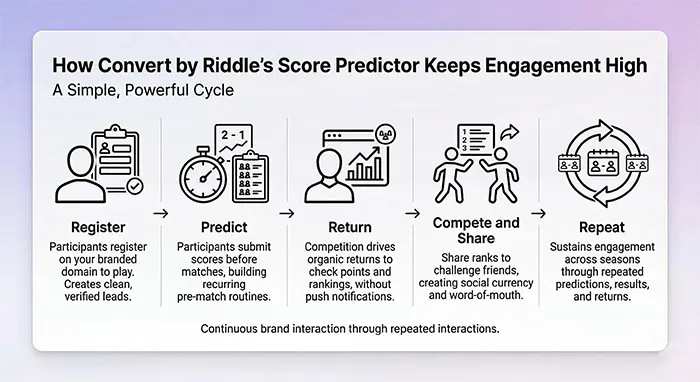
1. Register
A participant arrives at your branded predictor – on your domain, in your colours. To play, they register. Name, email, marketing opt-in, and any other fields you want to collect. The value exchange is clear: they get a free game tied to a tournament they already care about. You get a verified, opted-in lead.
2. Predict
Before each match, participants submit their score predictions. Predictions close at kick-off. This creates a recurring, time-sensitive action that builds into the pre-match routine.
3. Return
After the match, participants return to check their points and leaderboard position. This return is organic – driven by curiosity and competitiveness, not push notifications.
4. Compete and share
Leaderboards create social pressure and social currency. Participants share their ranking. They challenge colleagues and friends. New users arrive through word of mouth. “I’m ahead of you” is the phrase that gets people sharing the leaderboard. Players can also create their own private tournament group by creating their own team with a team leaderboard.
5. Repeat – across the full tournament
A major international tournament typically features 50-64 matches over 28-35 days. Each match is another prediction, another result, another leaderboard shift. The structure itself drives returns – there’s always a next match, always a chance to climb. The same mechanic works equally well for domestic seasons, cup competitions, and regional tournaments.
Who benefits – and how
Brands & sponsors
Sponsorship that runs for weeks, not hours
A banner ad is seen once. A predictor is used daily for four weeks (or more) – with the brand woven into the experience rather than bolted on top. Sponsors get title association (“the [Brand] Predictor”), logo presence across every session and leaderboard view, CTA placement at key moments, and first-party data from every registered participant.
What brands get
- Logo and brand presence across every session, match, and leaderboard view
- Named sponsorship: “The [Brand] Predictor” – title association for the full tournament
- CTA placement at registration, prediction submission, and results reveal
- Sponsored pre-match reminders and results notifications
- First-party, opted-in lead data from every participant – direct to CRM
- Participants who return 20+ times over 28 days build a different relationship than those who see one pre-roll ad
Publishers
Turning match-day spikes into sustained readership
Publishers have the content. The predictor gives readers a reason to return between match days – to check standings, review past predictions, and prepare the next one. It anchors the audience to your property across the full tournament window.
Commercially, the predictor is also a standalone sponsorship product. Sell the naming rights, logo integration, and data partnership as a premium package – 28 days of exclusive brand association, not a single ad slot. At scale, major publishers regularly reach 100,000-500,000 registered participants per tournament.
Publisher benefits
- Sustained traffic across the full tournament window, not just match days
- Multiple pageviews per session as users move between predictor and editorial
- Premium sponsorship inventory: the predictor itself as a named commercial asset
- First-party registration data – critical for audience targeting post third-party cookies
- Newsletter opt-in integration: route registered participants into sports newsletters
- Leaderboard moments drive organic social sharing
Sports clubs
Keeping fans active between fixtures
Match-day engagement is a solved problem for most clubs. The tricky gap is between matches. A club-branded predictor gives fans a structured activity that keeps them on club-owned platforms and building the habit of daily interaction.
For commercial partners, it also provides a concrete digital activation – prize sponsorship, branded notifications, CTA integration – that goes beyond badge placement and delivers measurable engagement data.
HR & internal comms
A morale tool that doesn’t need a budget
Major tournaments cut across departments, seniority levels, and office locations. Almost everyone has an opinion on the football. An internal predictor gives HR and internal comms a ready-made engagement vehicle: low effort to deploy, inherently cross-functional, and capable of creating connections that normal team structures don’t.
“When the head of sales and the new joiner are competing on the same leaderboard, the organisation feels smaller – in a good way.”
Department vs department, London vs Manchester, individual vs individual – the format scales to whatever structure you want. No IT integration required.
First-party data: the other return on a predictor
Every predictor deployment is also a data acquisition programme. This isn’t incidental – it’s one of the strongest arguments for running one.
Third-party cookies are nearly gone. The only sustainable model is first-party data: audience information collected directly, with explicit consent. Predictor-sourced data is strong on three counts:
Why the data quality is high
- Verified – users provide real details to participate. Fake emails mean no access.
- Consented – opt-in is explicit and contextual, meeting the highest GDPR standards
- Engaged – data comes from an active, returning audience, not a passive sweep
Beyond email and opt-in, a well-configured predictor can collect name, location, favourite team, newsletter preferences, and custom questions tied to purchase intent or product preference. All of it flows into your CRM via webhook, Zapier, or direct export.
“Predictor-sourced leads convert at 2-3x the rate of paid social leads at comparable cost.”
What Convert by Riddle provides
Convert by Riddle is built on the same infrastructure Riddle’s publisher clients use – fully white-label, ISO 27001 certified, and GDPR-compliant by design. A standard deployment from contract to live takes under two weeks.
Platform capabilities
- Fully white-labelled: your brand, your domain, your design – no Convert branding visible
- ISO 27001 certified and 100% GDPR-compliant
- Sponsor-ready: prize integration, branded zones, CTA management in-platform
- No coding: zero developer resources required to configure and launch
- Scales to 100,000+ simultaneous users during tournament peaks
- Internal mode: department and location-based leaderboard configuration
- Full CRM integration via webhooks, Zapier, and API
<2 wks
standard setup time
50-64
matches per major tournament
100%
first-party, opted-in leads
A banner ad is seen once. A score predictor runs for four weeks.
Most tournament campaigns are built for a moment, not a period. Convert by Riddle gives your audience a reason to return for every match – with first-party opt-in data collected at every step.
Fill in your details and we’ll show you how it works.
Frequently Asked Questions: Convert By Riddle’s score predictor
What is a score predictor and how does it work?
A score predictor is an interactive game where participants predict match outcomes before kick-off. Points are awarded for accuracy, and a live leaderboard ranks everyone across the tournament. The loop – predict, check results, predict again – drives daily return visits over 28-35 days rather than one-off traffic spikes.
How does a score predictor help brands build fan engagement?
A branded score predictor is used daily for four weeks, with the sponsor woven into the experience through title naming, logo placement, and CTA integration. Participants who return 20+ times over the course of a tournament engage with the brand in a way that a single ad impression simply can’t match.
What first-party data can a score predictor collect?
Registration captures name, email, and marketing opt-in. You can also collect favourite team, location, and custom fields tied to purchase intent. Participants provide real details to play, so the data is verified, consented, and considerably more useful than signals inferred from passive browsing.
Can a score predictor be fully white-labelled to match our brand?
Yes. Convert by Riddle is fully white-label – your brand, domain, colours, fonts, and layout. No Riddle or Convert branding is visible, and custom CSS helps it blend seamlessly into your site. The predictor sits on your own domain or embeds directly into your site.
How long does it take to set up a score predictor for a tournament?
Under two weeks from contract to live. No developer resource required. The Riddle team will also build a branded demo version within 48 hours of a demo booking.
Is Convert by Riddle’s score predictor GDPR compliant?
Yes. Convert by Riddle is ISO 27001 certified and 100% GDPR compliant. All data is stored on EU servers in Germany and Luxembourg. Registration forms support configurable consent checkboxes and double opt-in.